

Answer at a glance: A burr grinder for espresso machine use must do more than make coffee look finely ground. It needs a usable espresso-fine range, small repeatable adjustments, and a dosing workflow that works with your portafilter. Burr shape matters, but fit, retention, static control, cleaning access, and your daily routine decide whether a grinder will actually suit your setup.
A burr grinder for espresso machine use is where a lot of avoidable frustration begins. A grinder that can grind fine is not necessarily a coffee grinder for espresso: you need to be able to make a small change, return to it, dose neatly, and repeat that routine when the beans or recipe change. This guide helps you check those details without pretending there is one universal “best” model.
Use this short checklist before you compare grinders:
- Confirm that the grinder has a genuinely usable espresso-fine adjustment range.
- Check that settings can be changed in small, repeatable increments near espresso.
- Match the holder, chute, and clearance to your 51 mm or 58 mm portafilter.
- Treat retention, static, and cleaning access as everyday workflow issues—not minor extras.
- Choose capability for your actual setup instead of buying on burr type, setting count, or a “best” list alone.
What Makes an Espresso Grinder Different From Other Coffee Grinders?
A burr grinder for espresso machine use has a narrower job than a general-purpose grinder. A coffee grinder for espresso must let you respond to small changes in grind size, dose, and basket resistance with repeatable adjustment. If grounds are too coarse, a shot may run fast; if they are too fine, it may run slowly.
That is why a blade grinder and a burr coffee grinder should not be treated as equivalent starting points. A blade chops in a less controlled way, while burrs are designed to produce grounds more consistently. Still, the word burr on its own is not a guarantee. A burr grinder for espresso needs a useful fine range and an adjustment system that allows small, repeatable moves in that range. A high number of settings elsewhere on the dial does not necessarily tell you how much control exists where espresso is brewed.
From a grinder-design perspective, the difference between “it can reach a fine setting” and “it can be used every morning” is important. The useful sequence is simple: dose into your own basket, make a small adjustment after tasting or timing a shot, and clean the same path without turning the routine into a chore. Before buying, ask three questions: Can it reach espresso-fine settings? Can I make and repeat small changes? Can I dose into my basket without an awkward or messy workaround?
Choose the Burr Style: Conical vs. Flat for Espresso
A Conical Burr Grinder Is Often the Straightforward Home-Espresso Choice
A conical burr grinder is often a sensible home direction when the priority is a manageable daily routine. Still verify fine adjustment, chute access, retention, and portafilter support.
A Flat Burr Setup Can Make Sense for More Demanding or 58 mm Workflows
A flat burr setup can make sense for a more demanding or 58 mm-oriented routine. Hardshell’s documented 64 mm flat-burr configuration is positioned toward professional or light-commercial use and supports 51 mm and 58 mm portafilters. That is a design clue, not proof that flat burrs are right for every kitchen.
A 58 mm-oriented setup may place more emphasis on fine adjustment, consistent dosing, and a repeatable tamping routine, especially where a single-wall basket is used. It can also require more counter space and a more involved approach than a basic home setup. Hardshell’s published range includes Hardshell’s conical- and 64 mm flat-burr grinder configurations, which is useful as an example of why a specification sheet should state burr type, adjustment, cleaning access, and 51 mm/58 mm holder compatibility.
| Start with this question | A conical burr may suit you if… | A flat burr may be worth considering if… |
|---|---|---|
| What is your setup? | You want a practical home-espresso workflow. | You are building a more demanding or 58 mm-oriented setup. |
| What matters most? | Straightforward daily dialing-in and use. | Your workflow justifies more detailed adjustment and dosing comparisons. |
| What should you verify? | Fine adjustment, retention, cleaning, and portafilter fit. | The same basics, plus clearance, holder geometry, and whether you can use the added capability. |
Match the Grinder to Your Espresso Setup Before Comparing Features
Check 51 mm vs. 58 mm Portafilter Compatibility First
Portafilter compatibility is more than a diameter on a product page. Confirm that the holder supports your portafilter, the basket sits securely under the chute, and the grounds land cleanly. Ask whether the holder is included, optional, or unavailable for the version you are considering.
A 58 mm basket is common in more professional-oriented espresso workflows, but it is not automatically a better choice than 51 mm. Its shallower, wider basket geometry can make consistency in grind, dose, and tamping especially relevant. A 51 mm user deserves the same practical checks: a suitable holder, sensible chute clearance, and enough room to use the basket without spilling grounds. To see the machine-side context, review 58 mm professional espresso-machine configurations, then assess the complete workflow rather than the diameter alone.
Manufacturer Design Note: Hardshell’s CG2101–CG2109 conical-burr platform lists an optional 51 mm/58 mm powder or funnel bracket. Its CG2107 flat-burr model lists a holder compatible with both sizes. These are manufacturer configuration examples, not an industry standard or a retail recommendation. They show what a specification sheet should make clear: the actual basket size, whether the bracket is included, the chute clearance, and the path the grounds take into the portafilter.
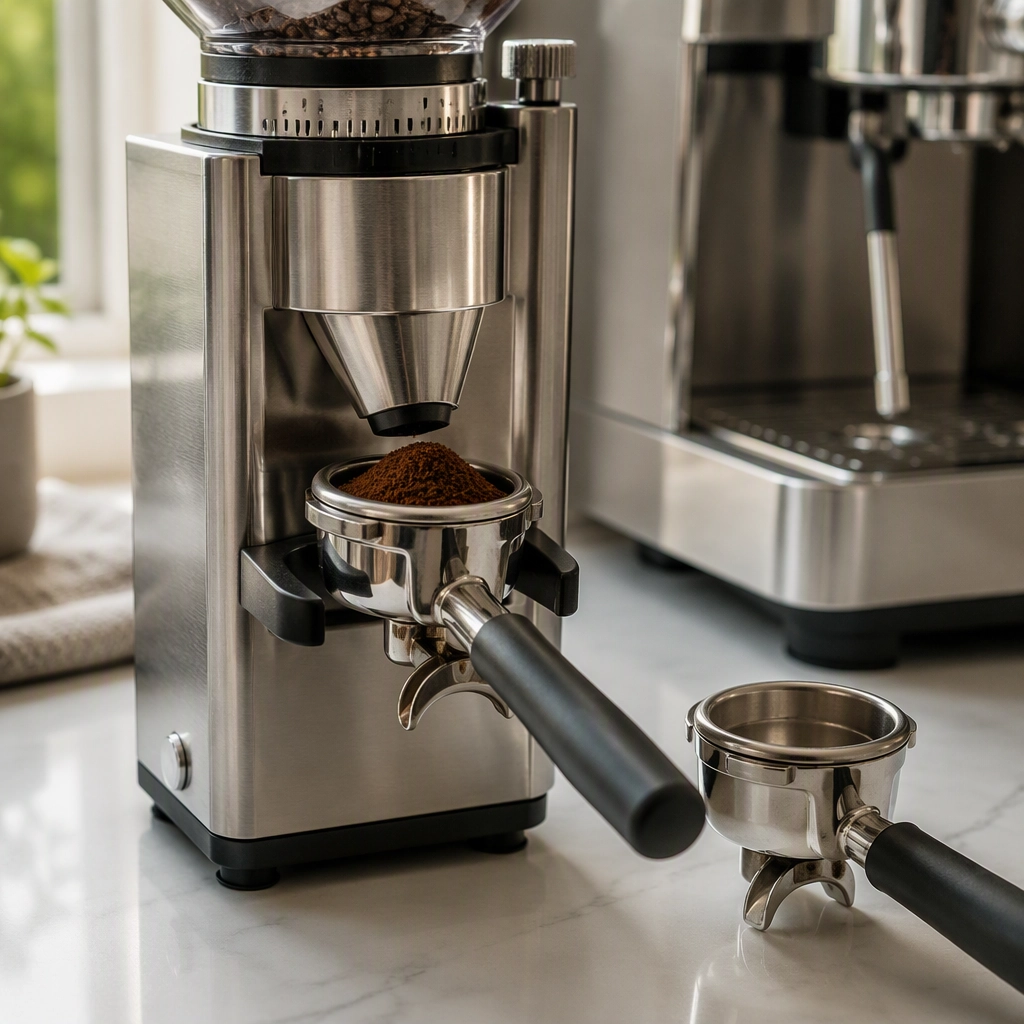
When a Compact Electric Espresso Grinder Makes Sense
A compact espresso grinder can suit a small kitchen, but check hopper height, service-part clearance, and whether the dosing routine works where it will live. An electric espresso grinder is useful when you make several drinks a day or value repeatable dosing without hand grinding; it is a workflow choice, not a quality badge.
Set a Budget by Capability, Not by “Best” Lists
Choose by capability rather than by a price-led ranking. A first dedicated grinder needs a usable fine range and repeatable adjustment; a home upgrade may justify a neater dosing path and easier cleaning; a 58 mm-oriented setup may demand closer attention to fine adjustment and basket preparation. A larger motor figure, a high setting count, or flat burrs alone do not guarantee better shots.
Before comparing prices, write down your basket size, available counter space, and how many drinks you expect to make on a typical day. Those constraints narrow the field faster than a headline specification.
| Capability level | What to prioritize | What not to assume |
|---|---|---|
| First dedicated espresso grinder | Espresso-fine range, repeatable adjustment, and manageable cleaning. | A high number of settings alone proves fine control. |
| Home upgrade | A better dosing workflow, lower day-to-day mess, and portafilter support that fits. | A larger motor number alone guarantees better espresso. |
| Advanced / 58 mm setup | Fine adjustment, consistent dosing, and a workflow suitable for the basket and recipe. | Flat burrs or premium materials automatically solve dialing-in. |
Retail pricing and availability vary by market, so compare available models by basket size, adjustment, cleaning, and counter space. “Best coffee grinder for espresso” and “best home coffee grinders” are broad searches; espresso needs its own questions about fine control, dosing, and portafilter fit.
Specs That Matter When You Dial In Espresso
A burr coffee grinder for espresso should be evaluated by what its specifications let you verify, not by whichever number looks largest. Espresso requires fine changes when you are dialing in, and the grinder must support a repeatable way to make them. Use a specification sheet and the current manual to ask practical questions about adjustment, burr access, retention, static, cleaning, and portafilter support. The answer to each should make sense for your own routine.
| Spec or design feature | Why it matters for espresso | What to check before buying |
|---|---|---|
| Adjustment system | You may need small changes while dialing in a shot. | Can you make fine, repeatable adjustments near espresso settings? |
| Burr design and alignment | Burr construction affects how grounds are produced and how the grinder can be maintained. | Is the burr type stated clearly, and is it serviceable as directed by the maker? |
| Retention and dosing path | Leftover grounds can make one dose less comparable with the next. | Is the chute accessible, and is there a practical route into your basket? |
| Anti-static design | Static can make grounds cling to surfaces or scatter during dosing. | Is a specific anti-static approach described, and can you check normal-use feedback and cleaning access? |
| Cleaning access | Coffee oils and retained grounds require regular attention. | Can the hopper and upper burr be removed following the manufacturer’s instructions? |
| Portafilter support | It affects workflow and mess, not only convenience. | Does the holder genuinely fit your 51 mm or 58 mm portafilter? |
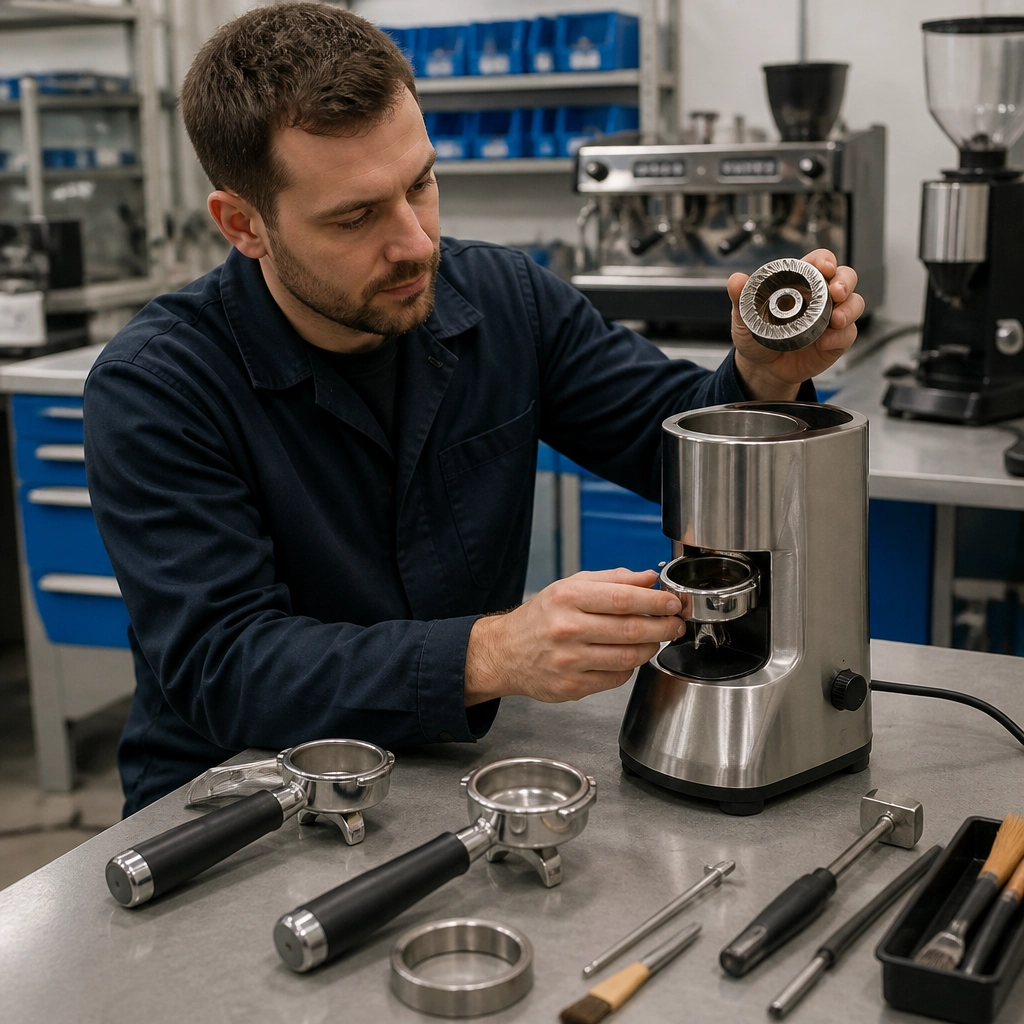
Anti-static is useful—but understand what it solves. Grinding can leave coffee particles electrically charged, which can make them cling to the outlet, dosing cup, or surrounding surfaces. Negative-ion or plasma anti-static approaches are intended to reduce that cling and scatter; they do not remove the need for routine cleaning or guarantee zero retention. Hardshell lists upgraded anti-static technology on CG2101–CG2109 and plasma anti-static technology plus a chamber designed to reduce residual grounds on CG2107. If a manufacturer cites such a feature, ask how anti-static grinding technology is applied and what access the design gives you for cleaning rather than assuming every system performs identically.
Avoid the Most Common Espresso-Grinder Mistakes
Buying on burr type alone. A conical or flat label is only the opening filter. Check the espresso adjustment range, retention, cleaning access, and actual portafilter fit before deciding that either style suits you.
Treating setting count as precision. “More settings” can describe a broader adjustment range rather than finer usable control near espresso. Ask how the grinder adjusts in the espresso zone and whether the setting can be returned to reliably after cleaning or changing beans.
Ignoring static, retention, and cleanup. Grounds that cling to the chute or scatter across the counter can become a daily irritation. Look for accessible removable parts and read the cleaning steps. An anti-static feature may reduce a problem, but it does not eliminate basic maintenance.
Assuming one setting works for every bean. Bean freshness, roast level, dose, basket, and recipe can all change the resistance you see in a shot. If a coffee grinder for espresso needs a small adjustment after you switch beans or open a fresher bag, that is part of dialing in—not automatic evidence that the grinder has failed.
For buyers who want confidence beyond a product page, also review the maker’s manual, warranty terms, availability of service parts, and independent reviews that disclose their test method and update date. Those checks provide a more realistic picture than a single headline claim.
FAQ: Burr Grinders for Espresso
Can a burr coffee grinder make espresso?
Yes, but only if it can reach an espresso-fine range and make small, repeatable adjustments in that range. A burr coffee grinder for espresso should also let you dose practically into your basket and keep the grounds path clean. “Burr” describes the grinding mechanism; it does not by itself confirm espresso suitability.
Are burr grinders good for espresso, and is a separate grinder worth it?
For people who want to use fresh beans and control their espresso recipe, burr grinders are usually a sensible starting point because they allow more controlled adjustment than a blade-style approach. A separate grinder is worth it when you will use that control. If you mostly use pre-ground coffee or rarely make espresso, the extra equipment may not be necessary.
What is the best espresso grinder for a home setup?
There is no single best espresso grinder for every home. Start with your portafilter size, the adjustment range you need, your counter space, how often you make drinks, and how willing you are to clean and dial in. For a ranked product recommendation, look for an independent review that explains its test method, sample, update date, local pricing, and retailer availability.
Should I choose an electric espresso grinder?
An electric espresso grinder can be a practical choice if you make multiple drinks a day, share the setup, or want a consistent repetitive workflow. It should still be judged by its fine adjustment, dosing path, static and retention management, footprint, and cleaning access. Electric operation does not automatically mean better espresso.
Can a compact espresso grinder still work with a 58 mm portafilter?
Yes, provided the actual holder, chute clearance, and dosing path support a 58 mm portafilter. Compact size alone does not establish compatibility. Confirm whether a 58 mm bracket is included or optional, measure the hopper height in your kitchen, and make sure you can remove parts for cleaning without moving the grinder every time.
For home buyers: Use the checks above to compare the exact grinders available in your market, including their current manuals, warranty terms, portafilter support, and independent reviews.
For coffee brands, importers, and sellers: If you are developing an espresso-grinder product line, Hardshell can help you discuss a grinder configuration for your product line, including conical- or flat-burr direction, 51 mm/58 mm workflow compatibility, anti-static design, and OEM/ODM options. For an initial project conversation, contact Anson at anson@hardshellcoffeemachine.com or WhatsApp +86 159 1457 0351.
About this perspective: Hardshell Technology is an OEM/ODM designer and manufacturer of espresso machines and coffee grinders. The selection notes in this guide draw on documented conical- and flat-burr product configurations and manufacturing experience. This is not an independently funded retail product ranking, and it is not a substitute for checking the manual, warranty, and current retailer information for a specific grinder.