

In short: A reliable coffee grinder supplier is one you can verify, not just one that quotes you a good price. Before you commit to an OEM/ODM partner, check five things you can actually confirm on paper or on a call: certifications that match your target market, a documented quality system with real checkpoints, MOQ flexibility for a first order, a transparent sampling timeline, and a product line deep enough to support you past your first purchase order.
If you're sourcing a coffee grinder supplier to manufacture your own branded product — not just shopping for one grinder to use yourself — this framework is for you. A lot of buyers land on this page after a rough experience: "The last factory we worked with drove me crazy, because the product quality just wasn't stable — units leaking, units arriving damaged." That's not a rare story in this industry. If you're searching for "coffee grinder suppliers," you probably already know you need a factory. What's actually stopping you isn't finding one — it's figuring out which one you can trust with your money and your timeline.
Quick checklist — what to verify before you commit to a supplier:
- Certifications that actually cover your target market (not just a generic CE stamp)
- A documented, multi-stage quality system — not just "we do QC"
- MOQ flexibility for a first, smaller order
- A sampling process with a real timeline and a clear fee policy
- A product line broad enough to grow with your roadmap
- Technical depth — can they explain why their grinder works, not just that it does
Why Evaluating Coffee Grinder Suppliers Feels Like a Gamble
Here's the uncomfortable truth about sourcing a grinder supplier: a factory can pass every spec on paper and still fail you in the field. We've seen it from the inside — a batch that checked out fine on the bench, with grind consistency and motor speed both within tolerance, that then showed up with complaints a few months into shipment. On paper, nothing was wrong. In the field, it was a real problem. That gap between "passed inspection" and "works well for the buyer" is exactly what makes this decision feel like a gamble.

Buyers usually land here after running into one or more of a handful of recurring headaches. The bulk order doesn't match the sample that got approved — a supplier tunes a machine perfectly for the demo unit, then quietly swaps a cheaper component once the order is confirmed. A factory goes quiet the moment the order size drops below their preferred volume, leaving a smaller brand with unanswered emails right when they need answers most. Or, worse, a design gets copied and shows up on a competitor's listing months later, after months of back-and-forth on specs and packaging that should have stayed confidential. None of this is paranoia; it's a documented pattern in this industry, which is exactly why the checklist below exists — not as a formality, but as the difference between a partner and a liability.
The best answer to all of it isn't a promise — it's seeing the factory behind these numbers, whether that's an on-site visit or a video call walkthrough. If you want a broader rundown of the specific warning signs to watch for across an entire sourcing relationship, our 5 red flags to watch for when vetting an espresso machine manufacturer covers ground that complements this framework.
6 Things to Check Before You Trust a Coffee Grinder Supplier
Certifications — Does the Supplier's Paperwork Match Your Target Market?
Certifications aren't a single checkbox — they're market-specific, and a supplier who can't map their paperwork to your destination market is a red flag. At minimum, ask for two layers: management-system certifications (ISO and BSCI, which cover how the factory is run and audited) and product-level certifications (CE, CB, ERP, LFGB, RoHS, and REACH, which cover the actual device).
Then go one level deeper and match paperwork to geography, because "we're certified" means different things depending on where you're shipping:
| Target market | What to ask for |
|---|---|
| North America | UL or ETL — note that UL testing is generally stricter and includes deeper component-level checks (e.g., plastic housing heat-resistance, wire gauge) plus more frequent factory audits |
| European Union | CE, with supporting RoHS/REACH documentation |
| United Kingdom | UKCA |
| Middle East | SABER, G-Mark |
| Russia | EAC |
A supplier who can name the right certification for your specific market — without you having to ask twice — is telling you something about how many export markets they've actually shipped to. You can see which certifications actually apply to your target market before you go further down the shortlist.
Quality System — Ask How Many Checkpoints Stand Between the Factory and Your Container
"We have quality control" is not an answer. Ask for the actual structure. A serious factory should be able to walk you through a multi-stage system with named checkpoints — in our case, five: SQE (supplier quality engineering, managing incoming material quality at the source), IQC (incoming quality control on all raw materials), PQC (in-process quality control during production), QA (systematic quality assurance), and FQC (final quality control before anything ships). Each stage has a pass/return mechanism — a batch that fails at any point gets sent back before it can move forward, which keeps defects from compounding down the line.
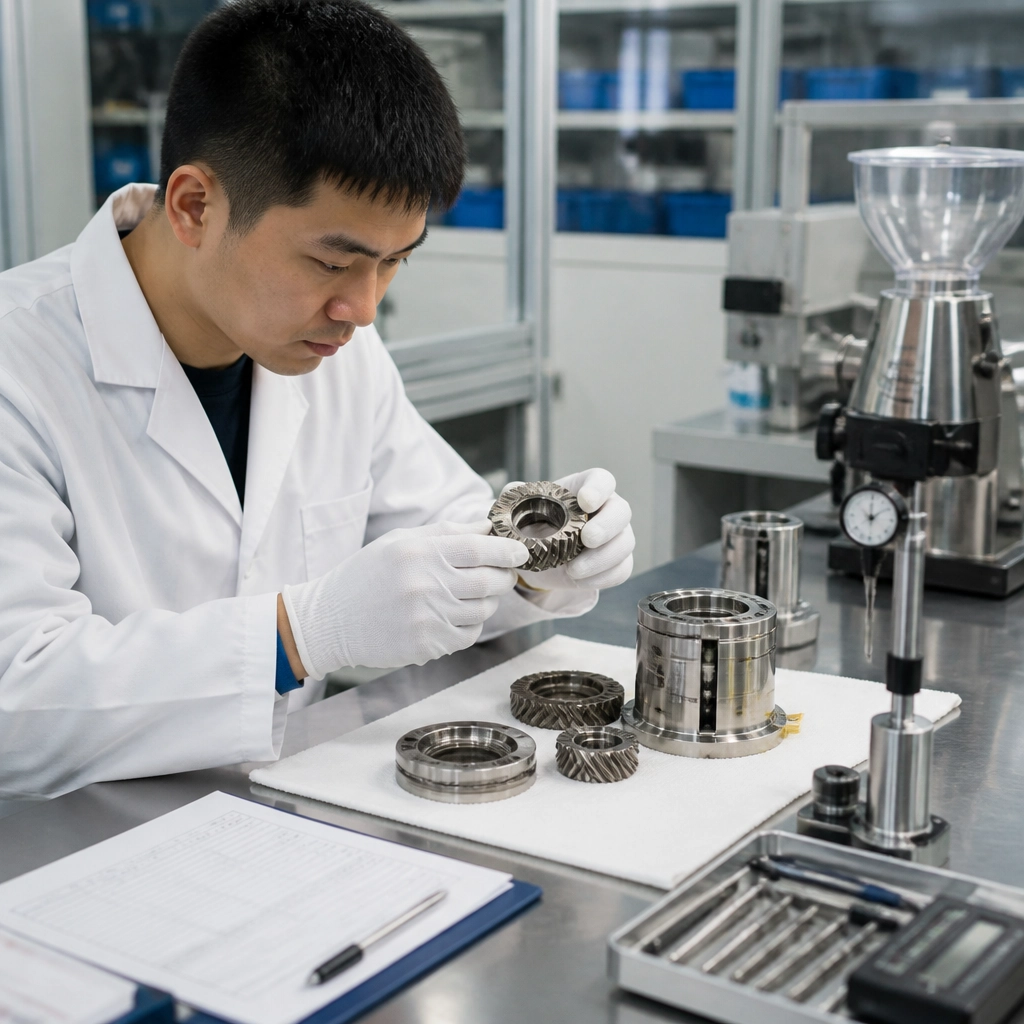
The number that matters more than the process diagram is the outcome: a 99% shipment pass rate, against an industry average commonly cited around 85-90%. But ask what happens when something slips through anyway. We added static and residue testing to our standard FQC checklist specifically after a batch shipped clean on the bench but showed static buildup and grounds scatter in the field — not because a spec was wrong, but because that particular failure mode only shows up under certain bean-oil and humidity conditions that a controlled bench test doesn't reproduce. Any batch that now shows abnormal static behavior under our accelerated test gets held before it ever reaches a container. That's the kind of detail that separates a documented process from a real one — see how our 5-checkpoint quality system works, checkpoint by checkpoint.
MOQ Flexibility — Will They Still Answer You After Your First Small Order?
Most suppliers quote MOQ like it's fixed, but the real question is what happens when you're a new account still building trust. Our standard MOQ is 1,000 units, or one 20-foot container. Larger, higher-value machines can go as low as 200 units, and our 3-in-1 espresso-and-grinder line can be ordered from 500 units — and for a new customer we consider a genuine fit, we flex further.
That's not a marketing line. A mid-sized e-commerce brand we worked with placed a first PO at 500 units — comfortably inside the flexible range we offer newer accounts, well below the standard 1,000-unit threshold for repeat business. If a supplier's MOQ policy sounds rigid on their website but they won't give you a straight number for your specific order size on a call, that's worth noting. You can review our MOQ and sampling policy in practice before you ask.
Sampling Process — What a Transparent Supplier's Timeline Looks Like
Ask for a day-by-day sampling timeline, not a vague "a few weeks." On a mature product, ours runs about one week to produce a sample, plus roughly another week in transit for the customer to evaluate it. Sample fees are collected on a first order, waived once you're an established partner, and refundable once your order reaches mass production. That last point matters: a supplier who charges a sample fee with no path to getting it back is treating you as a one-time transaction, not a relationship.
This timeline held on a real project: a customer needing a grinder to pair with their existing espresso-machine line had a tight listing-launch window, and a mature-product sample was ready within the standard one-week production cycle. If a supplier can't commit to a specific number of days when you ask directly, assume the real number is longer than what they'll admit.
A transparent supplier's sampling-to-order path usually looks like this:
flowchart LR
    A[Confirm requirements] --> B[Sample produced: ~1 week]
    B --> C[Sample in transit: ~1 week]
    C --> D[Buyer evaluates sample]
    D --> E[PO confirmed]
    E --> F[Mass production]
    F --> G[FQC before shipment]
If a supplier can't map their own process onto something this specific, that's usually a sign the timeline is more improvised than they're letting on.
Product Line Coverage — Can They Actually Support Your Roadmap, Not Just Your First Order
A supplier's current catalog tells you whether they can grow with you. Our grinder line covers six conical burr models (CG 2101, 2101A, 2102, 2103, 2108, 2109), one 64mm professional flat burr grinder (CG 2107), and one portable, battery-powered model (CG 2100) — eight models total, not a single SKU stretched across a marketing page.
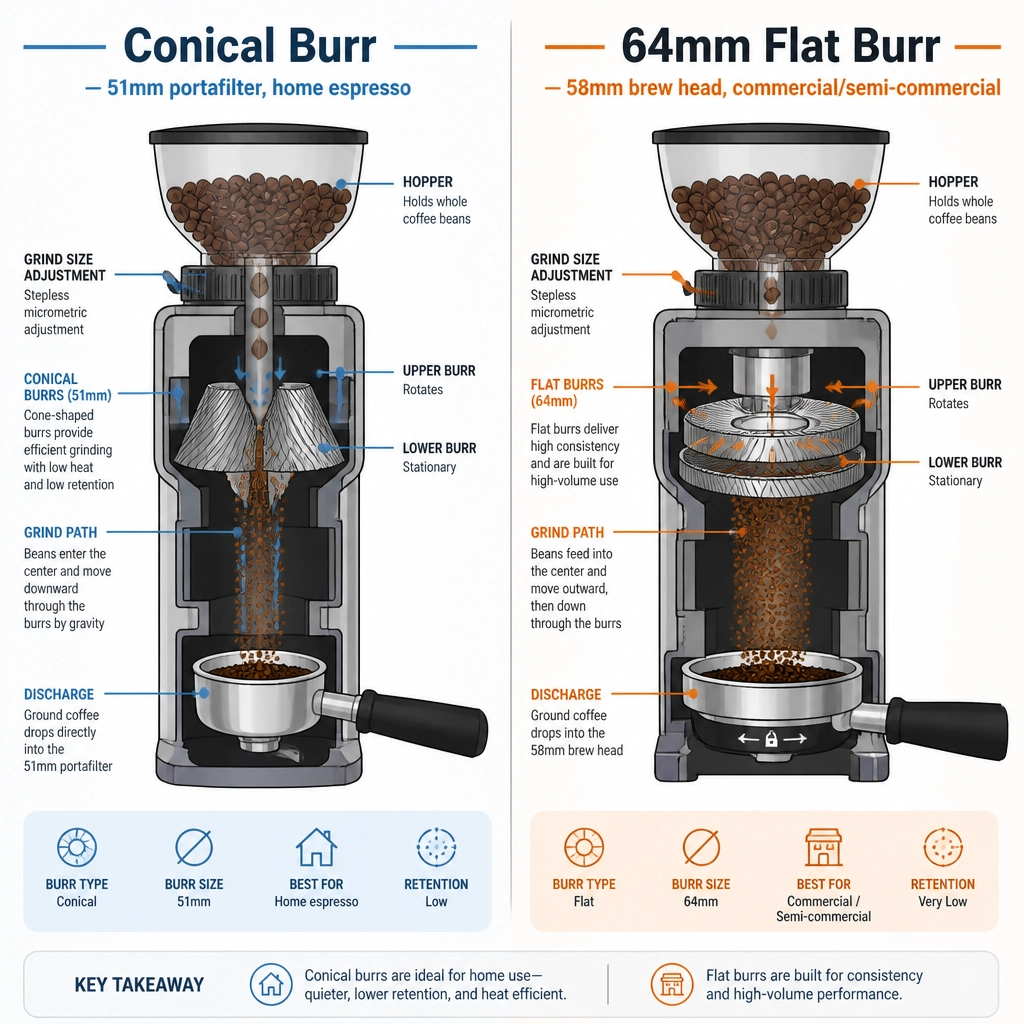
The two burr types aren't interchangeable, and a supplier who can't explain the difference probably hasn't thought hard about your use case. Conical burr grinders are the more common pairing for home-style espresso setups, typically working with 51mm portafilters, and they produce a uniform grind suited to lower-pressure extraction. A 64mm flat burr grinder is built more for commercial or semi-commercial use, usually paired with a 58mm brew head — that combination benefits from a shorter extraction channel and tends to produce a noticeably better crema. On a real project, we walked a customer through exactly this trade-off rather than pushing one grinder as "best" for both cases: we recommended the conical burr line for their entry SKU and flagged the 64mm flat burr unit as the natural upsell pairing for their higher-end model, instead of forcing a single-SKU compromise. You can browse the full conical and 64mm flat-burr grinder lineup to see the range for yourself. For a consumer-facing explanation of how burr type, fine adjustment, portafilter fit, retention, and counter space affect an actual setup—not a supplier shortlist—see how to choose a burr grinder for an espresso machine.
Technical Depth — Does the Supplier Understand Why Their Grinder Won't Clog or Spark Static
Anyone can claim "anti-static" or "won't clog." Ask them to explain the mechanism. Static buildup during grinding happens because grounds pick up a positive charge at high speed — it's a physics problem, not a cosmetic one. Our approach uses a plasma-based system where negative ions neutralize that positive charge as it forms, which is the actual cause, not just a symptom you could mask with a better-shaped collection box. That same principle sits behind burr stability over time and the clog-resistance testing we run before a design goes into production. A supplier who can explain why their solution works — not just recite that it does — is one who's actually engineered the problem, not copied someone else's housing design.
A Quick Coffee Grinder Suppliers Checklist You Can Reuse
| Check | What a passing answer sounds like |
|---|---|
| Certifications | Names the specific certification for your market without hesitation |
| Quality system | Can name each checkpoint and what happens when one fails |
| MOQ | Gives you a real number for your order size, not just a stock minimum |
| Sampling | Commits to a specific number of days and a clear fee policy |
| Product line | Shows multiple models and can explain trade-offs between them |
| Technical depth | Explains the mechanism behind a claim, not just the claim itself |
FAQ
What's a reasonable MOQ for a first order with a coffee grinder OEM supplier?
It depends on the model, but a standard MOQ around 1,000 units (roughly a 20-foot container) is common industry-wide. Flexible suppliers can go lower for a first order from a promising new account — we've taken first orders as low as 500 units on some product lines.
How do I verify a supplier's certifications are valid for my target market?
Ask them to name the specific certification for your destination country, not just list every certification they hold. North America typically needs UL or ETL, the EU needs CE, the UK needs UKCA, and Middle East markets often require SABER or G-Mark. A supplier who can map this instantly, without checking, usually has real export experience in that market.
What happens if the bulk order doesn't match the sample I approved?
This is exactly what a documented multi-checkpoint quality system is meant to prevent — ask specifically what checkpoint catches a mismatch between sample-stage and mass-production batches, and what the remedy is if one occurs. A supplier who waives or refunds sample fees once you reach mass production also has a financial incentive to keep sample and bulk quality aligned.
Can a small brand get design customization without a huge order?
Yes, with the right supplier. Customization on housing color, logo placement and method (silk-print, laser, or nameplate), functional tweaks, and packaging design can typically be supported without requiring your largest possible order size — it's a matter of the supplier being set up for OEM/ODM work rather than pure mass-market manufacturing.
Ready to Put This Framework to the Test?
Run this checklist against any supplier you're considering — including us. None of the six checks above require you to take a supplier's word for anything; each one is something you can verify with a direct question, a document request, or a short factory call. That's the point: a supplier worth committing to won't flinch at being evaluated this way, and one who dodges specifics on certifications, MOQ, or sampling timelines is telling you something too.
If you're specifically building a grinder line to sit alongside an existing espresso machine product, it's worth reading our full guide to briefing and shortlisting a coffee machine supplier as well, since a lot of the groundwork — briefing, budget range, and timeline expectations — carries over from one product line to the next.
Not sure which supplier fits your project? Send us a quick inquiry and see how we respond — no pressure. Reach us on WhatsApp at +86 15914570351 or by email , or head to our contact page to get started. In this business, a supplier that answers your first question clearly is usually the same one that answers your tenth.