

Quick answer: The five most common warning signs when vetting an espresso coffee machine manufacture are: you can't verify the factory actually exists, the sample looks nothing like the mass-production batch, quality is inconsistent from one batch to the next, materials get quietly downgraded to cut costs, and there's no protection for your product design. Each one is checkable before you wire a deposit — through a factory audit, sample retention, QC documentation, written material specs, and a signed NDA.
In this article:
- Why most of what shows up when you search for a manufacturer online is a European or American brand, not a Chinese factory
- The 5 red flags, what each one actually looks like in practice, and how to verify it
- A real case where a buyer's insistence on auditing the factory ended up strengthening the partnership
- A quick checklist you can run through before you commit
- Where to go next once a factory clears these checks
If you're sending your first deposit to an espresso coffee machine manufacturer you've never met in person, the two questions that matter most aren't about price. They're "does this factory actually exist the way they say it does" and "will batch two match batch one." Everything below is built around answering those two questions with evidence instead of guesswork.
Why Google Doesn't Show You the Factory You're Looking For
Search for an espresso coffee machine manufacturer today and the first page is dominated by European brands talking about being handmade in Germany or Italy since the early 1900s, or American workshops leaning on "built in the USA" as their trust signal. Actual Chinese OEM factories — the ones actually building a large share of the world's espresso machines — barely show up in that conversation.
That's not because they don't exist. It's because most of them never bothered publishing anything about how they operate. A factory that builds machines for other people's brands doesn't need a consumer-facing website the way a retail brand does, so it simply never shows up when someone searches. That silence leaves a gap, and vague trading companies are happy to fill it with a polished landing page and no real production line behind it.
This matters for how you vet a supplier: the absence of a manufacturer's own voice online isn't proof they're not real. But it does mean you can't rely on search results alone to tell real factories apart from trading companies posing as ones. You have to ask the right questions and check the right things yourself — which is what the rest of this guide walks through.
Red Flag #1: You Can't Verify the Factory Actually Exists
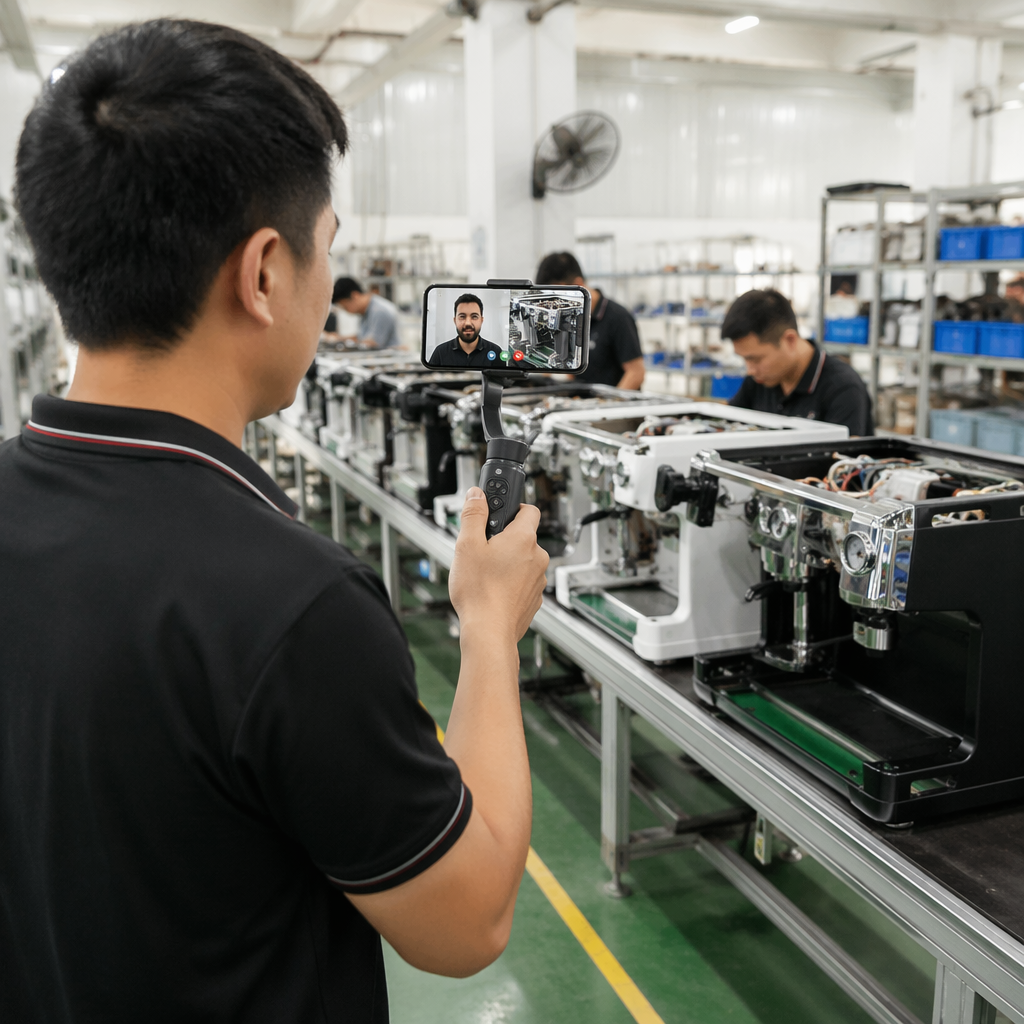
The most basic — and most overlooked — question is also the one every experienced buyer eventually asks: is this a real production facility, or just a trading company relaying your order to someone else?
The warning sign. You're dealing with a single Alibaba storefront and one sales contact on WhatsApp. There are no real production photos or videos, only stock imagery or renders. The quoted price is suspiciously uniform across "different" suppliers — a sign several listings might be reselling capacity from the same actual factory, or none at all. When you ask a technical question about the production process, the answer is vague or gets deflected to "our engineer will confirm."
How to verify it. Ask for a factory audit — either in person or by live video call. A legitimate manufacturer can walk you through the production lines, the incoming-material inspection area, and the test lab in about 30 to 60 minutes, and there's no reason a real factory should hesitate to show you around. If you're evaluating a factory right now, most trustworthy manufacturers — including ours — welcome you to book a factory tour, on-site or by video, and can usually arrange it on short notice, whether you're able to fly in or only have time for a screen share. Cross-check the company's registered business information against the address they give you, and pay attention to whether they can explain their own manufacturing process in specific terms rather than marketing language. A factory that has actually built the product for twenty-plus years will talk about boiler assembly, pump sourcing, and line changeover times without needing to check with someone else first.
Red Flag #2: The Sample Looks Nothing Like the Mass-Production Batch
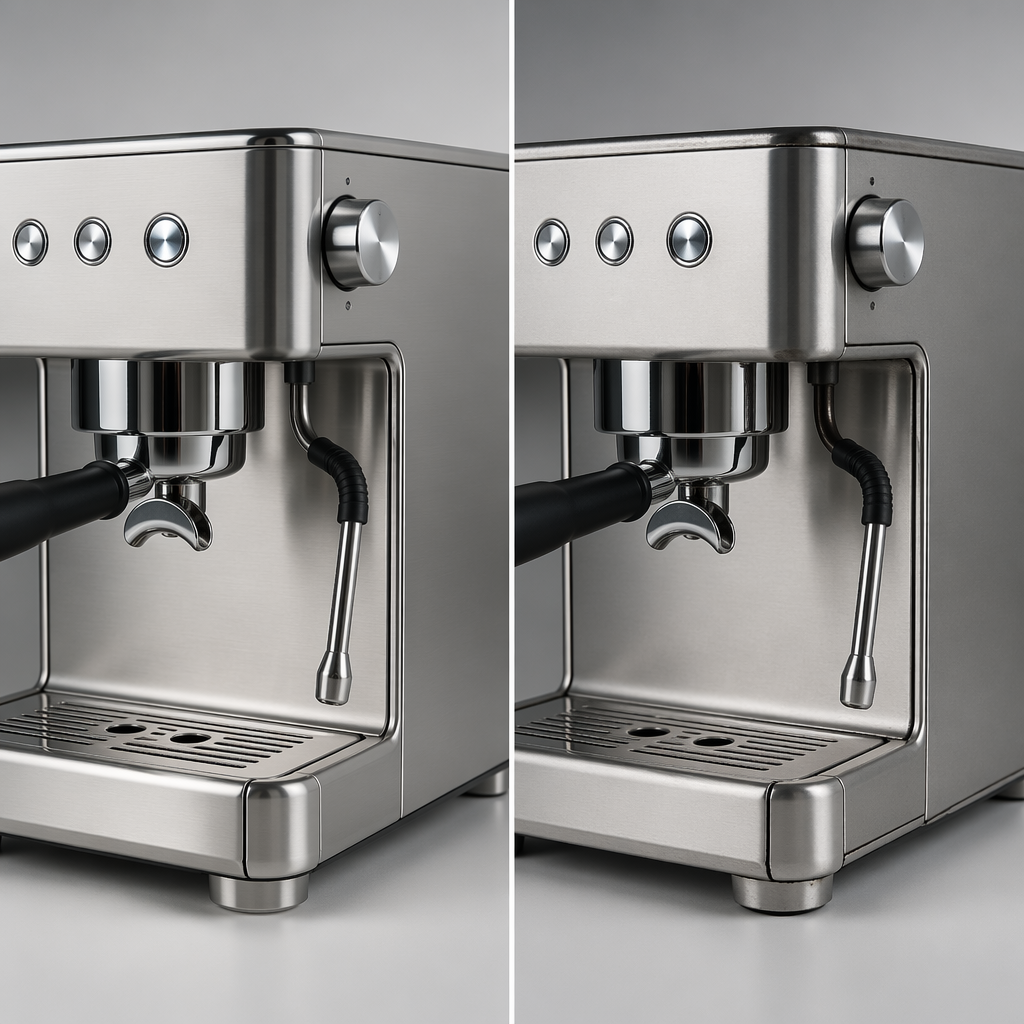
This is the complaint that comes up more than any other among buyers who've been burned before: the sample was excellent, and the container that showed up three months later wasn't the same product.
The warning sign. The approved sample has a tight panel fit, a properly finished steam wand, and a control panel that feels solid. The mass-production units arrive with a cheaper-feeling gasket, a slightly different finish, or a panel that technically "works the same" but clearly wasn't built with the same care. Nine times out of ten, this isn't intentional fraud — it's a factory with no independent inspection between the sample bench and the main assembly line. The sample gets hand-built by a senior technician; the production run gets built by whoever's on shift, from whatever stock happens to be available that week.
How to verify it. Ask for a sealed, signed retention sample before mass production starts, and request a First Article Inspection report once the first units come off the line — this is standard practice and any serious factory will already have a process for it. Ask specifically whether the factory runs incoming-material inspection (IQC) and in-process inspection (PQC) as separate steps from final inspection, rather than relying on a single check at the end. A factory that treats these as three distinct checkpoints is structurally less likely to let a mismatched batch through.
A few years ago, a premium European audio brand — new to coffee equipment entirely — came to us wanting to add an espresso machine to their lineup. They'd already visited more than 200 factories across two trade shows before narrowing the list down, and their own regional team initially pushed back on choosing us because we were a younger company on paper. What convinced them wasn't a sales pitch. Their QA lead requested a live factory audit, and a second visit roughly a year later to re-check our process once the relationship was underway. We said yes to both, walked them through our production lines and test lab, and treated their tighter tolerance requests as a genuine engineering brief. That first year, we adjusted our panel-fit tooling and tightened our final-inspection checklist specifically around the finish issues their team flagged. The partnership has run for several years since. What mattered wasn't that we passed the audit — it's that we didn't resist being checked in the first place.
Red Flag #3: Quality Is Inconsistent from Batch to Batch
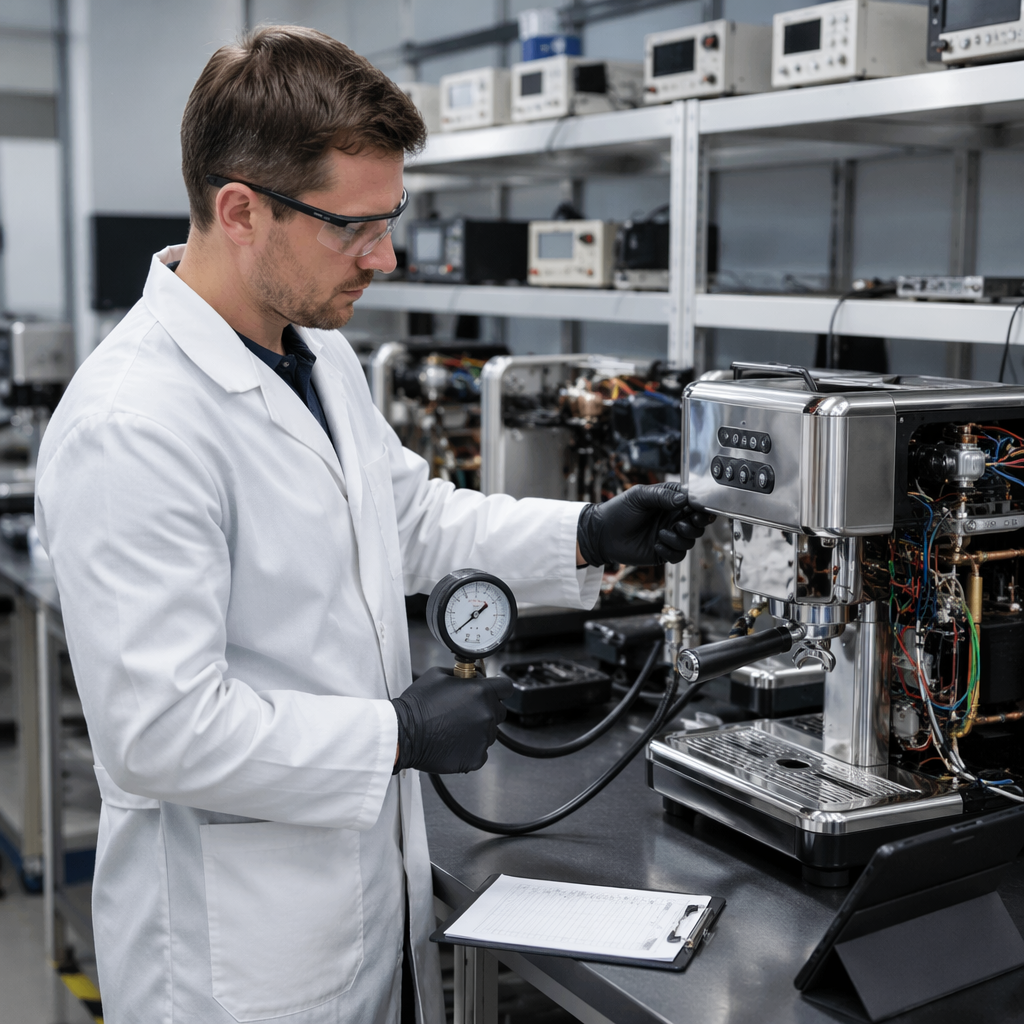
Ask anyone who has sourced coffee machines for more than a year and this is usually the first thing they mention: the first shipment was fine, and the second one had a leak rate or a steam-pressure issue that never showed up in testing.
The warning sign. Batch one passes every check. Batch two — sometimes using a different supplier lot for a gasket or a valve — starts generating complaints about leaks, inconsistent steam pressure, or unusual noise. There's no way to trace which production run, which line, or which material batch a defective unit came from, so the factory can only guess at the cause instead of pointing to a specific record.
How to verify it. Ask any manufacturer to walk you through how our 5-checkpoint QC system works — a factory that can't explain its own inspection flow in detail, checkpoint by checkpoint, is a red flag in itself. A real quality system runs material inspection, in-process inspection, and final inspection as separate, documented gates — ours is structured as five checkpoints (SQE, IQC, PQC, QA, and FQC), each with a clear pass/fail rule, and it consistently catches issues before they leave the building. We track outgoing pass rates against the industry average, and every unit carries a traceable serial code back to its production date, line, and material batch — so if something does go wrong, the cause can be found in minutes rather than guessed at for weeks. The same standard applies whether it's a countertop unit or a heavier-duty model like a commercial automatic espresso machine built for higher-volume use; the checkpoints don't change just because the product line does. I'd rather show a client a QC log than tell them a story about how careful we are.
Red Flag #4: Materials Are Quietly Downgraded to Cut Costs
The warning sign. A quote comes in noticeably cheaper than everyone else's for what looks like the same specification. The approved sample uses food-grade seals and a properly finished water tank; the production units quietly swap in a generic material that wasn't in the original spec. Sometimes this shows up immediately as a plastic smell in hot water; sometimes it only shows up months later when a seal degrades faster than it should.
How to verify it. Put the core material specs in writing before production starts — not just "stainless steel" but which grade, and not just "seal" but which material and rating. Ask for LFGB or equivalent food-contact test reports for any part that touches water or coffee. This is worth checking which certifications actually cover material safety before you assume a general safety certificate also covers food-contact materials — they're not always the same thing. Parts that see high heat and constant water contact need to hold up to that specifically. We use fluorocarbon seals rather than standard rubber and thicker PTFE tubing in the water path for exactly this reason, because the cheaper alternative fails faster under repeated heating and cooling. It's also worth understanding that a price difference between two quotes for the "same" machine often comes down to exactly this — the materials inside a boiler or a seal that you can't see just from a spec sheet, not simply one factory being greedier than another.
Red Flag #5: No Protection for Your Product Design or Intellectual Property
The warning sign. A factory is reluctant to sign anything before you share your design files, or brushes off the request as unnecessary. Months later, a very similar-looking machine shows up under a different brand. This happens often enough in this industry that it's worth taking seriously — design patent enforcement in this space is uneven, and a competitor can shift a detail here or there and argue they're not really copying anything.
How to verify it. Ask for a signed design-protection agreement before you send drawings or specifications — a factory that's serious about long-term partnerships will already have a standard NDA ready to go, because they've been asked before. It's also worth asking what proprietary technology the factory has actually developed itself, rather than assembled from off-the-shelf modules. We hold what we believe is the industry's first patent on a dual-boiler system that lets a home machine reach commercial-grade steam performance, along with a separate patent on an automatic milk-frothing system that maintains both foam texture and milk temperature at once — something most competitors have to trade off one for the other. A factory that's invested in developing its own technology generally has more incentive to protect original design work, including yours, than one that's purely assembling and reselling other people's engineering.
A Quick Vetting Checklist Before You Wire Any Deposit
Running through these five checks doesn't take long, and any manufacturer worth working with won't treat the questions as an inconvenience. Think of it less as an interrogation and more as the same due diligence you'd expect from a serious business partner before either side commits real money.
| Red flag | What to ask for | Green light looks like |
|---|---|---|
| Factory doesn't really exist | An on-site or live video audit | They offer it without hesitation, in 30–60 minutes |
| Sample vs. mass production mismatch | A sealed retention sample + First Article Inspection | Separate IQC/PQC/final inspection steps, not one check at the end |
| Batch-to-batch inconsistency | QC documentation + batch traceability | A named, multi-checkpoint system with a serial-code trace |
| Materials quietly downgraded | Written material specs + test reports | Specific grades in writing, LFGB or equivalent reports on request |
| No IP protection | A signed NDA before sharing files | A standard agreement they already have ready |
If a factory clears all five, you've done the hardest part of the vetting work — the parts that are genuinely hard to fake. What's left from there is comparing manufacturers on the things that matter once trust is already established: design capability, pricing structure, and how well they fit the specific market you're building for. See how we co-built an Amazon Top-3 espresso machine brand for a sense of what that longer-term relationship can look like once the initial vetting is behind you.
FAQ
Is it normal for an espresso coffee machine manufacturer to ask for a deposit before production?
Yes — a deposit before production and the balance before shipment is the standard structure across the industry, not a red flag on its own. What matters is whether the factory has already earned your confidence through a verified audit, a signed sample, and clear QC documentation before that deposit goes out.
What's a realistic minimum order quantity when working with a new manufacturer?
Industry MOQs are typically in the 500–1,000 unit range, though this varies by product complexity. Some factories, ours included, can flex lower — down to 200 units for higher-value models — for a buyer who shows real potential, rather than enforcing a rigid minimum on every first order.
Should I sign an NDA before sending my product design to a manufacturer?
Yes, and you shouldn't need to ask twice. A factory that's used to working with brand owners will already have a design-protection agreement ready before you request one — hesitation here is itself a signal worth noting.
How long does a factory audit or video tour usually take?
A standard walkthrough — production lines, incoming inspection area, and test lab — typically runs 30 to 60 minutes. Some buyers request a second, more detailed visit later once the relationship is underway, which is a reasonable ask rather than an unusual one.
Can a commercial automatic espresso machine and a home-use model come from the same manufacturer?
Yes — many manufacturers, including ours, build both off shared engineering knowledge, with the commercial line built to higher-volume duty cycles. The same QC checkpoints should apply across both product lines; if a factory treats commercial-grade quality as a separate, looser standard, that's worth asking about directly.
What's the difference between a real manufacturer and a trading company on platforms like Alibaba?
A trading company relays your order to a factory it doesn't own or fully control, usually adding a markup and a layer of communication delay. A real manufacturer can show you the actual production line making your product, explain its own process in specific technical terms, and arrange a direct audit — a trading company usually can't do the last part convincingly.
Ready to Start With a Manufacturer That Welcomes Being Checked
Vetting a manufacturer shouldn't feel like a leap of faith. A factory that's genuinely equipped to build your machines won't flinch at an audit request, a sample retention agreement, or a signed NDA — if anything, they'll have all three ready before you ask. That willingness to be checked is itself one of the clearest signals you'll get before you commit any money, and it costs you nothing but a little time to find out where a given factory stands.
We'd rather earn a new relationship this way than ask you to take our word for it. If you're currently comparing manufacturers and want to see how our QC system, traceability, and OEM process hold up to that kind of scrutiny, we're glad to walk you through it — whether that means a factory tour, on-site or by video, or a straightforward conversation about your product and target market. Once a factory clears these checks, the natural next question is what the actual production journey looks like — see our full sample-to-mass-production process, step by step. You can start with our OEM/ODM process and MOQ policy to see how sampling timelines and order minimums work in practice, or go straight to talking to our team about your project for a free sample discussion or a factory tour.