

Answer in brief: Choose a coffee machine supplier by product and market fit, manufacturing evidence, OEM/ODM execution, quality consistency, model-specific documentation, and total procurement risk—not by the lowest headline quote. Before requesting a price, define your target market, application, platform, voltage, functions, quantity, documents, sample deadline, and launch plan.
Key Takeaways
- Decide whether your project needs a manufacturer, OEM/ODM partner, distributor, retailer, or a combination of these.
- Match the machine platform to the target user, market, price position, counter space, and required workflow.
- Ask for evidence that the supplier can control the handoff from approved sample and BOM to mass production.
- Verify quality gates, electrical versions, food-contact materials, certificates, manuals, and after-sales responsibilities by exact model.
- Compare total procurement exposure—including tooling, certification, logistics, warranty, and return risk—not only unit FOB.
- Send a one-page project brief so shortlisted suppliers return comparable answers.
Why a New Brand Should Prepare Before Contacting a Coffee Machine Supplier
When you contact a coffee machine supplier with only “Please send your best price for an espresso machine,” the replies are rarely comparable. A reliable supplier needs the application, target market, platform, voltage, functions, quantity, documents, and timing before it can quote responsibly. This guide shows a new brand how to define that brief, shortlist the right partner, verify manufacturing evidence, and move from an approved sample to controlled production.
A Google search for a supplier can lead to a retailer, a commercial equipment distributor, a local service business, or an upstream OEM/ODM manufacturer. Each can be useful, but each answers a different purchasing question. A retailer may help you understand visible consumer features; a manufacturer must explain how those features, materials, electrical versions, documents, and production controls become a repeatable product for your brand.
That distinction matters when a product will be imported, sold under your own name, or reordered for several years. An incomplete brief makes a 120V U.S. configuration look comparable to a 220–240V model, or a mature private-label platform look comparable to a new mould and engineering project. It also makes MOQ, sample timing, lead time, and after-sales promises difficult to compare fairly.
This is a sourcing guide for new brands, product managers, importers, distributors, and product-led e-commerce sellers. It is not a consumer “best machine” ranking, a list of named retailers, or a promise that one platform fits every market. The practical goal is simple: make your first supplier conversation specific enough that the answer can be checked.
What Type of Coffee Machine Supplier Does Your Project Need?
The phrase coffee machine supplier covers several business models. Before comparing prices, decide whether you need a factory to manufacture an existing platform, an OEM/ODM partner to help define the product, a distributor with ready stock, or a retailer that sells individual units. A project can involve more than one type, but confusing them creates unrealistic expectations about customization, MOQ, service, and documentation.
| Supplier type | Usually best for | Evidence or service to request | Typical risk if misunderstood |
|---|---|---|---|
| Manufacturer | Brands and importers planning repeat orders | Legal entity, factory, engineering, production, QC, and model records | A factory may still be a poor product fit if it only sends a catalogue |
| OEM/ODM partner | New products, private label, platform changes, and product definition | Brief review, design or engineering scope, sample process, BOM, tooling, and change control | “OEM” may mean only logo application unless the scope is written down |
| Distributor or trading company | Ready products, regional availability, and local commercial support | Brand authorization, stock position, warranty route, and service coverage | You may not receive direct engineering access or true factory evidence |
| Retailer | Individual or small-quantity purchases and consumer selection | Product availability, returns, installation, and service terms | Retail specifications do not automatically define an OEM production brief |
Match the Application: Home, Office, or Commercial
The words commercial espresso machine, commercial coffee machines, professional coffee machine, and professional espresso machine describe a project requirement, not an automatic promise of café-scale capacity. Start with expected use, power supply, water handling, simultaneous brewing and steaming, counter space, user skill, maintenance, and service responsibility.

| Project or application | Questions before contacting a supplier | Possible platform direction |
|---|---|---|
| Home-focused brand | Counter space, user skill, target retail position, milk workflow, cleaning, and daily use | Classic, High-End Slim/Wide, grinder-integrated, or capsule platform, depending on the brief |
| Office or small commercial project | Expected daily use, electrical supply, water handling, steam demand, and service plan | A professional or commercial configuration after exact-model suitability is confirmed |
| Professional enthusiast or light commercial | Portafilter size, pressure and temperature control, grinder pairing, steam performance, and operator skill | Professional espresso machine or compatible espresso grinder direction |
For example, the documented CM 1678 commercial model uses double pumps and a triple-boiler architecture and is specified at 220–240V, 50–60Hz. That makes it a useful model-level reference, not a universal U.S. solution. Always match the application and voltage to the quoted model.
Choose the Platform: Semi-Automatic, Grinder-Integrated, Capsule, or Automatic
A semi automatic espresso machine gives the user more control over grinding, dosing, tamping, extraction, and milk preparation. A grinder-integrated or 3-in-1 platform trades some flexibility for a simpler product proposition. A standalone grinder may be the better choice for a professional machine line; brands that want to compare conical, 64 mm flat-burr, and portable directions can review the standalone coffee grinder options separately. A capsule platform targets convenience and a different repeat-purchase model.
| Platform direction | What the buyer should define |
|---|---|
| Semi-automatic or pressure machine | User skill, portafilter size, pressure/temperature expectations, cleaning, and target price |
| Grinder-integrated or 3-in-1 | Bean hopper, grinder type, milk workflow, controls, service access, and user simplicity |
| Standalone grinder | Conical or flat burr, grind range, portafilter support, static control, and machine pairing |
| Capsule platform | Capsule systems, trademark wording, market compatibility, cleaning, and documentation |
| Commercial configuration | Daily use, power, water handling, steam, service plan, and exact market approval |
The current product records document conical, flat-burr, and portable grinders; semi-automatic/pressure machines; grinder-integrated and milk-system families; a commercial model; and a multi-capsule model. CM 1813, for instance, is documented as compatible with Nespresso, DG Capsule, ESE Pod, and espresso powder. Verify the exact model, compatibility wording, voltage, certification, and destination-market documents before making a public product claim.
Set the Target Retail Position, Procurement Range, and Launch Quantity
A supplier cannot judge a product direction from a colour preference alone. Give it the target country, end user, brand position, target retail price, target procurement range, first order quantity, growth estimate, and launch date. A consumer search such as “best home espresso machines” can help you understand visible market expectations, but it should be converted into a list of must-have functions and a point of difference—not copied as a product strategy.
| Project input | Why the supplier needs it |
|---|---|
| Target market and end user | Determines application, voltage/frequency, language, documents, and service expectations |
| Retail position and procurement range | Helps separate essential functions from expensive features that do not support the target price |
| First order and reorder estimate | Affects MOQ discussion, component planning, packaging, and production scheduling |
| Competitor references | Shows the buyer’s baseline and where the new product must be different |
| Launch timing | Determines sample, testing, certification, production, inspection, and shipping sequence |
How to Match a Coffee Machine Supplier to Your Product Position
A coffee machine supplier is valuable to a new brand when it can turn market information into a practical platform decision. A long catalogue is not proof of fit. The right partner should explain the trade-offs among functions, footprint, materials, user experience, price, documentation, and production complexity, then show which parts are mature and which parts require engineering.
Use the Product Portfolio as a Platform Map, Not a Catalogue Dump
Hardshell’s documented catalogue is organized into 11 product families, including Classic, High-End Slim and Wide, Professional, 3-in-1, grinder-integrated, commercial, multi-capsule, and standalone grinder directions. That range is useful only when it is mapped to a buyer’s actual brief. Start with the espresso machine series and model range, then ask which exact model and revision support your market, voltage, functions, and target cost.
| Platform family | Product-position questions |
|---|---|
| Classic espresso machine | Is the priority an entry price, a mature espresso workflow, or broad retail accessibility? |
| High-End Slim | Does a narrow footprint create a clear benefit for the target kitchen and brand position? |
| High-End Wide | Do milk, cold-brew, display, or upgrade options justify the larger footprint and configuration? |
| Professional, grinder-integrated, or 3-in-1 | Does the buyer need a 58 mm professional workflow, integrated grinding, milk preparation, or simplified controls? |
| Coffee grinder | Should the line use an integrated grinder, a conical standalone unit, a 64 mm flat burr, or a portable model? |
| Commercial or multi-capsule | Is the project based on expected use, capsule compatibility, power, service, or convenience? |
“Espresso machine” and the consumer-facing term “espresso maker” can describe the same broad category, but a B2B brief must be more precise. It should state the architecture, power, heating system, controls, materials, functions, packaging, and destination-market documents.
Turn Competitor Research into Must-Have and Differentiating Functions
Use a simple sequence: market, end user, budget, brand position, competitor/function analysis, and then platform selection. List the functions competitors use to win attention, but separate them into must-have, useful, and differentiating. Depending on the platform, the list may include an integrated grinder, automatic milk frothing, cold brew, pressure display, touch display, a 51 or 58 mm portafilter, cleaning functions, materials, dimensions, and accessories.
The important point is not to add every visible feature. A larger boiler, a second heating system, a new milk circuit, or a 58 mm portafilter can change the mould, BOM, user skill, certification work, and service requirements. A supplier with engineering depth should be willing to explain those consequences instead of simply accepting a feature list.
Choose a Differentiation Route Instead of Copying a Retail Bestseller
A new brand normally has more room to grow by defining a clear price-and-use position than by making a near-copy of a visible bestseller. Differentiation can come from a slimmer footprint, a better milk workflow, a controlled grinder pairing, a different material and visual language, a useful cold-brew mode, a simpler user experience, or a package designed for a specific market. The supplier should explain which route is a mature-platform change and which route needs new tooling or development.
Representative project case — anonymized North American compact-machine brief
The following case is an anonymized, representative project direction rather than a named customer’s contractual record. The buyer was a product-led brand preparing a compact semi-automatic machine for home and light-office use, not a café-scale installation. Its research compared home and commercial product positioning, application questions, and professional attributes, then requested a slim footprint, a 58 mm professional signal, and a controlled launch quantity of about 500 units.
The difficult part was platform fit, not making a sample brew. A 58 mm architecture can change the mould, filter, operating expectations, and user skill requirement. Dual-boiler or direct-plumb features might suit a commercial brief, but they would have pushed this compact project in the wrong direction. We evaluated a mature Slim platform using the documented CM 1663 family as a reference: approximately 330 × 165 × 308 mm, 1,350 W, a 120V/60Hz U.S. version, thermoblock heating, 15/20-bar pump options, a 1.3 L detachable tank, and one- and two-cup ground-coffee filters. The exact quoted configuration still required confirmation.
We kept the mature platform and controlled the appearance, Logo method, packaging, label, and manual as OEM changes. A mature-platform sample was planned at about one week, with two colour-confirmation rounds. A new mould, portafilter architecture, milk system, or programme would move the sample expectation to about one month or longer. The 500-unit plan was negotiated project flexibility, not the normal MOQ of about 1,000 units.
After sample approval, the illustrative schedule used approximately 45 days for production, about one week for final inspection, and about one week for shipping arrangements. The live quotation had to reconcile the project’s commercial schedule. The acceptance record covered the applicable pressure test, electrical safety, single- and double-cup operation, steam/function, transport checks, and batch traceability. Any pressure drop or functional fault held the unit. The result was a controlled product decision—an approved sample, recorded changes, model-specific documents, and a release checklist—not a ranking promise.
How to Verify a Coffee Machine Supplier Is a Manufacturer, Not a Catalog-Only Trader
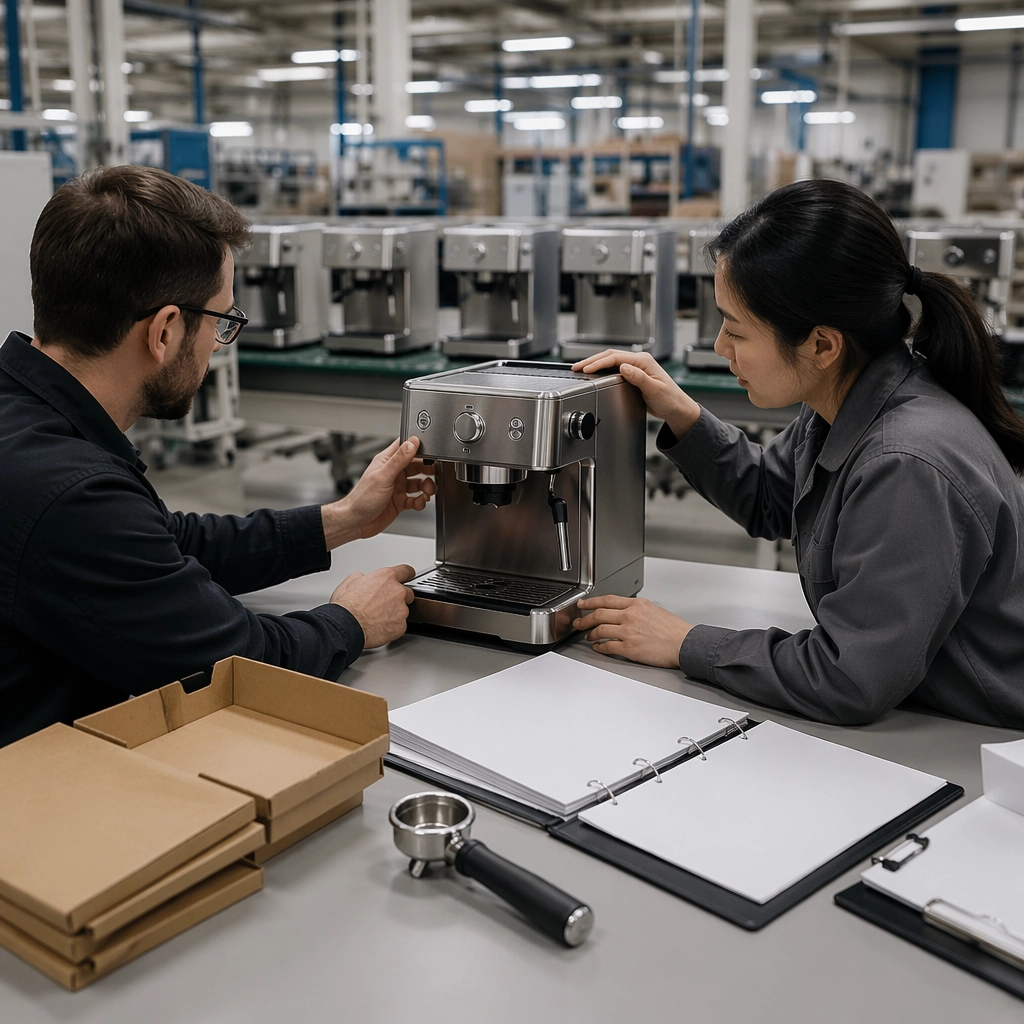
A coffee machine supplier should be able to show more than a polished catalogue. Before you pay for a sample or approve a launch, verify the legal company, factory, engineering contact, production route, customization scope, and sample-to-mass-production handoff. A video call is useful, but it should be tied to documents, model numbers, and a written change record.
Request Evidence of Factory, Engineering, and Production Capability
Ask for the legal company name and address, factory video or visit options, production-line evidence, engineering contact, assembly flow, current capacity information, and the person responsible for your project. For a buyer reviewing Hardshell Technology (Foshan) Co., Ltd., the documented starting points include a Foshan production site, about 8,000 m² of factory area, seven production lines, about 150 staff, and a stated regular capacity of about 50,000 pieces per month. Treat those figures as evidence to verify against the current factory and quotation, not as a substitute for due diligence.
A short visit or remote review should cover the warehouse, pre-assembly, main assembly, silk-printing or branding process, inspection area, testing laboratory, and finished-goods handling. You should also ask how a supplier manages changes when the sample, packaging, or PCB programme is revised.
The factory background and audit information should support this conversation, but it does not remove the need to check the exact model and production baseline.
Check Whether OEM/ODM Means More Than Logo Printing
Ask the supplier to separate four levels of work: branding a mature platform, changing appearance or colour, changing a programme or PCB, and developing a new mould or architecture. Logo application may involve silk print, laser, nameplate, or IMD. A new colour or package may be relatively contained; changing from a 51 mm to a 58 mm portafilter, adding a milk system, or changing the housing can affect tooling, BOM, testing, cost, and schedule.
Also ask who owns the artwork, mould, approved sample, and design files. Hardshell’s project materials describe design-protection agreements and project-based handling of customer assets. Put ownership, permitted use, and reuse restrictions in the commercial documents rather than relying on a verbal promise.
Verify the Sample-to-Mass-Production Handoff
A trustworthy handoff has a clear sequence:
flowchart LR
    A[One-page product brief] --> B[Platform and exact model]
    B --> C[Sample and recorded changes]
    C --> D[Approved BOM and market documents]
    D --> E[First-batch inspection]
    E --> F[Serial and batch traceability]
Ask who signs off the sample, how colour and functional changes are logged, which BOM becomes the production baseline, how first-batch inspection is handled, and how later batches are traced. Do not accept “same as sample” as a complete control method.
When I review a new inquiry, the first risk is often an incomplete brief rather than a failed component. Words such as professional, commercial, dual boiler, flow control, and direct-plumb do not define the complete machine. I still need to know the application, counter space, platform, voltage, frequency, functions, quantity, documentation, and service plan. I turn those inputs into a one-page brief, map it to a platform, and then lock the approved model, voltage version, BOM, sample changes, and packaging as the production baseline.
That is the difference between a catalogue answer and a manufacturing handoff: the decision can be checked by the buyer, the engineer, and the production team.
What Quality and Market-Entry Evidence Should a Coffee Machine Supplier Provide?
A coffee machine supplier should explain how it controls batch consistency and market entry at model level. “High quality” is not a useful comparison unless the supplier can show what happens to components, assemblies, finished machines, certificates, manuals, and traceability records. Ask for evidence that applies to the exact configuration you intend to sell.
Ask How the Supplier Controls Batch Consistency
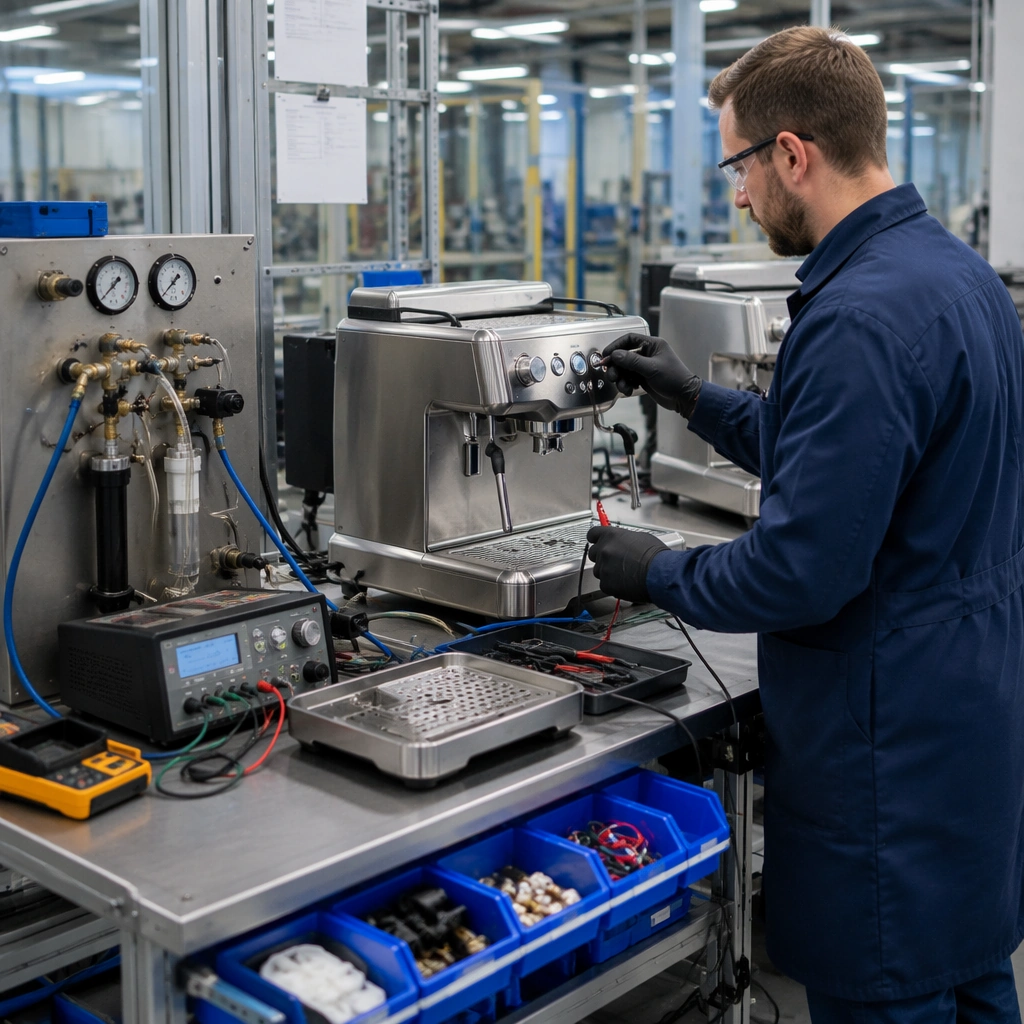
Hardshell’s documented quality structure uses five gates. The purpose is to catch risk as early as possible, not to wait until a finished machine reaches a customer.
| Quality gate | What it should control | Questions for the supplier |
|---|---|---|
| SQE — Supplier Quality Engineering | Supplier qualification, material risk, and corrective action | Which critical suppliers are approved, monitored, and reviewed? |
| IQC — Incoming Quality Control | Pumps, boilers, valves, seals, electrical parts, housings, and other incoming components | Are critical parts inspected before they enter production? |
| PQC — Process Quality Control | Pre-assembly, sealing, wiring, key dimensions, and assembly steps | Which checks happen before a component reaches final assembly? |
| QA — Quality Assurance | System records, process verification, corrective action, and release controls | How are recurring faults investigated and prevented? |
| FQC — Final Quality Control | Finished-machine function, safety, appearance, packing, and release | What exact tests must pass before shipment? |
For applicable models, the documented test categories include pressure and leakage, electrical safety, single- and double-cup operation, steam, grinding, cold brew, cleaning, transport, and short-life checks. A pressure test may be arranged at roughly twice the operating pressure for about 30 seconds, with the actual condition confirmed by model. Company know-how also records approximately 6,000 whole-machine cups and more than 15,000 pump cycles for applicable reliability plans. Those numbers are not a universal guarantee; request the model record and test conditions.
Serial codes and batch numbers matter because they connect a complaint to the production date, line, material lot, and corrective action. The five-checkpoint quality system gives buyers a useful reference for questions about inspection, reliability, and traceability.
My own release rule is practical: if a pressure drop, electrical fault, or functional problem appears during an applicable check, the unit is held rather than explained away. The goal is not to claim that a machine can never fail. It is to make the failure visible early enough to correct the process, protect the batch, and give the buyer a traceable answer.
Match Voltage and Certification Documents to the Exact Market and Model
Use this order: destination market → electrical version → exact configuration → required document → approved production version. A catalogue may contain both 120V/60Hz and 220–240V/50–60Hz variants, but that does not mean every model can be used in every country. CM 1678, for example, is documented at 220–240V, 50–60Hz; it should not be presented as an automatic U.S. solution.
| Evidence area | What to request | Why it matters |
|---|---|---|
| Electrical version | Model number, voltage, frequency, wattage, plug, and label artwork | Prevents a market, sample, and production mismatch |
| North American safety | Buyer-required ETL/UL path, test report, markings, wiring, and manual requirements | Retailer or platform requirements may differ by product and channel |
| European and other markets | Applicable CE/CB, ErP, RoHS, REACH, or local documents | The correct document depends on market, model, and configuration |
| Food-contact materials | Evidence for tank, pipes, filters, boiler, valves, seals, and coatings where applicable | Materials in the water and coffee path can affect compliance and user trust |
| Production identity | Certificate/report relationship to the exact model revision and BOM | A certificate for another version is not proof for your quoted machine |
The company materials list ISO and BSCI management-system certifications and product documentation categories including CE, CB, ErP, LFGB, RoHS, and REACH. Treat that as a starting point for document review, not a claim that every model carries every approval. For a U.S. project, ask specifically about the required ETL/UL route and the 120V/60Hz version. The market-specific certification guidance can help organize that verification.
Check Food-Contact Materials, Manuals, and Market Support
Ask which water tank, pipe, filter, boiler, valve, and other food-contact parts are covered by material or test documentation. Also request the final user manual, technical specification, packaging artwork, product and listing assets, spare-part guidance, training materials, warranty scope, and escalation process.
Hardshell’s documented support includes technical documents, product/listing materials, customer training, customer communication, spare-part and issue support, and a one-year warranty. The contract should still define what the warranty covers, who pays for parts and transport, how a batch issue is investigated, and how the buyer receives corrective-action information. A support statement is useful only when it is connected to a model, a responsible contact, and an agreed process.
How to Compare Espresso Machine Cost, MOQ, Samples, and Lead Time
Espresso machine cost is the total procurement exposure of the project, not only the unit price in a quotation. A coffee machine supplier can appear cheaper because tooling, certification, packaging, inspection, freight, or warranty handling has been left outside the headline figure. Ask every shortlisted supplier to state the same assumptions and exclusions.
Compare Total Procurement Cost, Not Only the Headline Quote
Use a like-for-like comparison before negotiating:
| Cost area | What to clarify in the quotation |
|---|---|
| Configuration and materials | Exact model, housing, heating system, pump, grinder, milk system, accessories, and finish |
| Tooling and engineering | New moulds, modifications, PCB/programme work, design files, and ownership |
| Compliance | Applicable testing, certificates, reports, labels, manuals, and market-specific changes |
| Sample and packaging | Sample fee, revisions, colour approvals, retail box, inserts, cartons, and marks |
| Quality and inspection | Factory QC, third-party inspection, rework, replacement, and release criteria |
| Logistics | Incoterm, freight, insurance, duty, tax, destination charges, and damage handling |
| After-sales exposure | Spare parts, training, warranty labour, returns, repair, and replacement assumptions |
The knowledge base contains indicative historical price information across different models, but it is not a live universal price list. A responsible quote should be tied to the model, options, quantity, market, currency, and validity period. Ask what changes the price if you remove a feature, change a material, add a document, or move from a mature platform to a new design.
Ask for Project-Specific MOQ, Sample Timing, and Production Timing
Use indicative ranges as questions, not promises. Hardshell’s project materials describe a normal MOQ of about 1,000 units or one 20-foot container, with some larger machines assessed around 200 units and some 3-in-1 projects around 500 units. A new brand may receive flexibility after the supplier reviews the product, commercial potential, and production plan, but a 500-unit discussion should not be presented as the standard MOQ for every model.
| Project stage | Qualified planning reference | What can change it |
|---|---|---|
| Mature-platform sample | About one week in a straightforward case | Colour rounds, accessories, packaging, testing, and approval speed |
| Customized sample | About one month when a programme or mould is involved | New architecture, tooling, milk system, portafilter, or certification work |
| Standard production | Often discussed around 40–45 days after approval | Model maturity, quantity, components, changes, certification, and production slot |
| Final inspection and shipping | Plan separately from production | Inspection findings, container booking, documents, and destination logistics |
The live quotation should state the committed schedule. A mature platform with a colour change is not the same project as a new mould, a 51-to-58 mm architecture change, or a new market voltage version. Put the sample approval date, production start, inspection window, and shipment responsibility in writing.
Confirm Inspection, Payment, Shipping, and After-Sales Responsibilities
Ask who pays for samples, tooling, certification, third-party inspection, rework, spare parts, training, and transport damage. Confirm the payment milestones, Incoterm, document release, packing standard, and what happens if a release test fails. A buyer may use a third-party inspector or request the supplier’s QC report, but neither option should be treated as automatic proof of every quality outcome.
Also clarify whether a sample fee is refundable after a production order, rather than advertising a universal free sample. Hardshell’s materials describe project-dependent sample charges and possible refund arrangements after mass production. The commercial agreement—not a general webpage—should control the final terms.
What to Put in Your First Coffee Machine Supplier Brief
A one-page brief is the fastest way to make a coffee machine supplier answer the same question you are asking. It reduces vague requests, exposes missing decisions early, and lets you compare a manufacturer with a distributor or trader on the same basis. Keep it short enough for a sales and engineering team to read in one sitting, but specific enough to identify the exact project.
Use a One-Page Brief to Get Comparable Answers
Include these fields before requesting a catalogue, sample, or quote:
| Brief field | Information to provide |
|---|---|
| 1. Market and electrical version | Country/region, 120V/60Hz or 220–240V/50–60Hz, plug, language, and market documents |
| 2. End user and application | Home, office, professional, light commercial, or another defined use case |
| 3. Platform | Semi-automatic, grinder-integrated, standalone espresso grinder, capsule, or confirmed commercial architecture |
| 4. Brand and price position | Target retail position, target procurement range, and the customer promise |
| 5. Quantity plan | First order, reorder estimate, launch volume, and possible phased shipments |
| 6. Functions and differentiation | Must-have, optional, competitor references, desired user experience, and features to avoid |
| 7. Appearance and packaging | Materials, colour, Logo method, dimensions, retail box, inserts, and tooling expectations |
| 8. Compliance and schedule | Exact documents, sample deadline, launch date, approval process, and service/parts plan |
If you are unsure about the platform, say so. A capable engineering partner should be able to turn an uncertain brief into two or three controlled options with clear trade-offs, rather than pretending that every feature can be added without cost or risk.
Use a Scorecard Instead of Comparing Only the Lowest Price
Score each shortlisted supplier against the same evidence. You do not need a complicated procurement system; a shared spreadsheet is enough.
| Evaluation criterion | Strong evidence | Weak answer |
|---|---|---|
| Product fit | Exact model, application logic, and documented trade-offs | A generic catalogue with no recommendation |
| Factory capability | Legal entity, factory review, engineering, and production route | Photos with no model or process connection |
| OEM/ODM depth | Written customization scope, sample control, tooling and IP terms | “Everything is possible” with no boundary |
| Sample quality | Approved sample, change list, test record, and sign-off | Verbal approval or an untracked sample |
| Batch control | SQE/IQC/PQC/QA/FQC, test records, and traceability | “Our quality is good” without checkpoints |
| Market documents | Exact model, voltage, report/certificate, manual, and label match | A certificate logo with no model reference |
| Commercial exposure | MOQ, lead time, tooling, logistics, warranty, and payment assumptions | A low unit price with missing costs |
| Communication and support | Named contact, escalation route, training, parts, and response process | Support promised only after a problem occurs |
The lowest quotation can still be the most expensive option if it creates a new mould without a clear ownership agreement, ships the wrong voltage, produces an unstable second batch, or leaves the brand to solve every end-user complaint alone.
FAQ — Coffee Machine Supplier Questions New Brands Ask
How Do I Find a Coffee Distributor or Coffee Machine Supplier?
First decide whether you need a local retailer, distributor, trading company, OEM/ODM manufacturer, or product-development partner. A “near me” search may be useful for showroom or repair access, while a global OEM may be better for private-label production. Compare product fit, factory evidence, exact documents, samples, MOQ, lead time, warranty, and support before choosing.
Can I Buy Coffee Equipment Wholesale?
Yes, but wholesale coffee equipment is different from wholesale coffee beans. A brand or distributor should provide the target market, platform, quantity, voltage, functions, packaging, document needs, and launch timing before requesting a wholesale quote. That information lets the supplier price the same configuration rather than an unrelated catalogue model.
Do You Supply Commercial or Professional Coffee Machines?
Commercial coffee machines and professional espresso machine projects require model-level review. The documented range includes professional, grinder-integrated, 3-in-1, and a commercial CM 1678 direction, but suitability depends on exact voltage, expected use, steam demand, water handling, and service plan. Do not assume that every catalogue model is suitable for a café or high-volume installation.
Do You Supply a Fully Automatic, Automatic, or Superautomatic Espresso Machine?
If your search uses “fully automatic espresso machine,” “automatic espresso machine,” “super automatic espresso machines,” or “superautomatic espresso machine,” define the required workflow first. The documented range is strongest in semi-automatic/pressure, grinder-integrated and milk-system, commercial, grinder, and capsule directions. Fully automatic milk frothing is documented on selected models, but full-automatic architecture and current availability must be confirmed for the exact project.
Can You Make a Nespresso-Compatible Capsule Machine?
The current product record documents CM 1813 as a multi-capsule model compatible with Nespresso, DG Capsule, ESE Pod, and espresso powder. If your project began with a “nespresso machine” search, confirm the exact capsule compatibility, trademark wording, voltage, certification, cleaning requirements, and destination-market documents before approving the model.
What Should Espresso Machine Cost for a New Brand?
There is no honest universal number. Compare the exact configuration, quantity, tooling, certification, sample, packaging, spare parts, inspection, freight, duty, warranty, and expected return or repair exposure. Ask suppliers to show assumptions and exclusions, then compare complete project costs rather than selecting the lowest headline FOB figure.
Your Next Step: Turn the Market Idea into a Supplier Brief
Before you ask an espresso machine supplier for a price, write down the decisions that make the price meaningful: target country, application, platform, exact voltage and frequency, must-have functions, brand position, quantity, documents, customization, sample deadline, launch date, and after-sales expectations. If some decisions are still open, ask the supplier to present clearly separated platform options instead of sending an unfiltered catalogue.
When your project already has a direction, review the private-label project workflow to understand how briefing, sampling, customization, MOQ, and production fit together. Then send a concise project brief and request a catalogue review, sample discussion, or OEM/ODM solution. Ask for the model number, current revision, test/document route, commercial assumptions, and committed schedule in the reply.
Hardshell Technology (Foshan) Co., Ltd. focuses on espresso/pressure coffee machines and grinders and supports product-led OEM/ODM projects from product definition through manufacturing, QC, documentation, and shipment. It is a possible manufacturing partner for brands, importers, distributors, and product-focused sellers—not a substitute for your own market, compliance, import, and local-service planning.
To discuss a project, use the contact us page or contact:
- WhatsApp: +86 15914570351
Include your target market, application, platform, quantity, voltage/frequency, required functions, certification needs, customization, sample timing, and launch plan. That gives the supplier something useful to quote—and gives you a much better basis for deciding whether the partnership is right.