

Quick answer: Building a custom espresso machine at Hardshell runs through six confirmed stages — locking your design brief, making your first sample, signing off on that sample, moving from mold to mass production, clearing 5 quality gates, then shipping. A non-mold customization (color, logo, features) can be sampled in about a week; a mold-based one takes closer to a month, with mass production on a fixed 45-day cycle once the sample is approved.
You've decided to customize your espresso machine for your brand. The real question is: what actually happens after you hit send on that inquiry? This article walks through our actual project timeline — step by step, from the first requirements call to the container leaving our dock — so you know exactly what to expect before you commit to a supplier.
In this article:
- How we turn a rough idea into a locked design brief (and why skipping this step is the #1 cause of "I asked for A, they built B")
- What a custom espresso machine sample actually involves — colors, logo, features, packaging
- How long sampling really takes: about a week for non-mold changes, close to a month if a mold is involved
- What our 45-day mass production cycle on the factory floor looks like, and how we flex capacity for rush orders
- The 5 quality gates every machine passes before it ships — including a real case where our life test caught a defect nothing else had found
- What to expect for QC reporting, factory verification, and lead time once your machines are ready to load
One quick note before we dive in: this article is about developing a brand-new product line for your business — not repainting or engraving a coffee maker you already own. If you're looking for a custom coffee maker, a personalized coffee machine as a gift, or tips on how to build your own espresso setup at home, this isn't that guide — but if you're a brand looking to bring a new custom espresso machine to market, keep reading.
Step 1 — Turning Your Requirements Into a Real Design Brief
What We Confirm Before Anything Gets Built
Before a single line gets drawn for your custom espresso machine, we lock four things with you, in writing: your target market, your brand positioning, your target FOB price, and the specific competitor machine you're benchmarking performance against. It sounds like a formality. It isn't. These four points are what separate "we're customizing a product" from "we're guessing at one" — and guessing at a coffee machine is an expensive way to find out you were wrong.
Why This Step Prevents "I Asked for A, They Built B"
I've been building espresso machines for the better part of thirty years now, and if there's one sentence I still hear from almost every new OEM client in the first phone call, it's some version of: "I asked for A, and the last factory gave me B." It's such a common complaint in this industry that I've stopped being surprised by it — I've just gotten serious about preventing it from happening on our floor.
Here's the pattern I've seen play out badly, more than once, before a client ever found us: a factory takes a verbal brief — "make it stainless, add a milk frother, keep it under $150 FOB" — and runs straight into tooling without pinning down the details that actually decide whether the finished machine matches what the client pictured. Target market, brand positioning, target price, and the specific competitor performance the client is benchmarking against — if those four things aren't locked in writing before anything gets built, you're not customizing a product, you're guessing at one. And guessing at a coffee machine is expensive, because once a mold is cut, "close enough" isn't a fix — it's a five- or six-figure (USD) re-tool.
So the change we made, years ago now, was structural, not cosmetic: no design brief moves past our desk without those four points confirmed by the client directly, in writing, before the first sample gets scheduled. It sounds almost too simple to be a "solution," but it's the single biggest reason our sample-to-confirmation cycle for a non-mold customization now runs about a week, and mold-based customization runs close to a month, rather than three rounds of expensive rework. We'd rather spend an extra two or three days upfront getting picky about the brief than spend three weeks and a re-cut mold fixing a machine that technically works but isn't the one the client asked for — you can see how we've helped other brands land a design that actually matched the brief once the requirements were locked properly.
We also weigh three practical factors alongside the brief: your budget, your target end-user, and your target market — because a machine built for European retail (price-sensitive, brand-loyal, harder to enter) needs different tradeoffs than one built for a North American Amazon launch (where quality-to-value ratio drives conversion).
Before entering a custom development process, complete this coffee machine supplier brief checklist so your market, platform, quantity, target price, and launch requirements are defined.
Step 2 — Making Your Custom Espresso Machine Sample
Color, Logo & Feature Customization in Practice
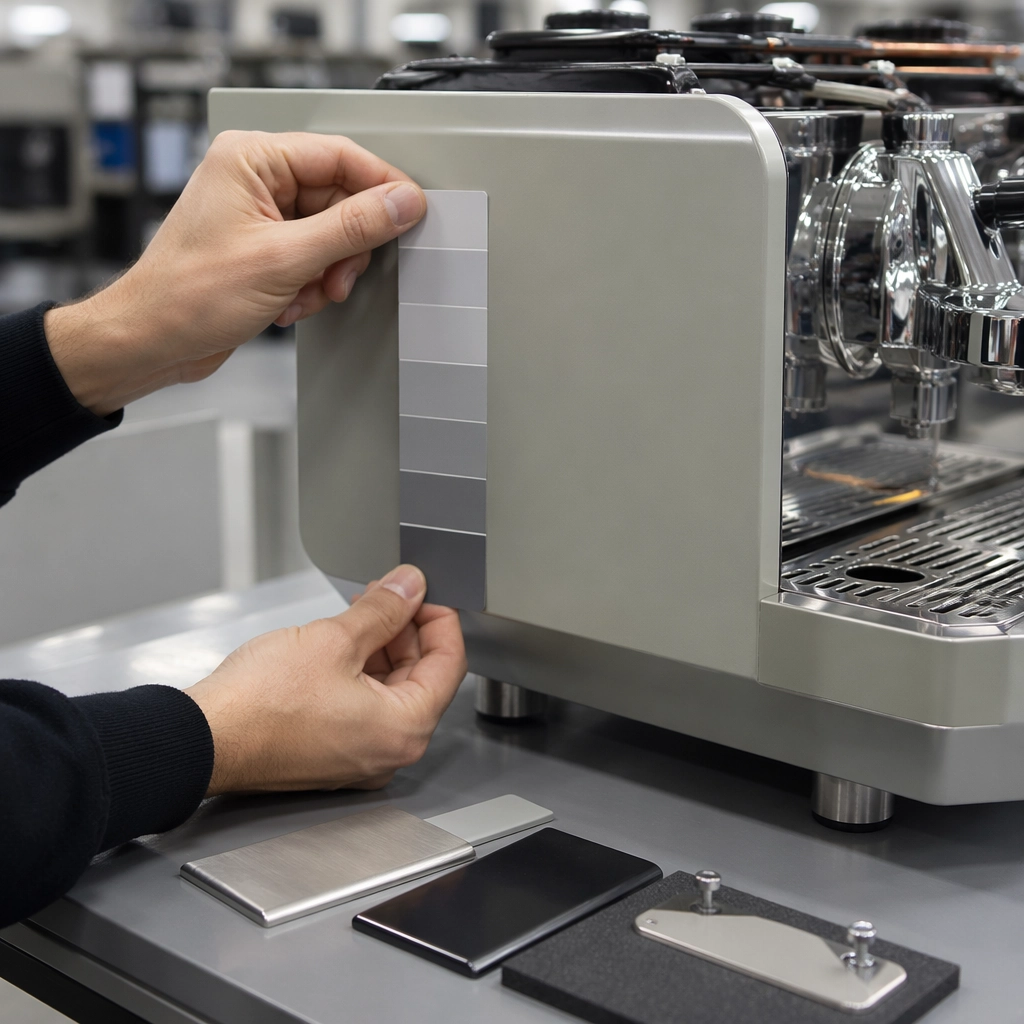
This isn't spray paint or a swapped panel — it's product development starting from the definition stage. Once your brief is locked, we support four categories of customization on your sample: exterior color (matched to your Pantone code or physical swatch), logo application (silkscreen, laser etching, a nameplate, or in-mold decoration/IMD, chosen based on your material and finish), feature additions or removals (milk frother on or off, brew-head size, control panel style), and packaging design. If you're a returning client, we typically waive the sample fee, and it's refundable once mass production is confirmed.
When a Sample Takes 1 Week — and When It Takes a Month
Not every customization needs a new mold, and that difference is what decides your timeline. If your changes are cosmetic or electronic — a new color, a different logo method, a firmware-level feature toggle — we can usually turn around a sample in about a week using existing tooling. If your request needs a new mold — say, moving from a 51mm to a 58mm brew head, or adding a milk tank housing that doesn't exist on the base model — expect closer to a month for that first sample, since it includes the mold development lead time. Either way, you'll know which category you're in before you approve the brief, not after.
Step 3 — Confirming the Sample Before Mass Production
The 2-Round Color & Function Sign-Off Process
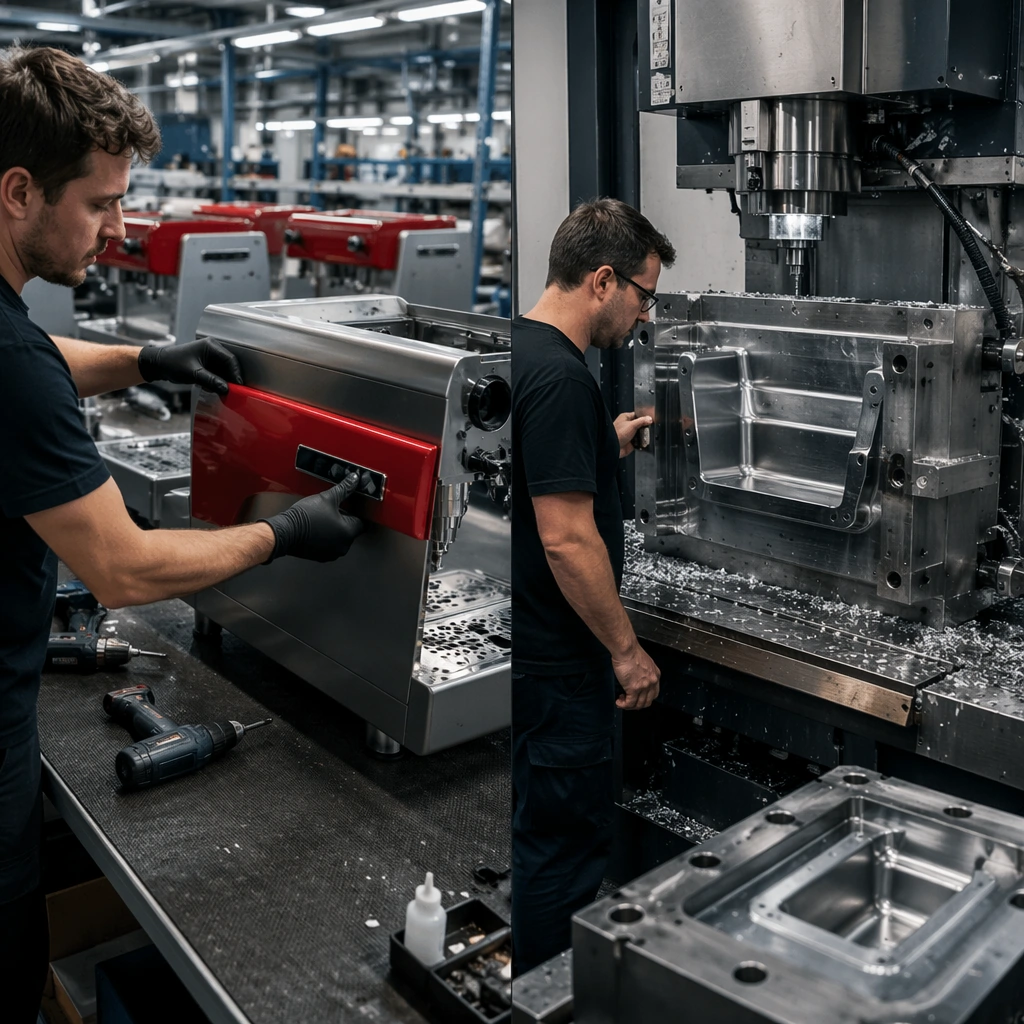
Color is the single most common source of disagreement at this stage — not because anyone is careless, but because a Pantone code on a screen, a physical swatch, and an injection-molded plastic surface under factory lighting can all read slightly differently. So we run color confirmation in two rounds by default: an initial trial sample against your reference, then a corrected second sample once you've flagged any deviation. It's a deliberate extra step, not a delay — it's cheaper to catch a color mismatch on a sample than on a container of finished units.
What Happens If the Sample Isn't Right Yet
In our experience, when a sample needs a second pass, it's almost always one of three things: color, control panel layout, or a specific feature — the physical dimensions of the machine itself are rarely the issue, since those were already locked in the design brief. We treat each round the same way: identify exactly what's off, correct it, and re-sample that specific element rather than restarting the whole build. Nothing moves to mold development or mass production until you've signed off in writing. This is also the point where we confirm packaging artwork and any accessory details (portafilter, milk jug, manuals) alongside the machine itself, so nothing gets discovered for the first time once a container is already loading.
Step 4 — From Confirmed Sample to Mass Production Process
Mold Development Timeline
If your custom espresso machine needs a new mold, that development runs on its own clock before mass production can start — typically running in parallel with your final sample approval so it doesn't add dead time to your overall schedule. And it's worth repeating the point from Step 1: once a mold is cut, "close enough" isn't a fix, it's a costly re-tool. That's exactly why we push so hard to get the brief and the sample right before any steel gets machined.
45-Day Production Cycle on the Factory Floor
Once your sample is confirmed, mass production runs on a fixed 45-day cycle as standard, with an expedited 25-to-30-day option available for orders that qualify. Our factory runs 7 production lines — pre-assembly, main assembly, and a dedicated silkscreen line — giving us a standard capacity of about 50,000 units a month, flexing up to 60,000–70,000 units a month during peak season. If you need to add volume mid-production, we can typically absorb up to a 50% increase on an existing order with a delivery as fast as 40 days, because the line is already running and tooled for your spec — it's a different situation than starting a new order from zero.
Curious what this process costs? See our full pricing breakdown for how sample-to-shipment timelines compare across order sizes.
Step 5 — The 5 Quality Gates Your Custom Machine Must Pass
SQE → IQC → PQC → QA → FQC, Explained With a Real Example
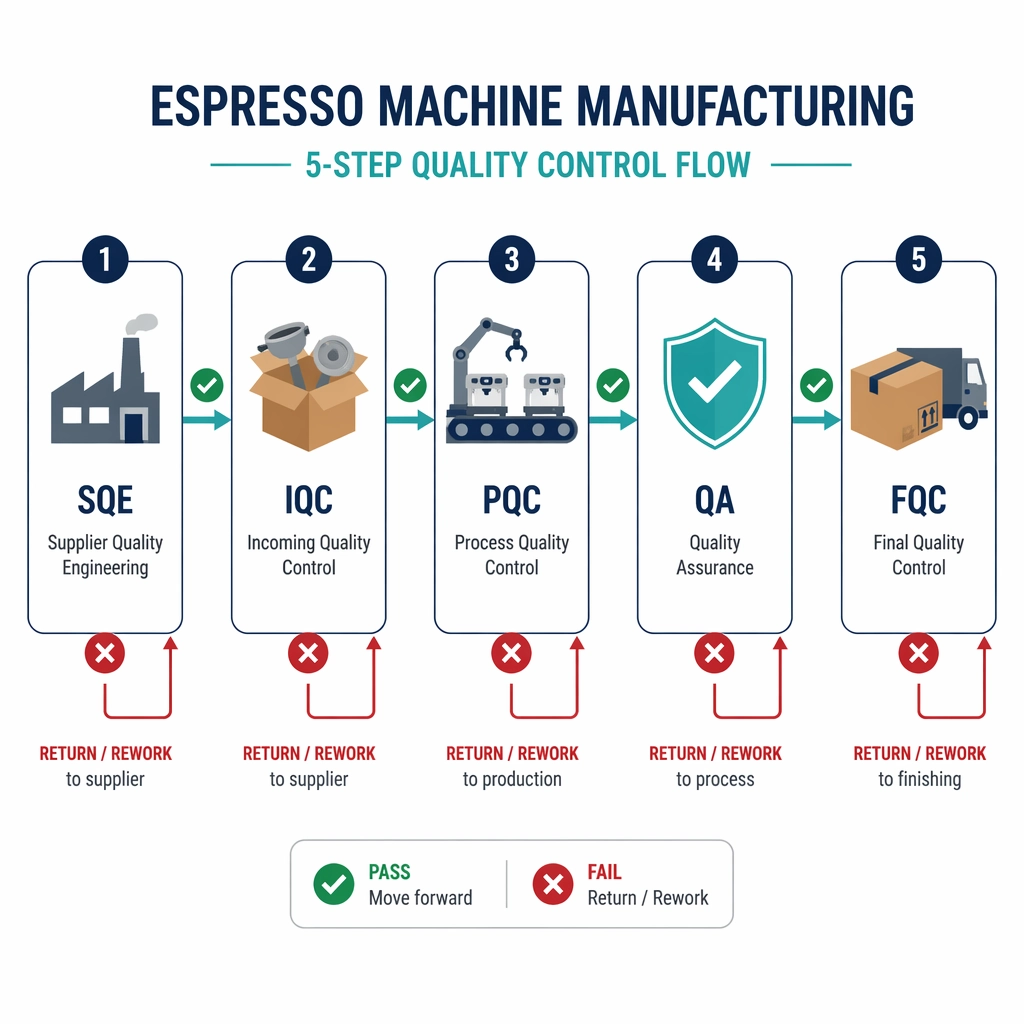
Every machine we build — custom or standard — moves through 5 quality checkpoints before it's cleared to ship, and each one has a clear pass/fail gate: nothing defective moves forward. It starts with SQE (Supplier Quality Engineering), where we control, analyze, and improve supplier performance before materials ever reach our floor. Incoming components then go through IQC (Incoming Quality Control) — anything that fails is returned to the supplier, not reworked internally. During assembly, PQC (Process Quality Control) inspects and spot-checks in real time; failed units go back for rework rather than continuing down the line. QA (Quality Assurance) then verifies the finished unit systematically, and FQC (Final Quality Control) is the last checkpoint before a machine is cleared for the customer. Every unit also carries a serial and batch code, so if an issue ever surfaces after shipment, we can trace it back to the exact production day, line, and material batch — not just "somewhere in that order."
Beyond the checkpoints themselves, every machine goes through electrical safety testing, full brewing/steam/milk/grinding functional checks, a zero-tolerance leak inspection, and a drop and transport test before it's cleared — the kind of testing that matters most once your machines are on a container ship for six weeks, not sitting in our test lab.
The Short-Term Life Test That Once Caught a Steam Valve Issue Before It Shipped
A brand we've worked with for several years came to us wanting to expand their line with a new mid-range espresso machine — stainless housing, an automatic milk frothing system, positioned for the North American market where their existing line was already selling well. Nothing about the brief itself was unusual; we'd built similar configurations before. The difficulty showed up later, in the quality gates, in a place most buyers never think to ask about.
Our short-term life test — 6,000 cup-cycles run on the assembled machine before it's cleared for mass production — flagged an inconsistency in the steam valve on a sample from that batch. Nothing had failed at incoming inspection (IQC), nothing failed in-process (PQC), and the finished unit passed final inspection (FQC) on the surface. It was only under the accelerated cycle testing that the valve showed early fatigue, traced back to a dimensional variance in a sealing gasket from one of our component suppliers — the kind of variance that's invisible until the part has been through thousands of steam cycles, not dozens.
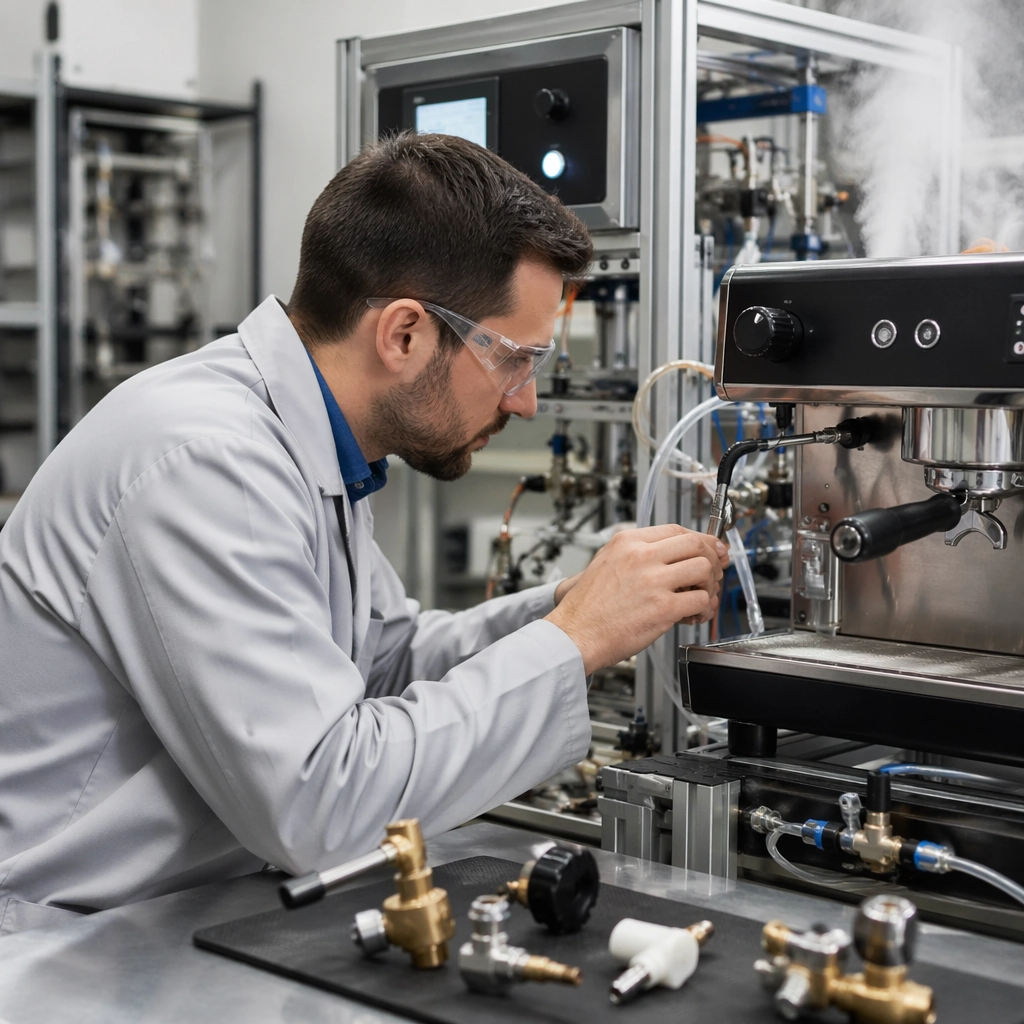
We held that batch. We went back to the supplier's tolerance data, tightened the incoming spec on that gasket, and re-ran the life test on a corrected sample before releasing the mold-confirmed design to the main production line. It cost us roughly a week we hadn't budgeted for in that project's timeline — and I'll be honest, a week matters when a client is planning an Amazon launch window. But shipping a machine with a steam valve that fails early instead of holding for 15,000+ pump cycles the way it's designed to would have cost a lot more than a week, in returns and in trust.
That's the real reason our shipment pass rate sits around 99%, well above what's typical for this industry. It's not that we don't find problems. It's that we're set up to catch them before they leave the factory, not after a customer's customer opens the box. If you want the full mechanics of how each checkpoint operates, see how our 5-checkpoint QC system works, checkpoint by checkpoint.
Step 6 — Shipping and What You Can Expect Next
QC Report, Loading & Lead Time Recap
Not every client can fly out to Foshan before a container ships, and that's fine — for clients who can't visit in person, we inspect the finished order on your behalf and issue an independent QC report, and we're glad to book a factory tour, on-site or by video if you want to see the line yourself before goods load. From there, final inspection typically runs about a week, and container booking runs on a similar timeline, so you can plan your downstream logistics — customs, freight forwarding, retail or Amazon prep — around a realistic date instead of a vague promise.
Here's the six-step timeline end to end: lock the design brief, build and confirm your sample, sign off on color and function, move through mold development and the 45-day production cycle, clear all 5 quality gates, then inspect, report, and ship. Every step has a confirmation point built in. That's not us being cautious for its own sake — it's the only way we've found to reliably turn "I want a custom espresso machine" into a container of machines that actually match what you asked for, without surprises showing up after the goods have already left Foshan.
Ready to Start Your Own Custom Espresso Machine Project?
If you're a brand looking to bring a new custom espresso machine to market — not repaint one you already own — this is the process you'd be walking through with us, start to finish. Talk to our team about your requirements: reach out to Anson at +86 19523898950 on WhatsApp, or contact us to request a quote or ask about sample availability for your spec.
FAQ
Is this the same as customizing or personalizing a coffee maker I already own?
No. This article — and Hardshell's service — is about developing a new custom espresso machine product line for your brand from the ground up: your own color, logo, features, and packaging on a machine we manufacture for you. If you're looking to repaint, engrave, or upgrade a coffee maker you or a customer already owns as a one-off personalized coffee machine or gift, that's a different market (retail customization shops) — we're an ODM/OEM factory building product lines for brands, not a retail modification service.
How long does it take to get a custom espresso machine sample?
It depends on whether your customization needs a new mold. Non-mold changes — color, logo method, or a firmware-level feature — usually sample in about a week. If your request needs a new mold, such as a different brew-head size or an added milk tank housing, plan for closer to a month for that first sample.
What's the minimum order quantity (MOQ) for a custom espresso machine?
MOQ depends on the model and configuration you choose, and we're often able to work with smaller quantities for brands with strong long-term potential rather than applying a single rigid number across the board. The clearest way to get an accurate figure for your specific spec is to see our full pricing breakdown or send us your requirements directly.
Can I customize the color, logo, and features without opening a new mold?
Yes, in many cases. Color, logo application (silkscreen, laser, nameplate, or IMD), and certain feature toggles can usually be handled on existing tooling, which keeps your sample timeline to about a week. Larger structural changes — like a different brew-head size — are the ones that typically require a new mold and a longer timeline.
What happens if there's a quality issue after mass production starts?
It shouldn't reach that point, because our 5 quality gates (SQE, IQC, PQC, QA, FQC) are designed to catch issues before mass production is released, not after. If something is ever flagged — as happened with a steam valve issue we caught during life testing on a past project — we hold the batch, trace the root cause with the supplier, and correct it before continuing, rather than shipping and dealing with returns later.