

Quick answer: China makes roughly 60% of the world's espresso and semi-automatic coffee machines, concentrated heavily around Foshan and Shunde in Guangdong province — home to around 30 dedicated coffee machine factories, including ours. FOB pricing for a standard semi-automatic machine typically runs $25 to $165 depending on the platform, MOQs range from 200 to 1,000 units, and standard lead time sits around 40 days. The real risk isn't finding a manufacturer — it's telling a stable one apart from a factory that will pass your first sample and then fail your third production batch.
If you've typed "coffee machine manufacturers in China" into Google, you already know China makes coffee machines. What you need to know is what a real quote looks like, why prices vary 3x for machines that look identical in a catalog photo, and what separates a factory that holds quality steady from one that doesn't.
I've spent over 20 years on the manufacturing side of this industry — first running the coffee machine division at one of China's largest ODM operations, then building Hardshell in Foshan. Here's what buyers actually need to check, using real numbers from our own production floor.
Why China Dominates Coffee Machine Manufacturing
Guangdong's Shunde district earned its "coffee machine capital" reputation the way most manufacturing clusters form: once the core supply chain — pumps, boilers, control boards, injection molding — sets up in one place, everyone building a finished machine benefits from being nearby. Around 30 coffee machine factories operate in this district alone, and most global brands you've heard of — De'Longhi, Breville, Gaggia, Philips — manufacture through Chinese OEM partners rather than running their own lines.
That concentration is also why "coffee machine made in China" doesn't mean one thing. Search "coffee machine China" and you'll get everything from bargain-bin plastic machines on shared tooling, to full-stainless, patented-tech platforms supplying Amazon's top-ranked coffee brands. The label tells you the country of origin — nothing about which factory built it, or how consistently.
What Coffee Machine Price in China Actually Looks Like
Buyers usually ask for "your best price" before defining what they're comparing — backwards, and why quotes from different factories look impossible to compare.
On our own lines, FOB pricing spans roughly $25 to $165 per unit, and the spread isn't random:
- Classic entry-level machines (plastic housing, aluminum die-cast boiler): around $30 FOB.
- Classic stainless-steel machines: around $45 FOB.
- High-end platforms with auto-milk systems, touch panels, or grind-and-brew (like our CM 1620M series): $75 to $80 FOB.
- Professional single-machine platforms: around $75 FOB.
- Top-tier configurations with full stainless housing, dual boilers, and 3-in-1 grinder-plus-milk systems: up to $165 FOB.
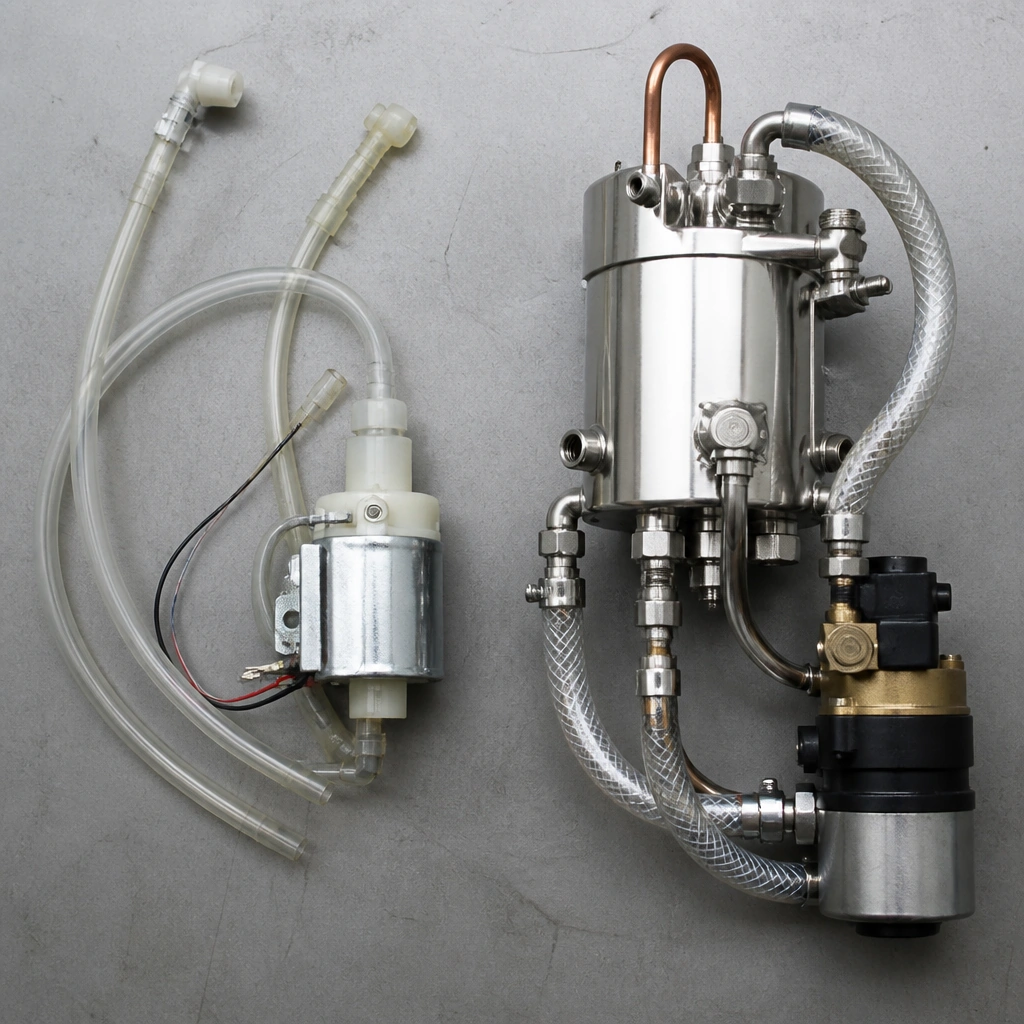
The gap between a $25 quote and a $70 quote for what looks like the same machine usually comes down to what's inside, not what's in the listing photo: the pump (imported Italian ULKA versus a domestic substitute), the boiler material, the seal compound, and whether the factory runs its own product design or copied someone else's mold. Match the spec line by line and quotes that looked wildly different tend to converge.
The Real Question: Can This Factory Hold Quality Steady?
Price gets buyers to the shortlist. Quality consistency is what determines whether they stay in business. The complaint I hear most from clients who switched to us wasn't about their old factory's first shipment — it was the third or fourth one. The first batch passes inspection. Somewhere around batch three, defect rates creep up and nobody at the factory can explain why.
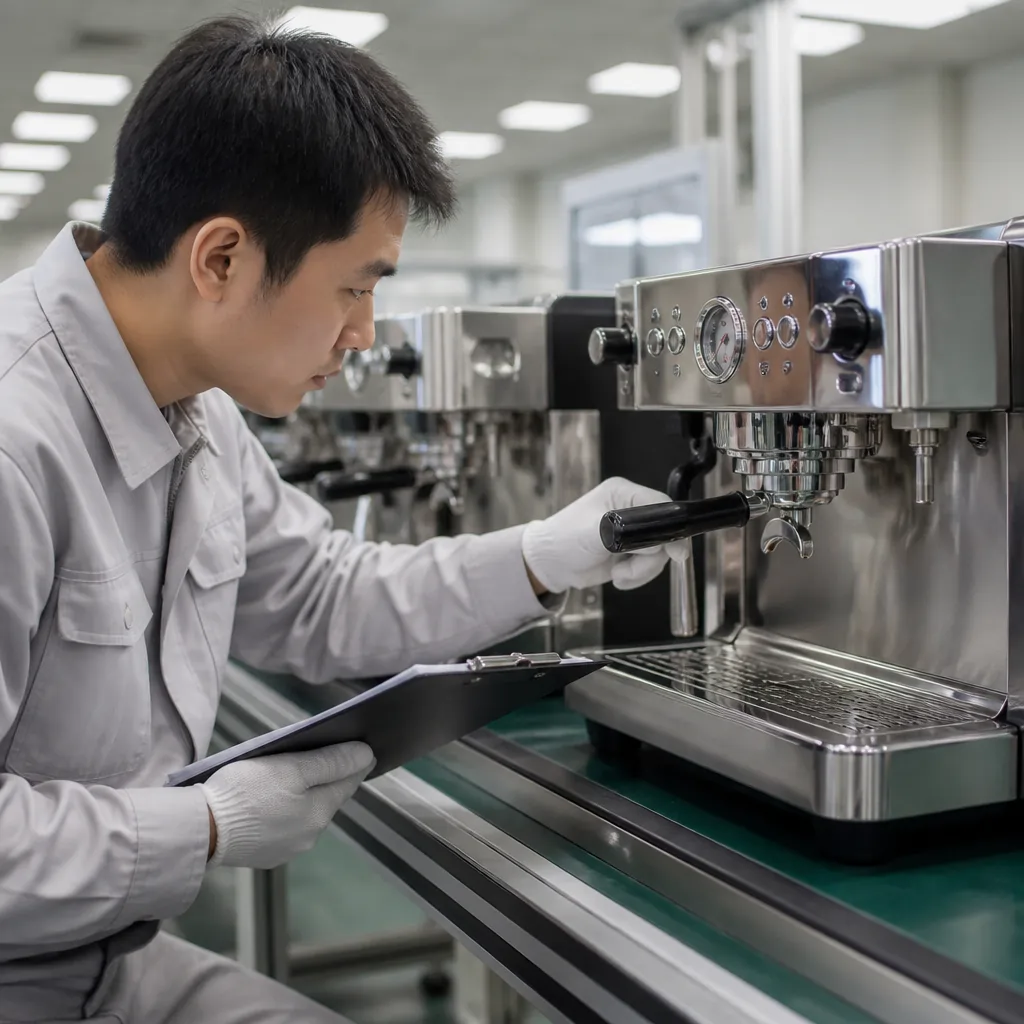
That's a process problem, not bad luck. At Hardshell, every machine moves through five checkpoints before it ships: SQE controls incoming component risk before it reaches our floor, IQC inspects every delivery and returns failures to the supplier rather than reworking them internally, PQC spot-checks during assembly, QA verifies the finished unit systematically, and FQC is the last gate before a machine clears for the customer. Nothing defective moves to the next stage — which is how we hold a 99% shipment pass rate against an industry average most sources put at 85–90%.
Ask any manufacturer you're evaluating what happens to a unit that fails inspection at each stage. A factory that can't answer specifically probably doesn't have five real gates — it has one QC person checking a box before the container closes.
Certifications and MOQ: What to Verify Before You Commit
Two things get overlooked until they cause a shipment delay. Certifications get your container through customs — confirm CE for Europe and ETL/UL for North America at minimum, and check for market-specific approvals like SASO/SABER (Saudi Arabia), G-Mark (GCC), EAC (Russia), or UKCA (UK). A factory holding both ISO and BSCI (a social-compliance audit many factories in this space still don't carry) is a reasonable signal of a documented operation.
MOQ is where new brands hit a wall. The industry standard runs 500 to 1,000 units, which scares off buyers wanting a smaller test run. We flex by platform — 1,000 units standard, 500 for our 3-in-1 series, as low as 200 for larger machines — and work with smaller first orders for clients with real long-term potential. A factory unwilling to discuss flexibility at all is worth noting.
What About a Coffee Machine Manufacturer in USA?
Some buyers search for a coffee machine manufacturer in USA to avoid sourcing overseas. Worth being direct: most "American" coffee machine brands design, market, and sell the product domestically while manufacturing happens in China, or occasionally Italy for premium commercial units. Genuine U.S. manufacturing of espresso machines is rare, and where it exists, it's small-batch, premium-priced commercial equipment — not a fit for a brand launching at a competitive price.
That's not a knock on U.S. companies; it's how this supply chain has worked for decades. If your real goal is a U.S.-based brand with manufacturing that hits a reasonable price point, an OEM/ODM partnership with a Chinese factory building under your name is the standard path, not a compromise.
A Practical Checklist Before You Send an RFQ
Before contacting any coffee machine manufacturers in China, have answers ready for: target market and required certifications, platform type (entry-level, mid-range with milk/grinder functions, or professional/commercial), target FOB price and realistic volume, and sample/lead-time expectations. On our side, non-mold customization samples in about a week, mold-based customization closer to a month, and mass production runs a standard 40-day cycle with a 25–30 day rush option. Decide upfront what quality evidence you'll request — QC reports, a factory audit in person or by video, and batch-code traceability.
Conclusion
Coffee machine manufacturers in China aren't hard to find — Foshan alone has around 30 of them, and the industry has supplied global brands for two decades. The harder job is verifying which factory holds a promised spec and defect rate across your fifth order, not just your first sample. Define your market, certifications, and volume before requesting pricing, and use quality-gate specifics — not just the FOB number — to separate a real manufacturing partner from a factory that's guessing along with you.
If you're evaluating suppliers and want to compare a real quote against your current one, get a quote from our OEM/ODM team or see how our 5-checkpoint quality system works before you decide.
FAQ
What is the average price of a coffee machine made in China?
It depends entirely on the platform. Entry-level plastic machines run around $25–$30 FOB, mid-range stainless models with milk or grinder functions run $75–$80, and top-tier configurations with dual boilers and multiple functions can reach $160–$165. Get quotes for a specific spec, not a general "coffee machine," to make prices comparable.
Is buying from a coffee machine manufacturer in China risky for a new brand?
Not inherently — most established coffee brands worldwide already manufacture in China. The risk is skipping verification: check certifications for your target market, ask how quality is controlled across batches (not just the first sample), and confirm MOQ and lead time in writing before you commit.
What's the difference between an OEM and ODM coffee machine manufacturer in China?
OEM (original equipment manufacturer) typically means the factory builds an existing design under your brand and logo. ODM (original design manufacturer) means the factory participates in product definition and design from the brief stage, which is closer to how most new brands actually work with a factory like ours.
Do all coffee machine manufacturers in China offer the same certifications?
No. Baseline certifications like CE, RoHS, and REACH are common across export-focused factories, but social-compliance audits like BSCI, and market-specific approvals like SASO/SABER or EAC, aren't universal. Confirm the exact certifications you need before assuming a factory has them.
Why do some coffee machine manufacturers in China quote much lower prices than others for a similar-looking machine?
The visible design can look nearly identical while the internal components differ significantly — pump origin, boiler material, seal compound, and whether the factory owns its own mold or copied one. A lower price usually reflects lower-grade components or looser quality control, which tends to show up later as a higher return rate rather than an immediate problem.