
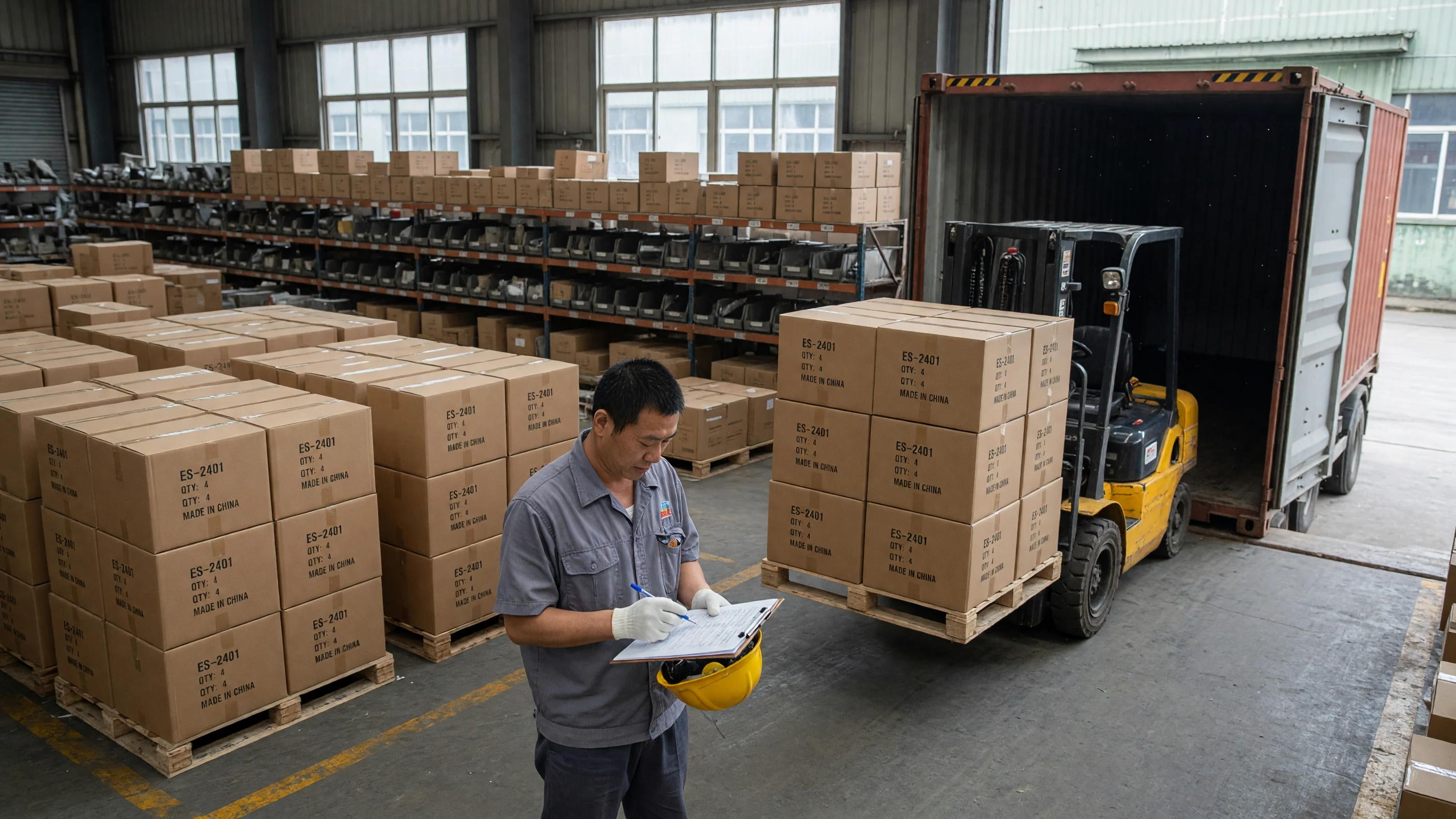
Quick answer: Coffee machine distributors source in one of three ways: resell an established brand, buy through a trading company, or go factory-direct with an OEM/ODM manufacturer. The models differ less on unit price than on who owns the quality outcome, who controls the product, and whose brand each container builds. Choose by channel depth and risk appetite — then vet the factory before the first container, not after the third.
I've spent 20-plus years on the manufacturing side of this industry — first running the coffee machine division of one of China's largest ODM groups, then founding Hardshell in Foshan. Distributors and channel partners are about 30% of our customer mix; here is how the three models compare.
Why the Sourcing Model Matters More Than the Machine
The call every distributor dreads is not about the first container. It is about the third: the first order sells through, the retailers are happy, you commit to a bigger territory push — and then leak complaints trickle back from shops across the region.
I have lived the factory side of that call. The failure that taught us the most was a brew-head seal ring that measured inside the drawing, passed the finished-goods test, then started weeping after a few dozen shots. The root cause sat one step back — a supplier had drifted a valve-cavity dimension by a few tenths of a millimeter, and the silicone took a set only after repeated heat cycles. For an ecommerce seller this hurts a listing. For a distributor it is worse: the defect is scattered across retail doors, and the channel relationship you spent two years building takes the damage.
An espresso machine is a high-temperature, high-pressure product; consistency is decided at incoming parts, not at final test. "This container was fine, the next one wasn't" is the number-one complaint buyers bring us from previous factories — so the sourcing question is really about risk ownership: who can see batch problems coming, and whose name absorbs them?
The 3 Sourcing Models Coffee Machine Distributors Can Choose From
Model 1: Distribute an established brand. You take the brand's territory, sell what the brand ships, and let its marketing do the heavy lifting — the fastest route to credibility with retailers. The trade-offs: margins are thin and controlled, the brand allocates your territory, and every container you sell builds the brand owner's asset rather than yours.
Model 2: Buy through a trading company or wholesale supplier. The lowest-friction route to wholesale coffee machines: small minimums, mixed containers, one invoice across categories — real value for a new wholesaler testing a market. The trade-offs sit where you cannot see them: a margin stack over the factory price, no engineering visibility into what you buy, and no protection against the same box being sold to your competitor. When a batch problem arrives, most coffee machine wholesale suppliers are messengers, not manufacturers.
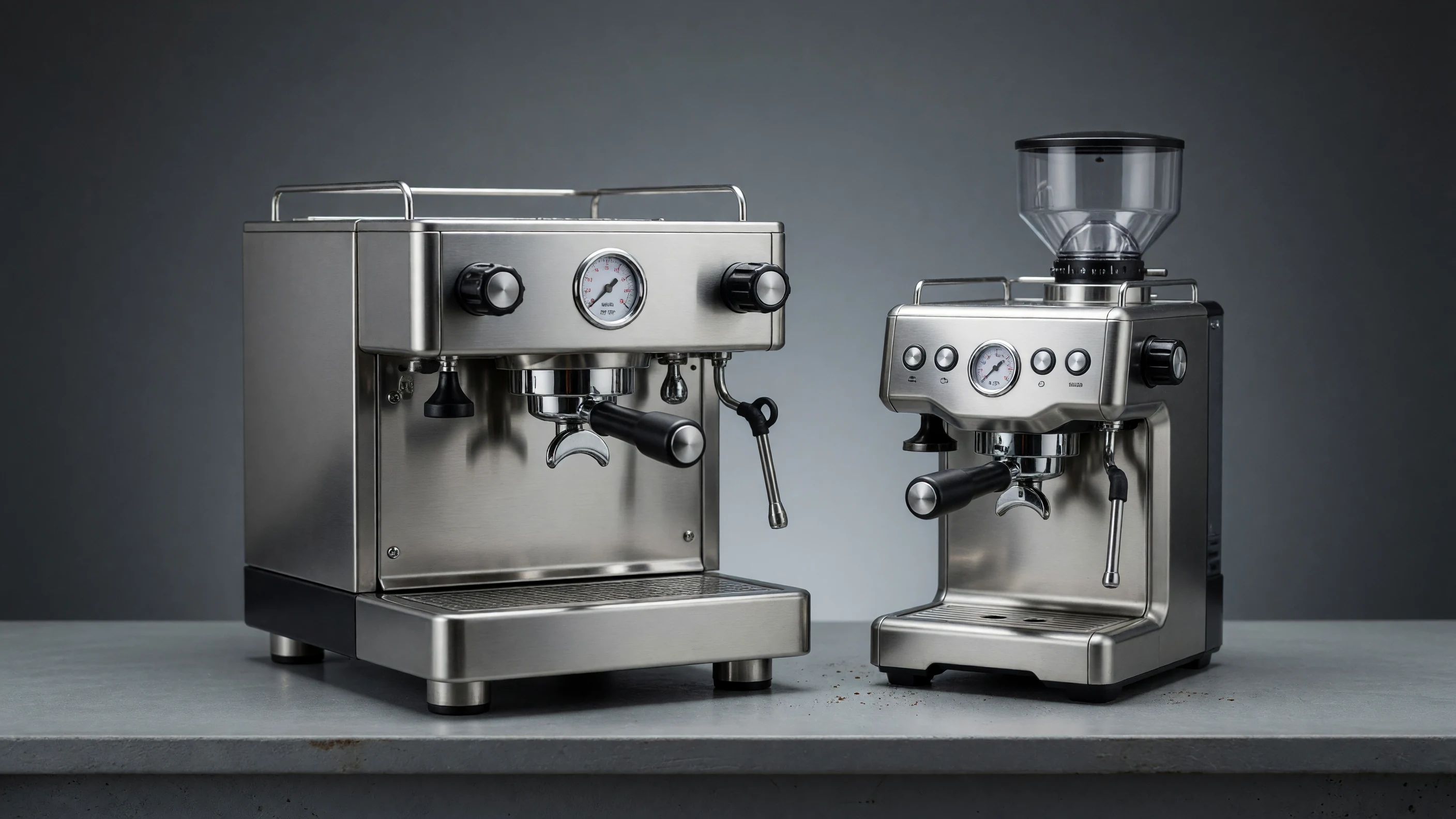
Model 3: Factory-direct OEM/ODM — your own line. You spec the product, print your logo (silk print, laser, or nameplate), tune the firmware to your market, and keep the widest margin in the chain. The trade-offs: real minimums — commonly 1,000 pcs or one 20GP container, 200 for large commercial machines, 500 on some 3-in-1 platforms — and you own the quality outcome. A representative pattern from our order book: a Gulf-region distributor supplying coffee shops and restaurants moved from reselling other brands to a private-label two-rung line — a commercial unit (our CM 1678: dual pumps, triple boiler, 58 mm horn portafilter) for its HoReCa accounts, and a high-value grinder-equipped semi-auto (CM 1610D, 20-bar ULKA pump, dual thermoblocks) for retail shelves. Two rungs from one plant takes a deep espresso machine range; our case studies show the ecommerce side of that record.
| Brand resale | Trading company | Factory-direct OEM/ODM | |
|---|---|---|---|
| Margin logic | Thin, brand-controlled | Middleman stack over factory price | Widest — but you own the quality outcome |
| MOQ / capital | Set by the brand | Lowest; mixed SKUs | ~1,000 pcs / one 20GP (200 for large machines; 500 on some 3-in-1) |
| Product control | None | Catalog pick, no engineering say | Full: spec, firmware, color, logo, packaging, market tuning |
| Quality visibility | The brand's problem — until your retailers call you | Opaque; the trader owns no test lab | Direct: audit the QC gates yourself |
| Channel conflict | Brand allocates territory | Same box sold to your competitor | Customized design avoids same-box conflict; exclusivity case by case |
| Typical failure | Margin squeeze, territory loss | Batch drift you cannot trace | Picking the wrong factory — the third-container problem |
What to Verify Before You Commit to an Espresso Machine Supplier
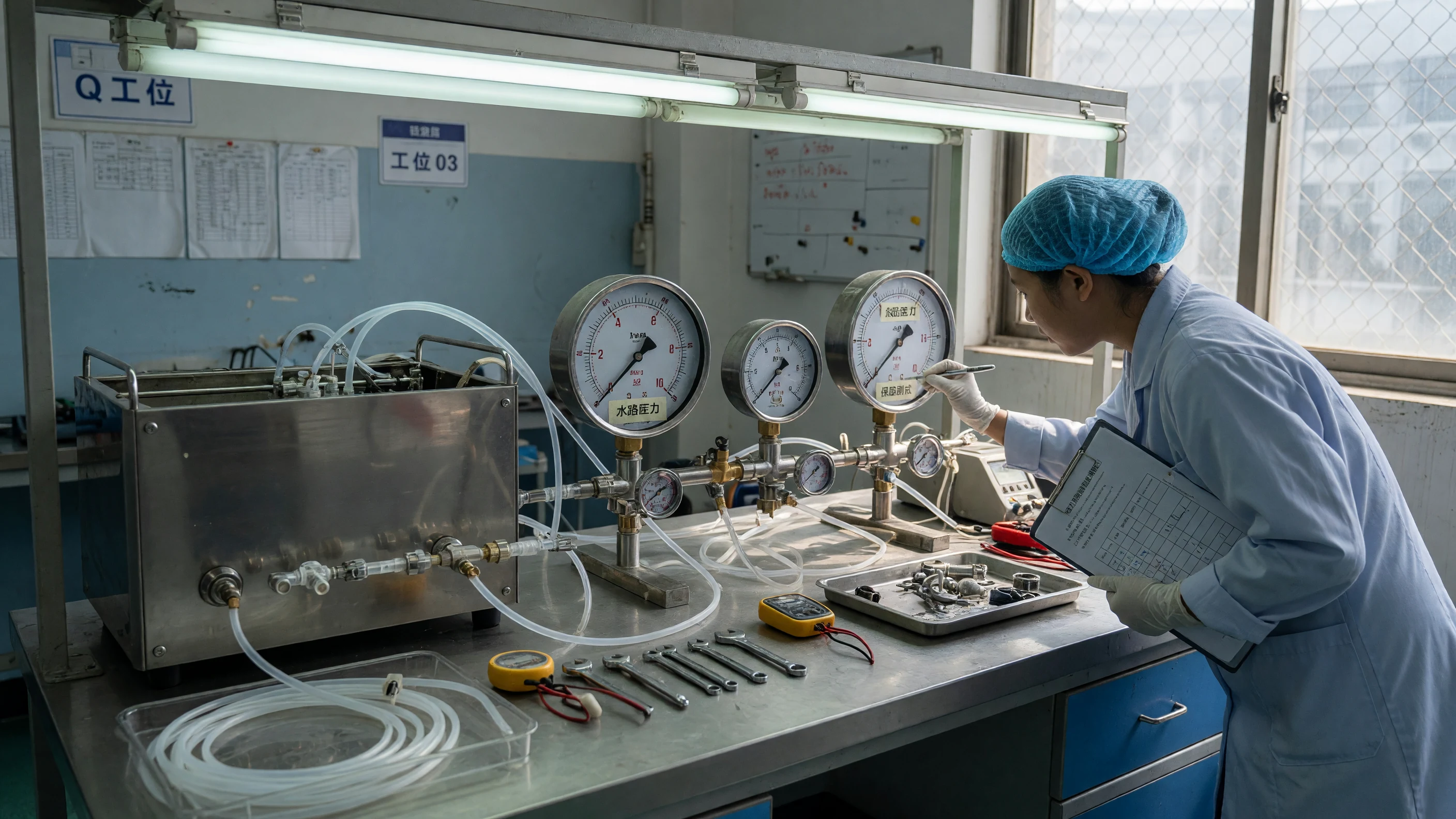
For factory-direct buyers, the factory audit is the business decision. Six checks, in the order that kills the most deals:
1. Batch discipline at incoming parts. Ask whether core parts — pump, valves, seals, thermoblock — get full inspection at IQC or just sampling. Sampling is how the third-container problem gets in. We treat those as high-risk incoming and inspect every piece; if process QC is catching core-part defects, incoming control has already failed. The full five-gate version is on our quality page.
2. Leak and life testing with real numbers. Water-path integrity should be tested in a closed circuit at roughly twice working pressure — a 20-bar machine pushed to 30–40 bar and held for about 30 seconds; any pressure drop rejects the unit. Ask about life testing: our reference is about 6,000 cups on the machine and 15,000-plus on the pump, sampled per order. And ask whether a serial traces to a production date, line, and material lot — traceability that isolates one batch instead of writing off your season.
3. Market-fit engineering. A real espresso machine supplier tunes the product to your market, not just the carton. Documented work: panel wording and water-out time changed in firmware to move a 30–60 ml double-shot platform to the 150–350 ml Americano a Gulf market actually drinks, with grinder dosage adjusted through the same program. Regional taste tuning is routine — coarser grinds and 50–60 ml cups for the US, ~30 ml shots for Southern Europe, crema priority in the Middle East. Dual voltage exists across the line, but switching between 120 V and 220–240 V is a re-spec of PCB and components, not a sticker change.
4. Certifications for your market. Europe: CE (LVD + EMC), ErP auto shut-off, food-contact evidence such as LFGB. North America: UL or ETL — CE alone does not open that market; ETL runs roughly half the cost and 2–4 weeks against UL's 4–8. UK: UKCA is separate from CE. Russia/EAEU: EAC. Saudi Arabia: SABER — a product certificate plus a per-shipment certificate, neither issuable after arrival. Our certifications page maps these by market.
5. Logistics math. From our catalogue: slim models load 818 pcs per 20GP, classic 900, 3-in-1 grinder models 560 — one 20GP is the standard planning unit. Route packaging matters too: Russia-bound rail needed waterproofing, Middle East chains need higher drop resistance, and a drop sample belongs in outgoing QC.
6. Commercial terms you can actually use. For reference, our terms: FOB; 30% deposit, 70% before shipment or against B/L; TT or LC; first-deal sample fee, usually refunded after mass production; one-year warranty on core function (thermoblock, pump, boiler assemblies) with parts and courier covered for manufacturing faults; and a committed defect/return band of 2–3%. One honest note: credit terms and territory exclusivity are case-by-case everywhere in this industry — a factory offering them casually is a risk signal, not a perk. For the sample-versus-bulk checks underneath, see our red-flags checklist.
Which Sourcing Model Fits Your Distribution Business
Testing a market with limited capital: start with a brand or a trader — the flexibility is worth the margin until your sell-through proves out.
Established distributor with retail doors: factory-direct is where the margin and the moat are. The pattern: one or two models first, then the line consolidates with us once the first containers sell through without a quality storm. A healthy Gulf account reorders two to three times a year (ecommerce monthly, European brands quarterly, Russia three to four). What keeps a distributor is retailers not calling with problems — not the FOB number.
HoReCa and hotel/restaurant equipment suppliers: you need a two-rung line and proof of speed. We answer the rush-hour question with a camera, not a brochure: an Americano and a cappuccino in two to three minutes each, and peak throughput scales by adding units or stepping up to the commercial platform.
The price-only buyer: if the only metric is the cheapest unit, a product-driven factory is the wrong shortlist. Our FOB range runs $25 to $165, positioned mid-to-high, and the argument is total cost: buyers report return rates at roughly half of what they saw before. If that math does not matter to your model, saying so early saves us both time.
If you are weighing factory-direct, the OEM/ODM page covers sampling, MOQ, and customization; the supplier guide for new brands and the custom-build walkthrough go one level deeper.
FAQ
What is the difference between a coffee machine distributor and a wholesaler?
The roles overlap. A coffee machine distributor usually owns a territory or channel relationship and carries after-sales responsibility; a wholesaler moves boxes.
What MOQ should coffee machine distributors expect from a Chinese factory?
Commonly 1,000 pcs or one 20GP container; large commercial machines from 200 pcs, some 3-in-1 platforms from 500. First-order flexibility exists for accounts that look durable — ask for it.
How do I verify a coffee machine factory is real and not a trading company?
Three questions: Can a serial number trace to a production date, line, and material lot? Will they walk the line live on video? What happens to a unit that fails each QC gate? Real manufacturers answer all three without hesitation.
What certifications do I need to distribute espresso machines in my market?
EU: CE (LVD + EMC), ErP, food-contact evidence. North America: UL or ETL — CE is not enough. UK: UKCA. Russia/EAEU: EAC. Saudi Arabia: SABER product plus per-shipment certificates before the goods ship.
Conclusion
Coffee machine distributors do not fail because they picked a bad machine. They fail because they picked a sourcing model whose risk they could not see. Resell a brand and you rent credibility. Buy through a trader and you rent flexibility. Go factory-direct and you own the margin, the product, and the quality outcome — all three. Match the model to your channel depth, then verify the factory before the first container.
If factory-direct is your model, talk to our OEM/ODM team or review our quality system first; to walk the line yourself, book a factory tour or live video audit. We will tell you straight whether your brief fits our line.