
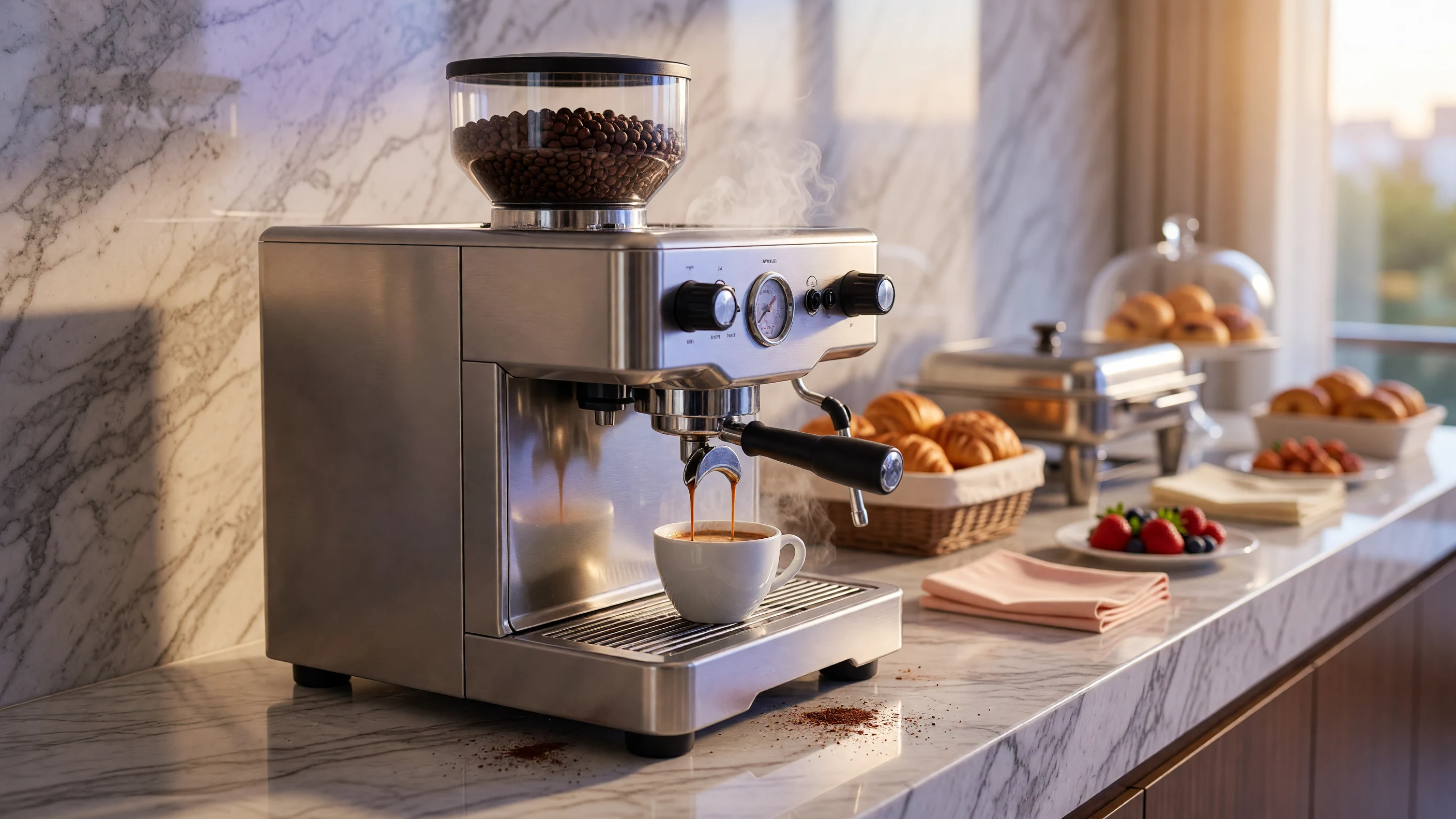
Quick answer: An espresso machine with coffee grinder hardware built in — technically, a semi-automatic espresso machine with a built-in conical burr grinder — is the right spec wherever fresh-ground espresso should be served without buying and housing a separate grinder: café counters, restaurants, hotel breakfast stations, lounges, guest rooms and suites, bakery cafés. Three things decide success: the grinder engineering (anti-clog, anti-static, grind stability), the extraction platform behind it, and whether the factory tests and tunes the grinder rather than just bolting one in.
I've spent more than 20 years building espresso machines in Foshan, China — first running the coffee machine division of one of China's largest ODM groups, then founding Hardshell. Grinder-equipped machines are one of our main lines: 15 espresso-with-grinder models and 11 three-in-one models with an automatic milk system. Here is what I would check before buying them for a venue.
What an Espresso Machine with a Coffee Grinder Actually Is
The category goes by several names on spec sheets and marketplaces — espresso machine with grinder, espresso machine with a built-in grinder, grind and brew espresso machine, coffee machine with grinder. They all point at the same product: a semi-automatic espresso machine with a conical burr grinder inside the housing. The grinder doses fresh grounds; the operator locks in a portafilter and pulls the shot. It is not a bean-to-cup machine — there is no integrated tamper, and the puck is still prepared by hand.
The category exists because fresh-ground coffee has become the expectation, not the upgrade — and the combo delivers it without a second appliance, outlet, or training burden. "Espresso machine with grinder" is literally a phrase end users type into Amazon; hospitality buyers are following that demand. See the category on our espresso machine range page.
One scope note: built-in grinders here are conical burr systems. The 64 mm flat burr belongs to standalone professional grinders — a different tool, as the comparison below will show.
Where an Espresso Machine with a Coffee Grinder Works in a Hotel, Restaurant, or Café
The short version: anywhere fresh-ground espresso should be served without a barista station.
Café counters and coffee chains. Fresh-ground espresso is the core offer, and the built-in grinder removes a separate purchase, a second footprint, and part of the training burden.
Restaurants and bakery cafés. Espresso-based drinks join the menu without rebuilding the kitchen. One button pulls the shot; a steam wand — or an automatic milk system on the 3-in-1 models — covers cappuccino and latte.
Hotel breakfast stations and executive lounges. Consistency is the whole game across a service window: the same fresh espresso at 7 a.m. and at 10 a.m., in a stainless housing that looks right on the buffet.
Hotel guest rooms and suites. For properties positioning coffee as part of the room experience — executive floors, suites, serviced apartments — a compact grinder-equipped machine is a genuine premium amenity: whole beans in the hopper, fresh-ground espresso in the room, no separate grinder to buy and maintain across hundreds of rooms.
A note on volume. Speccing a high-volume specialty café bar? Step up to the 58 mm prosumer platform with a built-in grinder (our CM 1610/1612) — and read the next section first.
Built-In Grinder vs. Separate Grinder: The Real Trade-Offs
This is the first real decision in the category, and it should be made on workflow, not brochure photos.
| Built-in conical burr (combo machine) | Separate grinder + espresso machine | |
|---|---|---|
| Counter footprint | One appliance, one outlet | Two appliances, two outlets |
| Workflow & skill | Lowest; grind, lock, pull | Higher; dialing in is a skill |
| Equipment cost | One purchase — the grinder comes inside | Machine plus a capable grinder on top |
| Grind-quality ceiling | Excellent for espresso service at moderate volume | Highest — a 64 mm flat burr gives more range and headroom |
| Cleaning & service | One unit to maintain; engineered anti-clog and anti-static | Two units; the grinder can be swapped or serviced alone |
| Best fit | Restaurants, hotels, bakery cafés, offices, retail shelves | High-volume specialty café bars |
Our rule of thumb: if volume is moderate and staff are not trained baristas, the built-in conical burr wins on consistency and simplicity. If grind range and throughput are the craft, pair a 58 mm machine with a standalone 64 mm flat burr — our coffee grinder line exists for exactly that pairing, and our burr grinder selection guide goes deeper.
What to Check Before You Order an Espresso Machine with Grinder: A Factory Checklist
Here is what two decades on the factory side teach you: in this category, the grinder is half the product, and it fails in ways a coffee-only machine never sees. The complaints that come back are rarely "the pump died." They are "the grinder stopped feeding," "there is coffee dust all over the counter," and — the subtle one — "the espresso was great for three months and then went weak." All three are grinder problems, and all three pass a bench test with flying colors. Vet the grinder and you have vetted the machine.
1. Anti-clog engineering. Ground coffee is hygroscopic: ship into a humid spring market, add an oily dark roast, and grounds cake inside the powder channel until the chute bridges. Ask whether the channel is the factory's own geometry on its own tooling — ours is, shaped so grounds fall instead of cling — and whether anti-clog testing uses humidified beans. Bench tests with dry showroom beans pass units that fail in the field.
2. Static control. Grinding charges coffee particles, and static throws fine powder onto the counter — the "flying powder" complaint — while making grounds cling to channel walls where moisture finishes the job. Our answer is a dual negative-ion module that neutralizes the charge at the chute exit. A supplier with no answer to static has an accessory, not engineering.
3. Grind stability over time. On a cheap grinder the burr set wears or shifts, the grind drifts coarse after about six months, and the machine that pulled a rich shot in January pours pale and fast by summer. The customer blames the pump; it is almost never the pump. Ask how burr sets are checked so today's setting is still the setting a year from now.
4. The extraction platform. A thermoblock heats instantly, preheats fast, serves continuous cups, and stores no water to scale. On pressure: 15 vs 20 bar is largely a market label — extraction happens around 9 bar at the puck. On the group: a 58 mm basket is shallower, with a shorter extraction path — fuller extraction, better crema — but demands grind uniformity and tamp discipline, which is why 58 mm marks the professional tier. An Italian ULKA pump is a documented option at about +$2.5 per unit.
5. The milk system, if you need one. The complaint that killed competing machines in the field was milk-tank clogging. Our third-generation milk system survived months of deliberate no-cleaning torture testing without a single blockage — ask any supplier what their version of that test is.
6. Market-fit tuning. Regional tuning is standard factory practice: coarser grinds and 50–60 ml cups for the US (a drip-coffee palate), ~30 ml shots for Southern Europe, crema priority in the Middle East. Grind dosage per shot is programmable from the panel — documented work includes moving a 30–60 ml double-shot platform to the 150–350 ml Americano a Gulf market actually drinks, by changing panel wording, water-out time, and grinder dosage in one firmware pass.
7. Certifications and voltage. Europe: CE (LVD + EMC), ErP, food-contact evidence such as LFGB. North America: UL or ETL — CE alone does not open that market; ETL runs roughly half the cost and 2–4 weeks against UL's 4–8. UK: UKCA. Russia/EAEU: EAC. Saudi Arabia: SABER, a product certificate plus a per-shipment certificate, neither issuable after arrival. Dual voltage exists across the line, but switching between 120 V and 220–240 V is a re-spec, not a sticker change. Our certifications page maps this by market.
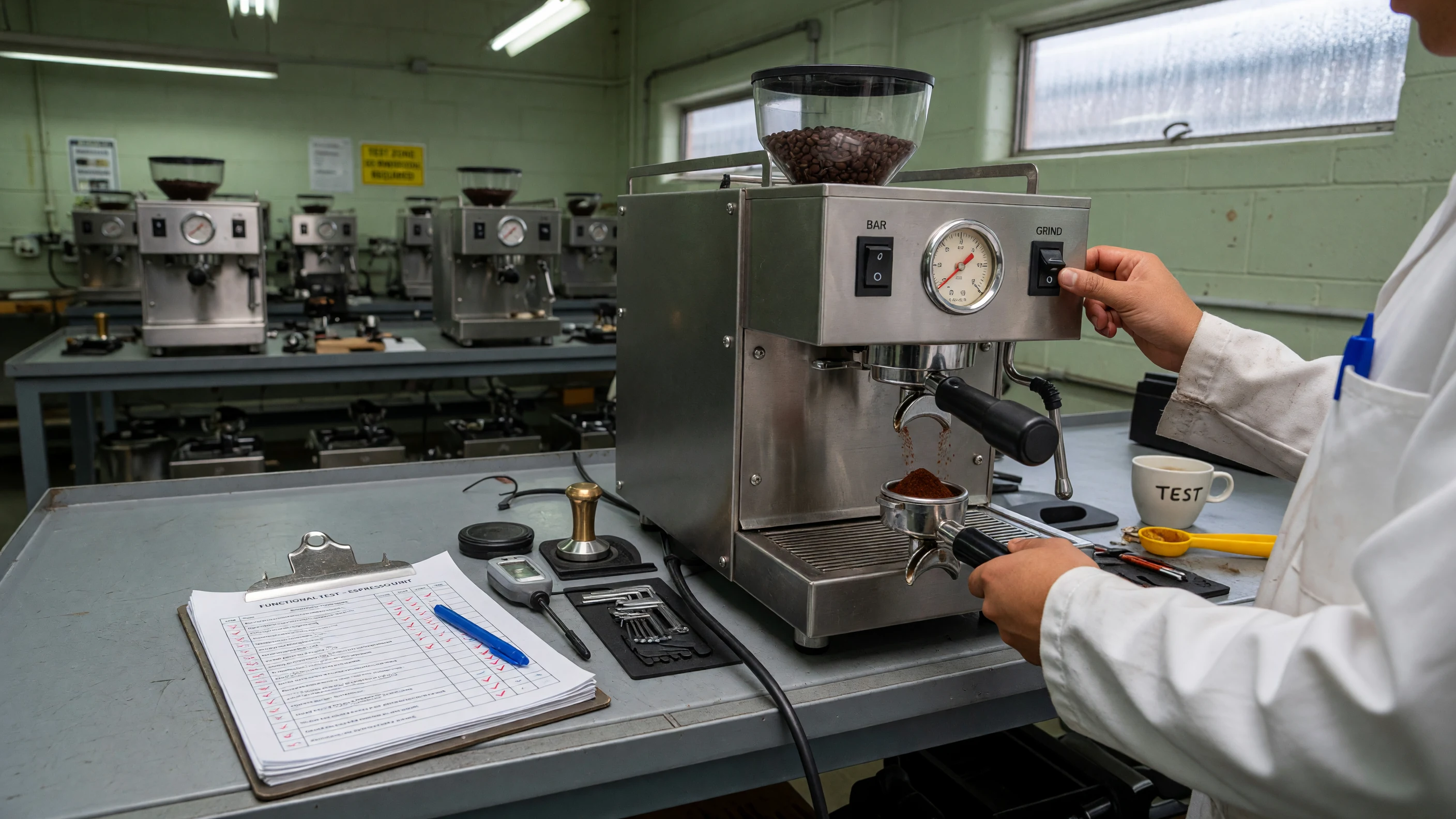
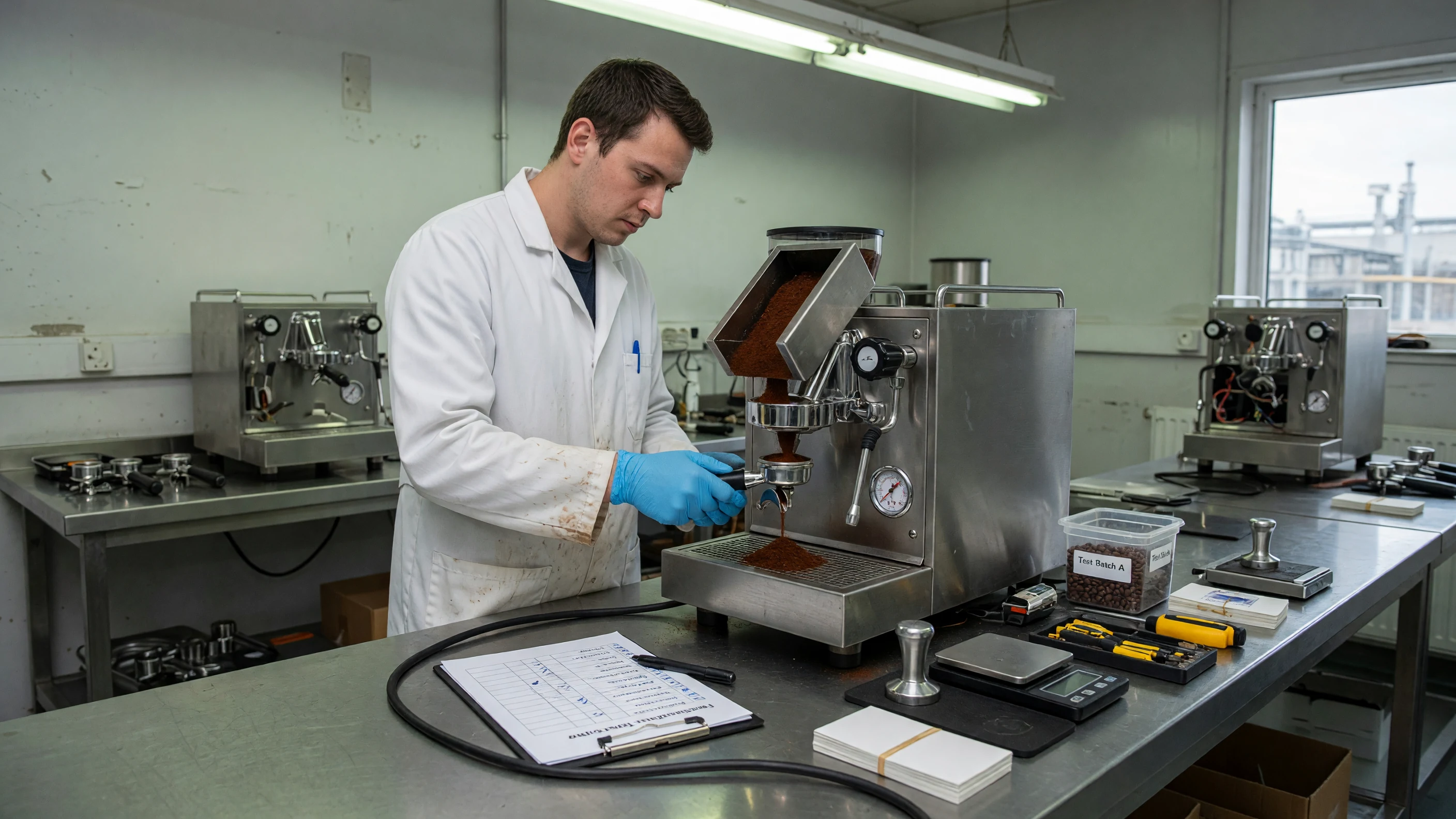
8. QC and after-sales numbers. Five gates — SQE, IQC, PQC, QA, FQC — and every unit runs a real grind-and-brew functional test: beans in, grind, extract single and double, steam, cold brew where fitted. Water-path integrity is tested at roughly twice working pressure — a 20-bar machine pushed to 30–40 bar for about 30 seconds, any drop rejects the unit — under a zero-leak rule. Life references: about 6,000 cups on the machine, 15,000-plus on the pump. That system holds our outgoing lots at a 99% pass rate against an industry average our CEO estimates at 85–90%. After the sale: a one-year warranty with parts and courier covered, and a committed 2–3% defect band. Details on our quality page and grinder supplier guide.
Matching the Machine to Your Venue
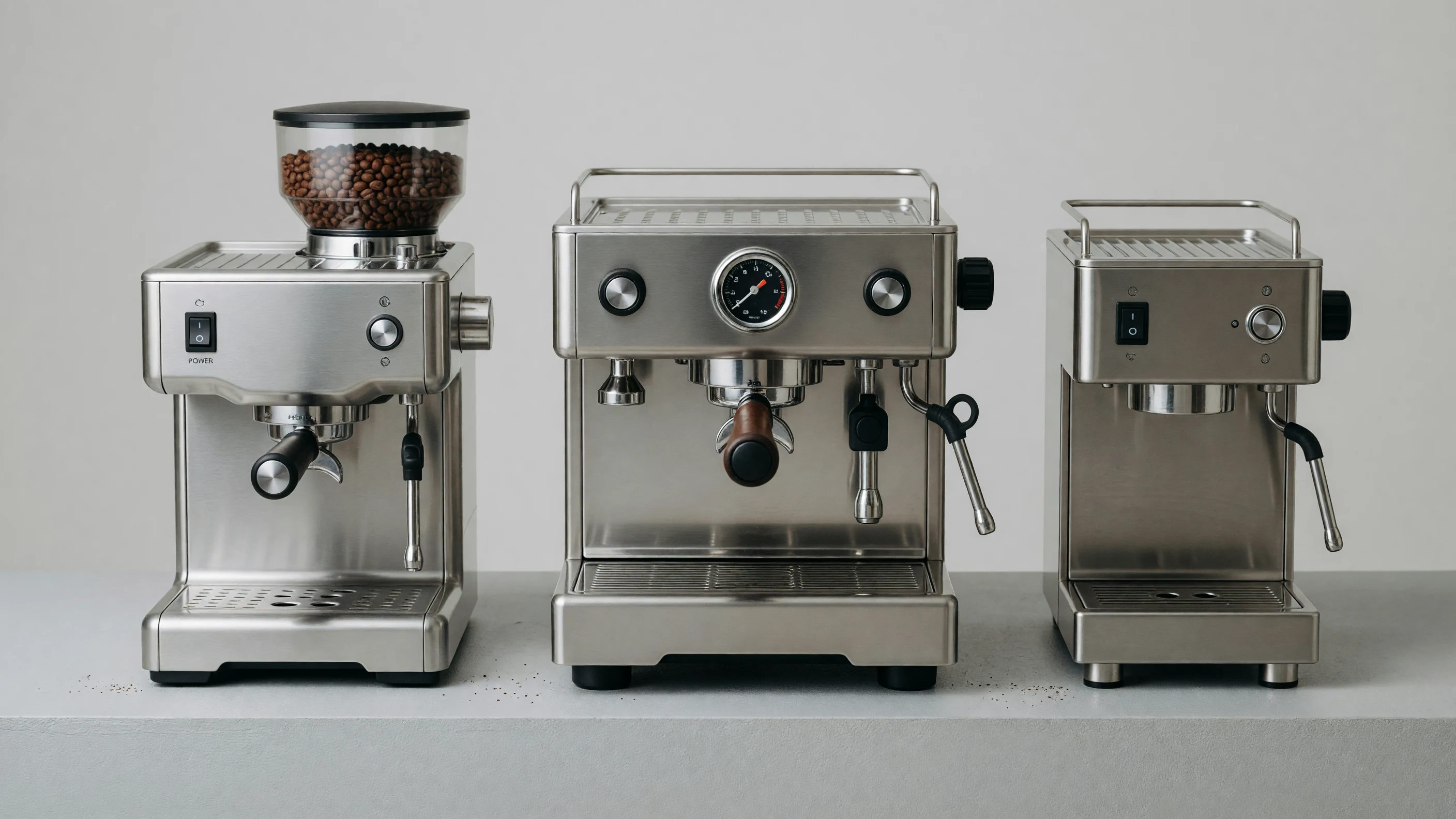
Coffee shops and chains. The 58 mm prosumer platform with a built-in grinder — our CM 1610/1612, with a 20-bar ULKA pump, dual or triple thermoblocks, a flow meter, and a 160 g bean box — is built for this. A representative pattern from our order book: a Gulf-region supplier serving coffee shops and restaurants built its line around a commercial unit and a grinder-equipped prosumer model, and we answered the rush-hour question with a camera, not a brochure — an Americano and a cappuccino in two to three minutes each.
Restaurants, hotels, and bakery cafés. The grinder-equipped series (CM 1600–1629: 15/20 bar, conical burr, full stainless housing, 1.8 L tank, 110 g bean box, roughly 281 × 248 × 373 mm, 760 pcs per 20GP container) covers breakfast stations, lounges, and guest-room amenity programs; the 3-in-1 platform adds a 330 ml automatic milk tank for one-button cappuccino and latte.
On commercial terms, for reference: MOQ is commonly 1,000 pcs or one 20GP container — 500 on 3-in-1 platforms, 200–300 on high-value machines. FOB pricing across our catalogue runs about $25–165, with the grinder 3-in-1 band around $75–80. Lead time is roughly 45 days, about 30 for urgent orders; payment is 30% deposit, 70% before shipment or against B/L, TT or LC; a first-deal sample fee is usually refunded after mass production. One honest note: we price mid-to-high and are the wrong shortlist if the only metric is the cheapest unit — buyers report our return rates at roughly half of what they saw from previous suppliers, and that total-cost math is the actual argument. The OEM/ODM page covers sampling and customization; our case studies show the track record.
FAQ
Is an espresso machine with a built-in grinder as good as a separate grinder setup?
For moderate volume and non-specialist staff, yes — on consistency, footprint, and total cost. A separate 64 mm flat burr wins on grind-range headroom and throughput. Choose on workflow, not brochure photos.
Is a 20-bar espresso machine with a coffee grinder better than a 15-bar one?
No. Extraction happens around 9 bar at the puck; the 15 vs 20 bar difference is a market-label preference, not extraction physics. Buy the grinder engineering and the QC system, not the bar number.
Can the machine be tuned to my market's taste?
Yes. Grind dosage, brew volume, and panel wording are programmable in firmware — we have retuned a 30–60 ml double-shot platform to pour a 150–350 ml Americano, and regional grind calibration is standard practice.
How much cleaning does a grinder-equipped machine need daily?
A daily rinse of the milk system if fitted, a wipe of the grounds path, and descaling when the machine prompts. The anti-clog channel and anti-static module exist to keep that burden low.
Conclusion
An espresso machine with a coffee grinder succeeds or fails on the grinder. The category fits anywhere fresh-ground espresso should be served without a separate grinder — but only when the grinder is engineered against clogging and static, the burrs hold their setting, and the factory tests every unit as a grinder and as a machine. Vet the grinder, then match the platform to the venue.
If you are speccing a line, talk to our OEM/ODM team, browse the With Grinder series on our espresso machine range, or book a factory tour or live video audit. We will tell you straight whether your brief fits our line.