
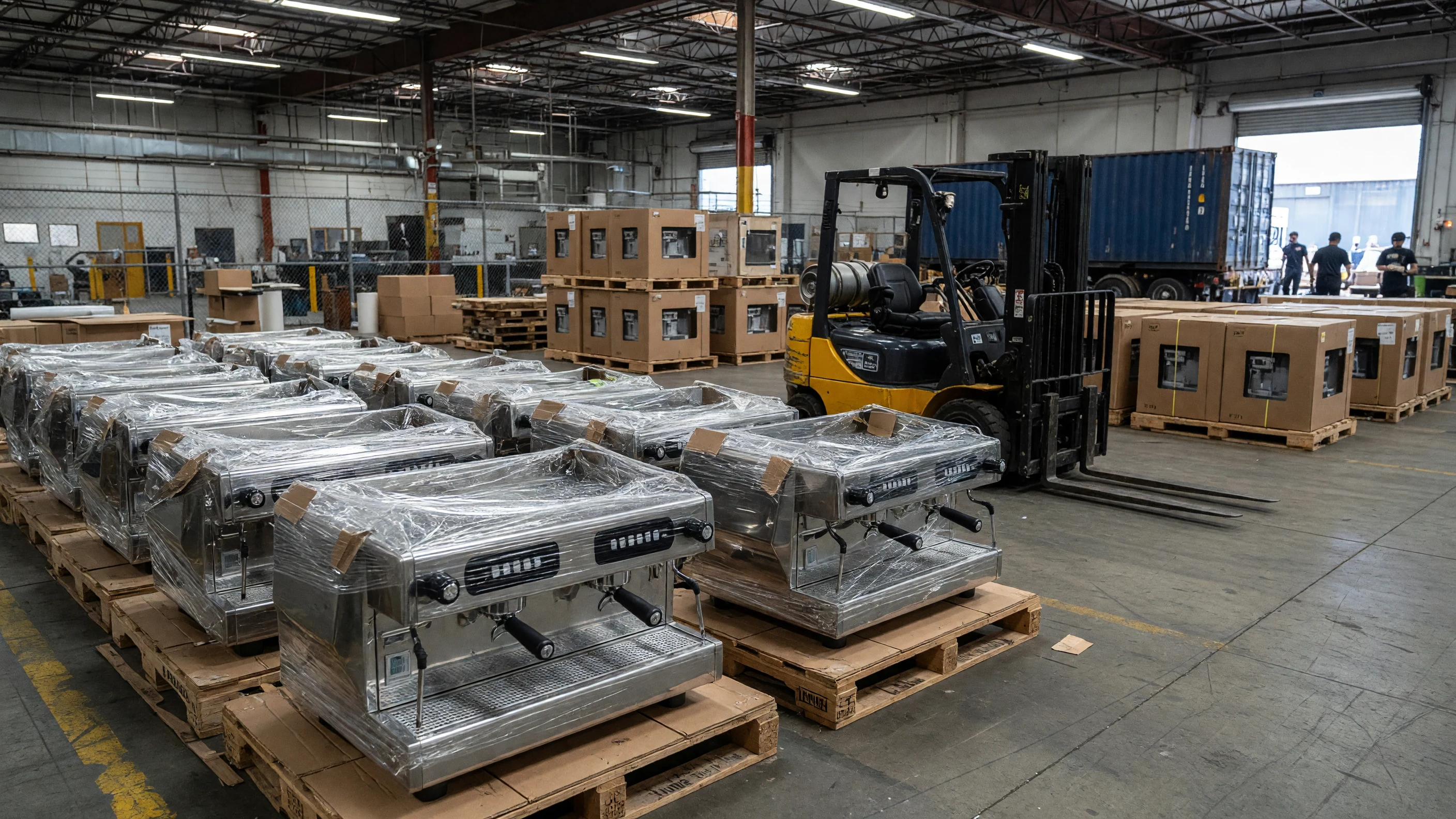
What "wholesale" actually means when you're buying espresso machines for hotel rooms, a café counter, or a chain of restaurant accounts — and how to pick the right machine class before you ask for a quote.
Two very different buyers type the same three words into Google. One is a hotel owner who needs 300 units for guest rooms before a renovation deadline. The other is a hospitality equipment distributor filling a container across four restaurant accounts with different budgets. Both search "coffee machine wholesale," and both get generic results.
They usually don't — not because they're inexperienced, but because coffee machine wholesale runs on its own mechanics: FOB pricing tied to a specific model number, MOQs that vary by machine class, and a catalogue spanning a $25 entry unit and a $165 stainless commercial platform. Buying wholesale starts with understanding that structure, then matching a machine class to where it will actually sit — a hotel nightstand is not a coffee shop counter, and a coffee shop counter is not a 200-cover breakfast service.
I've spent close to 20 years on the manufacturing side of espresso machines — running coffee machine programs for a large Guangdong ODM group, then leading new-product development at Hardshell. This guide covers what a wholesale order involves, how to match machine class to project, and how to vet a supplier before you commit.
What Coffee Machine Wholesale Really Means for B2B Buyers
A wholesale coffee machine order starts with a model number, not a price list. Factories quote FOB (or EXW) per specific model, because pricing depends on the exact configuration — pump type, boiler setup, screen, milk system — not a generic "espresso machine" category.
Minimum order quantities follow the same logic: they vary by product class, not one blanket number. Standard semi-automatic models commonly run a minimum in the 500–1,000 unit range, while larger or higher-value platforms — including 3-in-1 machines with a grinder and milk tank — often drop to somewhere between 200 and 500 units. If your first order doesn't clear the threshold on one model, most factories will let you combine two or three SKUs into a single 20-foot container, typically at a modest price premium of around 5% for the mixed-model flexibility.
Sampling also works differently from a retail purchase: a factory-direct order usually asks you to cover the sample at roughly 1.5x the quoted price plus courier, then deducts that cost from your balance payment on the first production order — so you effectively only pay courier in the end. That trips up a lot of first-time buyers who assume "free sample" means no cost at all.
Once you understand the FOB/MOQ structure, the real work is choosing the right machine class for your project — which is where most buyers go wrong.
Match the Machine Class to Where It Will Actually Sit
The single biggest mistake in coffee machine wholesale buying is treating "espresso machine" as one category. A hotel guest room, a lobby breakfast counter, and a 200-cover restaurant kitchen each pull toward a different machine class — pick the wrong one and it shows up later as maintenance calls, not a purchase-order problem.
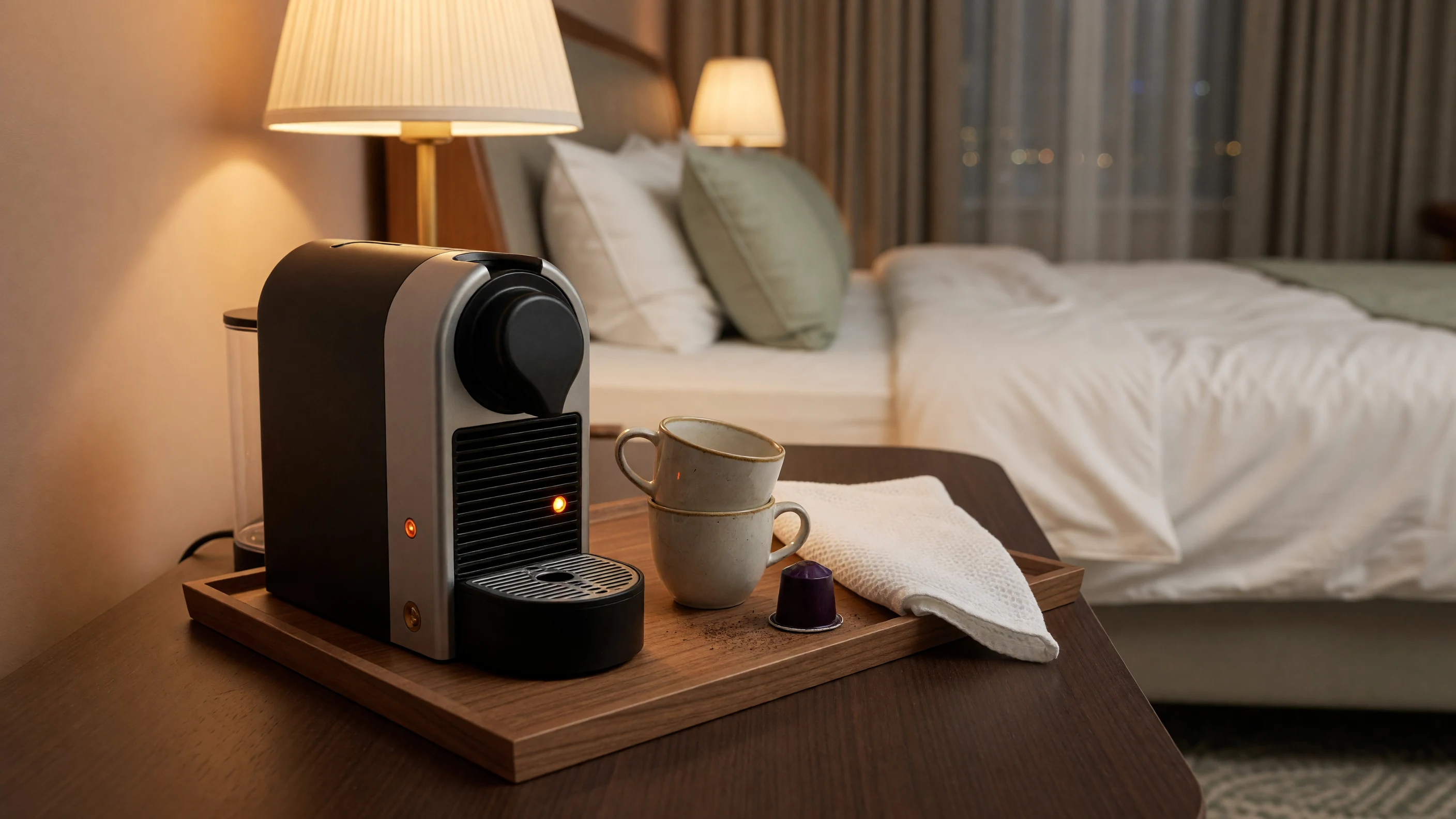
Guest rooms and in-room units need low-maintenance design more than brewing sophistication. Housekeeping won't deep-clean a machine every day, so anything that traps milk residue or ground coffee in a hard-to-reach channel becomes a recurring service ticket across every room. Multi-format capsule machines — compatible with Nespresso-style pods, DG capsules, ESE pods, or ground coffee in one unit — are a common fit here because they sidestep grinder and milk-tank upkeep entirely. If a hotel wants milk-based drinks in upgraded rooms instead, milk-tank design matters most: a poorly designed milk channel left uncleaned for a week in an unattended room will clog, and once it clogs the machine is dead until a technician gets to it. Ask any supplier what their milk-tank design does to prevent that — see our patented clog-free milk system for one engineered fix.
Lobby counters and breakfast buffets sit in a different use pattern — visible to guests, used in short bursts, expected to look presentable rather than industrial. 3-in-1 machines with a built-in grinder and automatic milk frothing cover espresso, cappuccino, and latte from one button, fitting a buffet attendant who isn't a trained barista. High-end wide or slim-body models with a colour touch panel tend to read better at a counter than a stripped-down classic model, even when brewing performance is similar.
High-traffic restaurant, café-chain, or hotel F&B outlets need a different spec entirely: enough boiler capacity and pump pressure to pull an espresso and steam milk back-to-back without a recovery lag during a rush. A commercial dual-pump, triple-boiler platform (our CM1678 is built this way) is designed for exactly that overlap — but one machine rarely covers every account in a wholesale order, which the next section explains.
| Where it sits | Priority spec | Representative machine class |
|---|---|---|
| Hotel guest room | Low maintenance, minimal cleaning | Multi-format capsule/pod machine or compact semi-automatic |
| Lobby / breakfast counter | One-button milk drinks, presentable design | 3-in-1 with automatic milk frothing, high-end wide/slim body |
| High-traffic F&B outlet | Recovery speed under back-to-back orders | Commercial dual-pump, multi-boiler platform |
Our full espresso machine lineup breaks these classes down by series if you want to see the spread before requesting quotes.
How to Vet a Wholesale Coffee Machine Supplier Before You Commit
Once you know the machine class you need, the harder question is whether the factory quoting it can deliver at volume. A few checks catch most of the risk before you wire a deposit.
Start with certifications for your destination market — this is where wholesale orders most often stall mid-production. Europe needs CE; North America needs ETL or UL; Saudi Arabia requires SASO/SABER; Russia and the wider EAEU need EAC; the UK needs UKCA; and GCC markets generally recognize the shared G-Mark. Ask which certifications the factory already holds for the exact model versus which need to be newly applied for — that gap can add weeks to a timeline you didn't plan for.
Lead time is the next check. Standard production commonly runs 40–45 days from order confirmation, with a faster 25–30 day option only when a factory confirms open capacity — treat a blanket "we can always rush it" answer with skepticism, and ask for the current schedule instead.
Quality process matters more in a wholesale order than a single purchase, because a defect invisible in one unit becomes visible across a few hundred. Ask whether incoming materials, in-process assembly, and finished units go through separate inspection stages, and whether units carry a batch code traceable to a production date and material lot. Our own 5-stage quality control system documents this end-to-end.
Finally, check how flexible the OEM/ODM side is beyond swapping a logo. A useful example: a hospitality customer once needed a one-button Americano instead of a standard double-shot espresso output — the fix was adjusting the panel's display wording and lengthening the water-flow time to hit the 150–350ml pour a real Americano needs, rather than redesigning the machine. That kind of panel- and dosage-level adjustment is a reasonable ask of any factory quoting your order. Our OEM/ODM program covers what's typically adjustable versus what requires new tooling. For how factory-direct sourcing compares to a trading company or reselling an existing brand, see our breakdown of coffee machine distributors, and our red flags checklist for warning signs worth checking before any deposit.
A Wholesale Scenario Worth Copying: One Order, Multiple Accounts
One project that illustrates this well involved a Middle East hospitality-equipment distributor supplying espresso machines to coffee shops and restaurants across several accounts — a classic wholesale buyer sourcing for many end customers rather than one retail brand. Their brief: a commercial-grade machine that could keep up during breakfast and dinner rush, at a price point that still let them offer a second, more budget-friendly model to smaller, price-sensitive accounts.
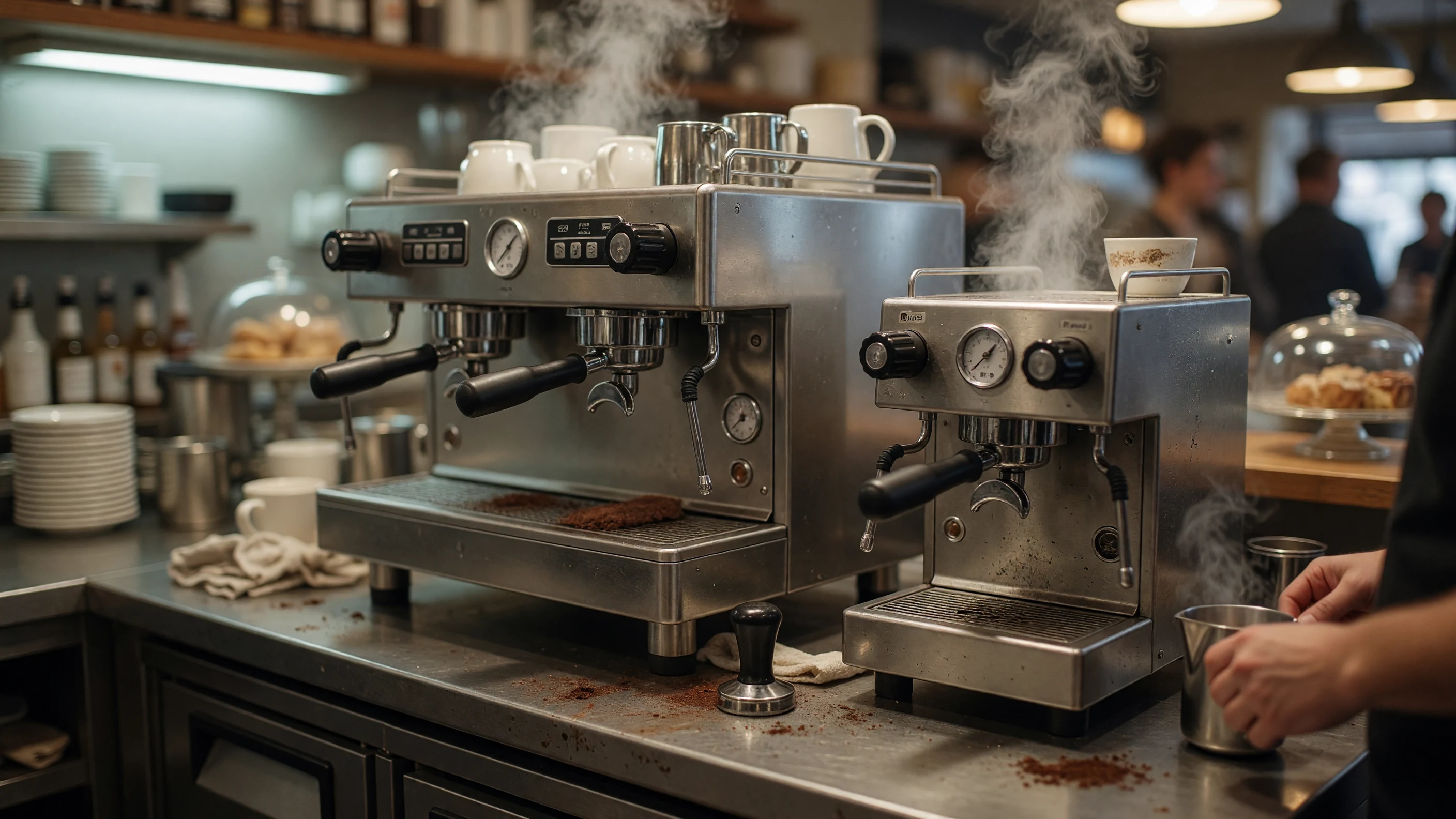
Rather than just quoting the largest machine in the catalogue, we proposed two side by side: a commercial dual-pump, triple-boiler unit for high-traffic venues, and a companion model pairing an Italian ULKA pump with dual thermal blocks for a comparable brew standard at a noticeably lower FOB cost. To settle the "will it keep up" question, we filmed the full brew cycle on both — an Americano and a cappuccino, start to finish, about 2–3 minutes per order — showing how a second unit covers a peak-hour spike without a capital-heavy upgrade.
The distributor placed orders across both models to cover different account tiers, and that same demo video ended up doubling as their own sales material with new accounts. It's a good reminder that a wholesale coffee machine order is rarely about finding one "best" machine — it's about giving the buyer a right-sized range they can resell into different budgets without diluting quality or after-sales support.
FAQ
What is a typical MOQ for coffee machine wholesale orders?
It depends on the machine class. Standard semi-automatic models commonly run 500–1,000 units per model, while larger or higher-value platforms — including 3-in-1 machines with a grinder and milk tank — often drop to 200–500 units. Combining two or three models into one container is common when a single SKU doesn't hit the threshold, usually at a modest price premium of around 5%.
How much does a wholesale coffee machine cost per unit (FOB)?
It depends on configuration. Across a typical factory catalogue, FOB pricing spans roughly $25 for entry-level plastic-bodied units up to $165 for full-stainless commercial platforms with a grinder and milk system. Always request a quote against a specific model number rather than a category.
Can I mix different coffee machine models in one wholesale order?
Usually yes. If one model doesn't clear the minimum on its own, most factories let you combine several SKUs to fill a container — for example, two or three models at 200–300 units each — typically at a small price premium for the added flexibility.
What certifications does a wholesale coffee machine need for my market?
It depends on the destination: Europe requires CE; North America requires ETL or UL; Saudi Arabia requires SASO/SABER; Russia and the EAEU require EAC; the UK requires UKCA; and GCC countries generally recognize the shared G-Mark. Confirm which certifications the specific model already holds before committing to a launch date.
Conclusion
Coffee machine wholesale buying comes down to three things: understanding how FOB pricing and MOQ work per model, matching the machine class to where it will sit, and vetting a supplier's certifications, lead time, and quality process before volume is on the line. Get those three right, and the rest of the order is mostly logistics.
If you're sourcing for a hotel renovation, a distributor account list, or a multi-property rollout, talk to our team about your wholesale order — we can walk through which machine class fits each part of your project before you request formal quotes.