
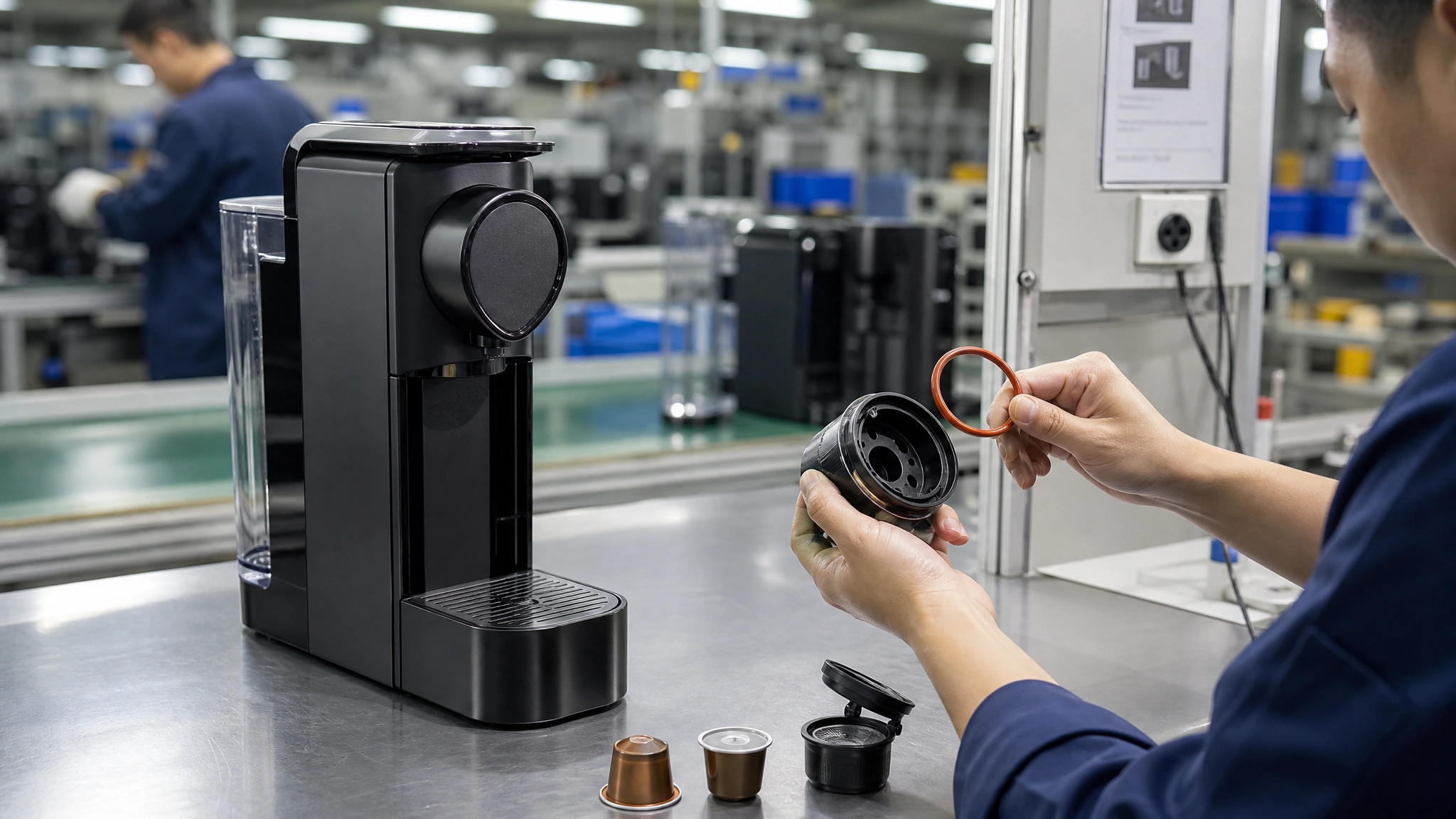
Quick answer: A china coffee machine factory can print “Nespresso compatible” on a carton in an afternoon. The harder question is whether the brew head still seals after the user swaps adapters. In this industry, that phrase almost always means a third-party machine that can brew Original-style capsules. It does not mean Nestlé signed off on the design. If you are buying OEM, ask for multi-format sealing evidence — not a logo mockup.
I've spent more than 20 years on the manufacturing side of this category, first running the coffee machine division of a large Chinese ODM group and then founding Hardshell in Foshan. We are an espresso OEM/ODM first. We also build one 4-in-1 capsule platform. That split matters. Buyers searching for nespresso compatible coffee machine manufacturers in china often treat a capsule clone shop and an espresso plant with one multi-pod SKU as the same supplier type. They are not.
What “Nespresso-Compatible” Actually Means in Chinese Manufacturing
Most Chinese OEM platforms are not official Nespresso products. They are third-party machines built for Original-style capsules, and many also claim DG capsules, ESE pods, and a powder adapter. That 4-in-1 line looks efficient in a catalog. On the bench, it is four brew faces sharing one pump and one thermoblock.
The pump rating is the easy specification. A 15-bar or 20-bar label is mostly a market preference — buyers in the Middle East and Russia often want 20-bar printing — and it does not, by itself, make a better capsule shot. What decides the cup is the seal stack: the ring, the valve cavity, and how much compression remains after the user has swapped adapters a few dozen times.
Our documented capsule platform is CM 1813: 20-bar pump, 1350 W, 0.6 L tank, 120 V and 220–240 V versions, touch panel, hot and cold brew, ErP auto shut-off, about 338 × 115 × 303 mm. It can brew Original-style Nespresso capsules, DG capsules, ESE pods, and espresso powder. That is one catalogue model against more than 100 espresso and grinder SKUs. If a factory talks as if it runs a full capsule line, ask to see the other models.
Keep the trademark in its lane. Descriptive compatibility is a technical claim. Putting a Nestlé mark on the carton is a legal one.
How to Shortlist Pod Compatible Coffee Machine Manufacturers in China
You do not need a ranked list of factories. You need a brief, then five checks that survive a video audit.
1. Lock the brief before you request quotes. Target market, voltage, channel, first quantity, and single-format versus 4-in-1. A hotel pantry, a retail listing, and a café counter are not the same duty cycle. We see more capsule demand from Russia than from the Middle East, where the category is thin.
2. Ask what the factory actually is. A dedicated capsule house and an espresso plant with one multi-pod platform can both ship a workable machine. The first may quote lower and work from a shared tool. The second may already understand pressure and batch QC — and still have little capsule SKU depth. We sit in the second group.
3. Sample every claimed format. A unit that makes one clean Original-style cup is not finished. Ask for DG, ESE, and powder on the same serial, after the adapter has been swapped.
4. Write the OEM scope down. Logo, panel art, brew volume per format, color, packaging, firmware, ErP shut-off. On a mature platform, a sample is often about a week if you are only changing logo, art, and programs. A new housing tool is months and roughly six figures in RMB. After deposit, standard production here is about 40–45 days, plus about a week of FQC and a week to book the container.
5. Check commercial terms without inventing a price. Typical MOQ on a standard machine is 1,000 pcs or one 20-foot container. We have taken 500 on some 3-in-1 platforms when the account looks real. I will not publish a CM 1813 FOB. It is quoted per spec.
For the wider vetting sequence, use our China coffee machine factory checklist. The OEM/ODM page covers customization, sampling, and MOQ. If Europe or Russia is the destination, map CE plus ErP, or EAC, on the certifications page before you lock artwork.
What a China Coffee Machine Factory Should Test Before a Capsule Shipment
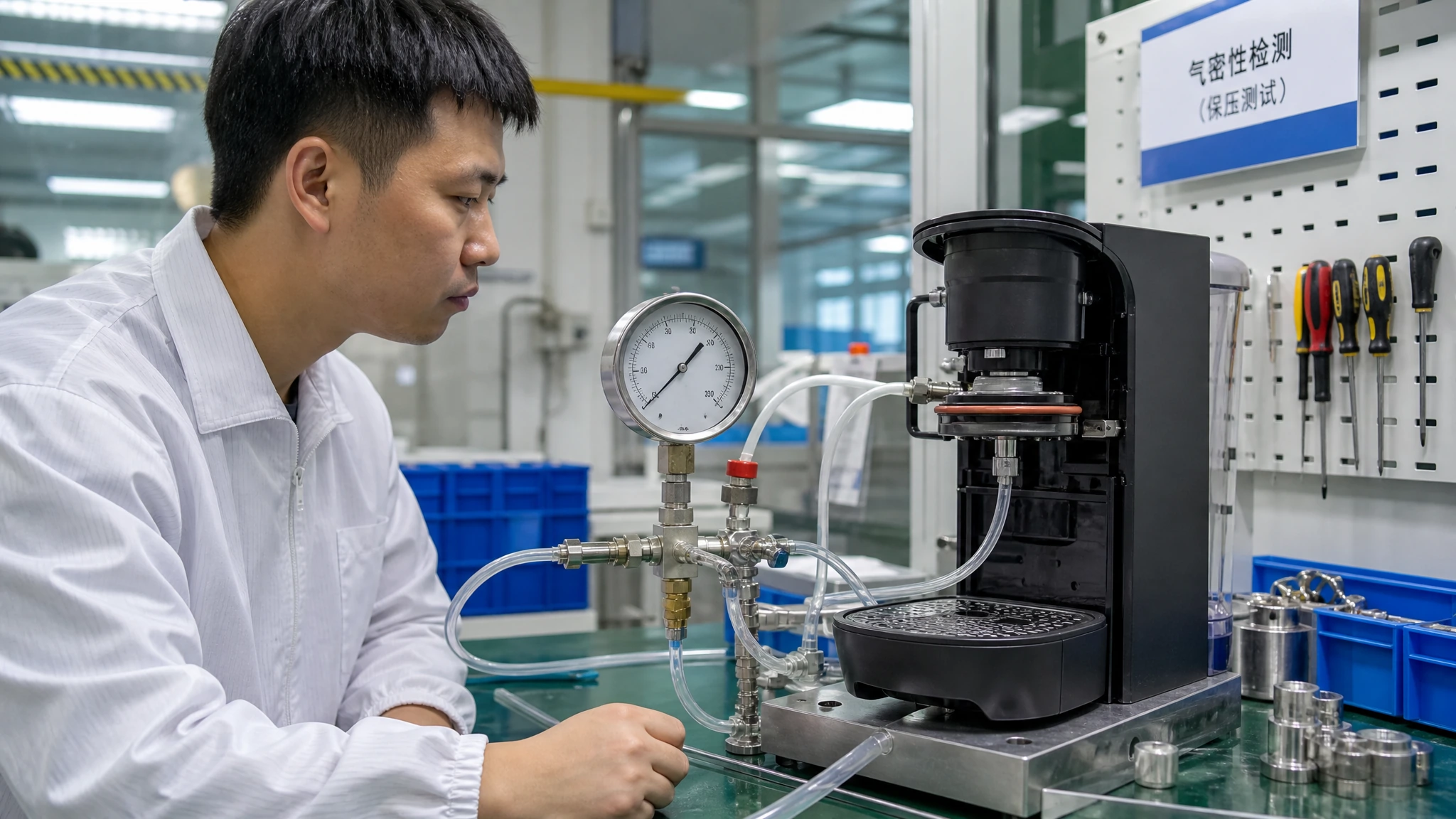
A hipot pass does not tell you much on a 4-in-1. The unit I worry about already made one clean Original-style cup, then started to weep at the brew head the first time we fitted a different adapter.
Incoming rings can sit inside the drawing and still relax after cycling, usually because a supplier nudged a valve cavity by a few tenths of a millimeter. Powder left on the brew face is an old espresso complaint; it arrives sooner here because the user is meant to change formats. If IQC misses the seal, finished-goods testing often misses it too. The leak shows up later, after the silicone has taken a set.
The fixes are unglamorous. Treat pump, valves, and seals as high-risk incoming. Water-path leak testing is a closed circuit at roughly twice working pressure: a 20-bar machine is pushed to about 30–40 bar and held for around 30 seconds. If the pressure drops, the seal is rejected. Functional testing has to cover all four brew modes. Every order still gets a short-life sample. In-house, we use about 6,000 cups as a whole-machine life reference and 15,000+ cups as the pump pass bar. Food-contact parts stay in stainless or qualified polymers. Finished units still go through five gates — SQE, IQC, PQC, QA, FQC — plus electrical safety, an internal leak check, and a transport drop sample.
Warranty on our side is one year on core function — thermoblock, pump, boiler-type assemblies — with replacement parts and courier covered when the fault is manufacturing. We commit to keeping the overall defect and return band around 2–3 percent. If a buyer only wants the cheapest clone number, this plant is the wrong shortlist.
See the five-checkpoint quality system for how those gates are written. The same sample-versus-bulk problems show up on espresso lines; the red-flag checklist still applies.
When a Capsule Program Is the Wrong Brief
Capsule and espresso are different categories. Buyers who hesitate between them are uncommon, and they should not be talked into the wrong platform just to fill a container.
Choose capsule when the end user has little time, will pay for pods, and does not want a portafilter ritual. Choose espresso when they want cheaper beans or powder, or they care about the manual process. If the program is a hotel breakfast line or a café that needs steam and a 58 mm group, start from the espresso machine range, not from a 0.6 L 4-in-1.
If the same brand later wants a portafilter line, that is still our main plant. Capsule is an adjacent OEM/ODM capability. Selling the wrong platform is how both sides lose a season.
FAQ
Are machines from Nespresso-compatible factories in China officially licensed?
Usually no. Unless a factory can show a real license, you are buying a third-party compatible machine. Descriptive compatibility is not Nestlé approval.
What should I test on a sample from pod compatible coffee machine manufacturers in China?
Every claimed format, on the same unit, after adapter swaps. Check leak hold, cup volume per format, and whether powder residue from the adapter ruins the next capsule seal. One clean Original-style shot is not a release.
What certifications are needed for European or North American capsule machines?
Europe: CE, ErP, and food-contact evidence such as LFGB. North America: UL or ETL — CE is not enough. Russia: EAC. Great Britain: UKCA is separate from CE. Ask for the exact model report, not a factory-wide poster.
What MOQ and lead time should I expect?
Often 1,000 pcs or one 20GP on a standard machine. A mature-platform sample is often about a week. Standard production after deposit is commonly about 40–45 days, plus FQC and booking. New tools change the calendar.
Conclusion
The question is not whether a china coffee machine factory can print a compatible claim. It is whether the seal stack, the leak test, and all four brew modes still hold after the adapter has been changed. Match the platform to the drinker first. Then audit incoming seals, closed-circuit leak hold, full-format function, and a warranty you can actually use.
If you are evaluating a multi-capsule OEM brief, talk to our OEM/ODM team or review the quality system. The product range shows where the 4-in-1 sits next to the espresso line — which is how it should be discussed.