
Introduction
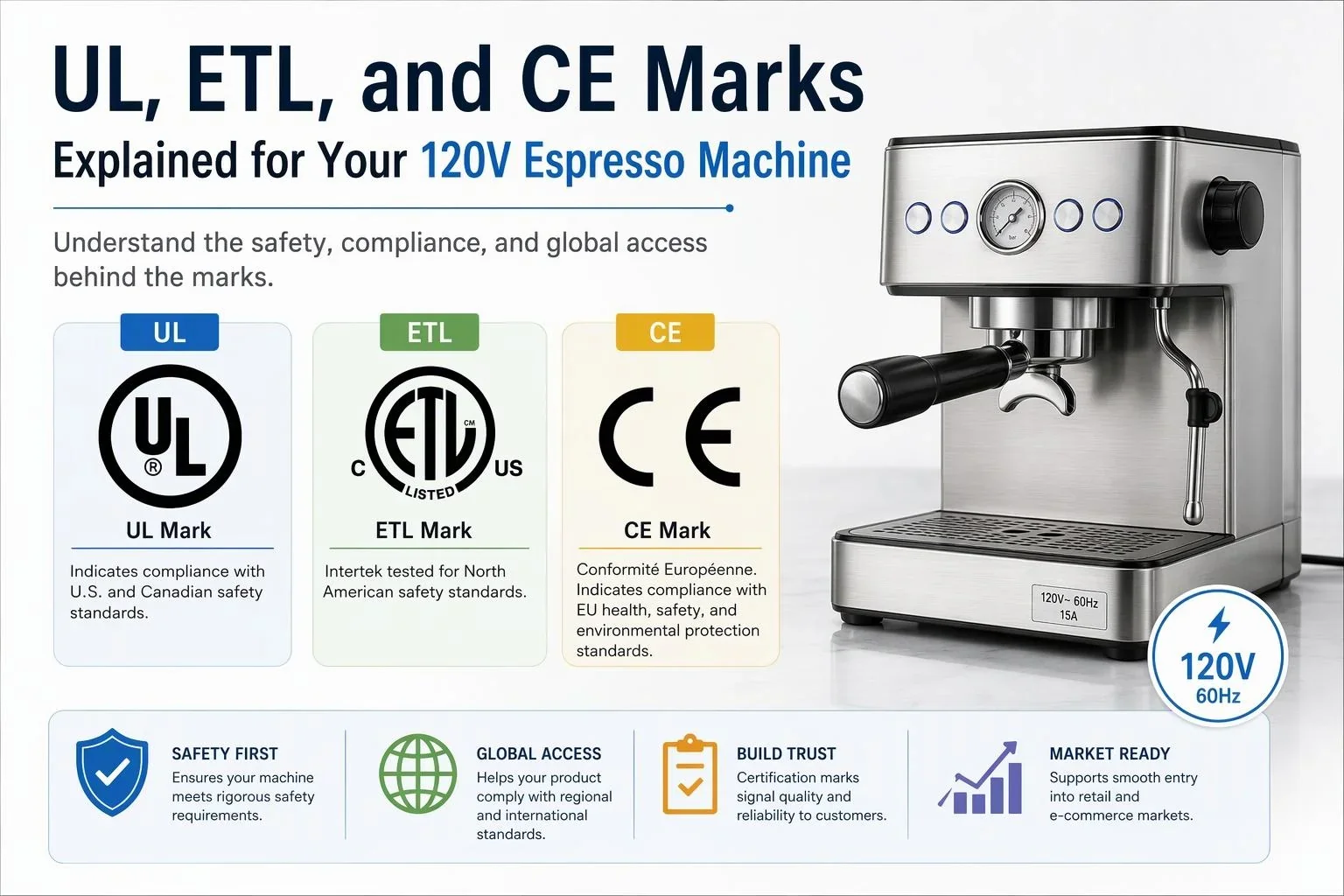
A 120V espresso machine sold on Amazon or into the EU carries two different kinds of paperwork, and sellers routinely confuse them. In the US, the mark on the rating label — UL, ETL, or another NRTL mark — is a certification issued by an OSHA-recognized testing laboratory against a specific product safety standard, and it is verifiable in that laboratory's public directory. In the EU, CE marking is not a certificate at all: it is the manufacturer's declaration that the product meets the applicable EU legislation, backed by a technical file and a signed Declaration of Conformity. OSHA states plainly that "the CE mark is unrelated to the requirements for product safety in the United States" — a CE-marked machine is not thereby acceptable for the US market, and a UL-listed machine is not thereby CE-compliant.
What actually gets a model accepted is proof that names that model. A UL certificate of compliance lists specific model designations — one real example, a UL certificate for an espresso coffee maker, covers "CM5411C-UL, CM8011-BLACK, CM8011-BLACK-CS" and nothing else. The same certificate states that it "does not provide authorization to apply the UL Mark" and that only products bearing the mark should be considered UL Certified. A generic PDF, a badge image lifted from a supplier's website, or a certificate for a sibling model does not transfer. When a marketplace or a retailer's compliance team asks for evidence, they are asking whether your model number appears in a live listing.
This guide gives you two working checklists — one for US directory verification, one for EU documentation — plus the reasoning behind each check, so you can audit a supplier's file before you commit to a purchase order and re-audit when the platform or the factory changes something.
US compliance essentials
US acceptance rests on one structural fact: OSHA recognizes private organizations as Nationally Recognized Testing Laboratories, and each NRTL certifies products only within a defined scope of test standards using its own registered mark. The mark is the evidence; the directory is where you confirm it.
NRTL marks: UL vs ETL
UL and ETL are both marks issued by organizations OSHA recognizes as Nationally Recognized Testing Laboratories, and OSHA's current list includes both UL LLC and Intertek Testing Services NA. The distinction that matters for a 120V espresso machine is not which mark looks more prestigious but whether the specific certifying body is recognized for the standard your machine was tested to. Each NRTL holds a defined scope of test standards, and OSHA states that a product is properly certified only when it carries that laboratory's registered mark, the certification covers a standard within the lab's recognized scope, and it was issued from a recognized site. Intertek describes the ETL Listed Mark as tested to the same product safety standards used by other certification bodies, with the difference being the laboratory rather than the standard. For a private-label seller, that means UL and ETL are functionally parallel routes to the same US acceptance, and the choice usually comes down to which laboratory your factory already works with and how quickly a listing can be added for your model.
Applicable US standards
The standard follows the intended use, not the wattage. UL 1082 covers "portable electric coffee makers, percolators, coffee urns, and other brewing-type appliances rated 120 V or less, for use in ordinary locations in accordance with the National Electrical Code, NFPA 70." That is the document behind a household 120V espresso machine — and the 120 V ceiling in its scope is why the voltage on your rating label is a compliance fact, not a marketing detail.
UL 197 covers commercial electric cooking appliances rated 600 V or less, including coffee makers intended for commercial kitchens and explicitly excluding "cooking appliances intended for household use." UL's own appliance guidance confirms the split: coffee makers are investigated under UL 1082 when marked household use and UL 197 when marked commercial use, and "the standards are not identical, each based on assumed conditions of use in the respective environments." A seller positioning a machine for café or office use should expect a UL 197 question; a household countertop unit should not be listed to UL 197 and presented as a home appliance.
Note also that a UL 1082 listing is not a federal legal requirement for a home appliance. The pressure comes from retailers, marketplaces, and insurers — which is precisely why the proof has to be model-specific rather than assumed.
Model-specific listing control
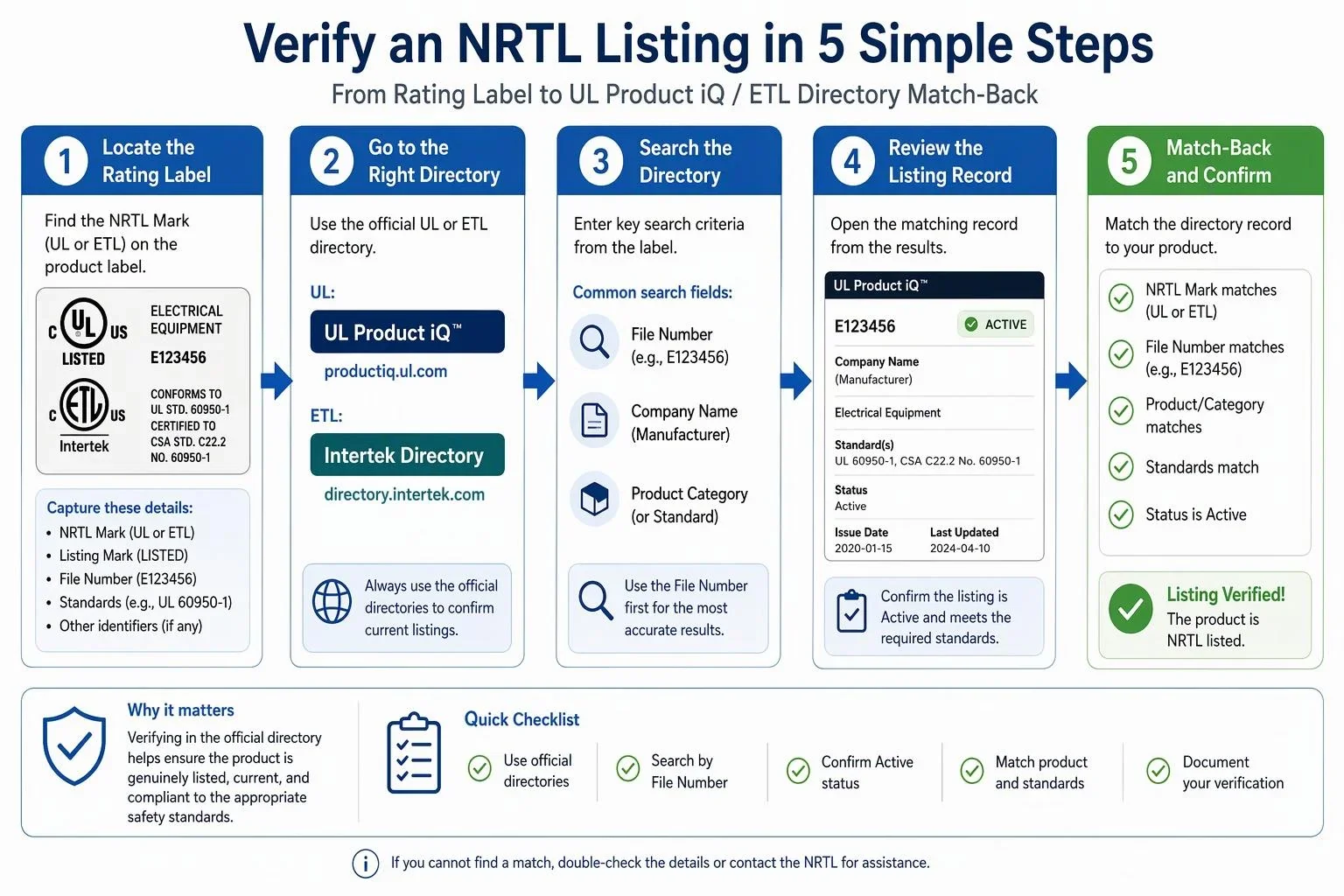
A listing is a record tied to a manufacturer, a file number, a category control number (CCN), and a set of model designations. Change any of those and the record no longer describes your product. Rebadging a factory platform with your brand, swapping a pump or heating element, or adding a model variant to the catalog does not automatically extend the listing — the certificate covers the models it names, and a new designation needs to be added by the certificate holder.
The certificate holder is usually the factory, not your brand. That is workable, but it means your evidence chain runs through a third party: you need the file number, the exact model string as it appears in the directory, and confirmation that the certificate is current. UL's own certificate language is explicit that only products bearing the mark are covered by its Follow-Up Services — the ongoing factory surveillance that keeps a listing valid between audits. A certificate dated two years ago tells you the design passed; it does not by itself tell you the units in your container were built under that surveillance.
EU CE framework
The EU framework inverts the US logic. There is no third-party mark to look up in a public directory; the manufacturer asserts conformity, and the burden of proof sits in documents you have to read.
Legislation scope
A mains-powered espresso machine falls under the Low Voltage Directive 2014/35/EU, applicable since 20 April 2016, which covers electrical equipment within defined voltage limits and names household appliances among its scope. It sets safety objectives rather than prescribing a single design; compliance is typically demonstrated by testing to harmonised standards, which for household coffee makers means the IEC 60335-2-15 family.
Other legislation can attach depending on the build: electromagnetic compatibility for the electronics, food-contact rules for anything the coffee touches, and materials rules for the plastics and seals. The European Commission's position is unambiguous on one point — CE marking "can only be affixed after testing the product and performing the conformity assessment procedure prescribed by the applicable EU harmonisation legislation," and "it is not acceptable for certificates to bear a CE marking." A test certificate with a CE logo printed on it is a category error, not stronger evidence.
DoC and technical file
The Declaration of Conformity is the document that legally carries the claim. It identifies the manufacturer, the product and model, the legislation complied with, any harmonised standards applied, and the authorised signatory — and it must be kept with the technical documentation, which exists "to prove the product meets essential requirements." The technical file typically includes design and construction information, circuit and component details, test reports, and the risk assessment behind the standards chosen.
For a private-label seller the practical question is who signs. If the DoC is issued by the factory, your brand is not the declaring party, and the model string on the DoC must still match the model you sell. A DoC naming a platform code that never appears on your packaging is a mismatch a customs officer or marketplace reviewer can find.
Responsible Person and CB Scheme
Under EU market-surveillance rules, a product placed on the EU market needs a responsible economic operator established in the EU — the "Responsible Person" — whose name and address appear on the product or packaging so authorities have someone to contact. For a brand importing from a Chinese factory, that role is normally filled by an EU-based importer, authorised representative, or fulfilment partner. It is an address-and-accountability requirement, not a testing one, and it is frequently the last item missing when a listing goes live.
The CB Scheme is a separate, voluntary layer. An IECEE CB test certificate and report for IEC 60335-2-15 can be used by certification bodies in participating countries to reduce repeat testing, and factories often hold one. It is useful evidence of the underlying safety testing and can shorten a UL or ETL project, but it is not an NRTL listing and it is not CE marking. Treat it as an input to certification, never as a substitute for the mark or the DoC.
Verification checklists
Both checks follow the same discipline: start from the physical rating label, then match outward to the record. Work from the unit or the pre-production sample, not from the supplier's slide deck.
US directory checks
- Photograph the rating label. Capture the mark, the file or control number, the model string, the voltage (120V), the frequency, and the wattage.
- Search UL Product iQ by file number or CCN, or the Intertek directory of listed products by manufacturer, model, or standard.
- Confirm four things match: the company holding the listing, the CCN or category description, the model designation, and the ratings. A file number that resolves to a different company, or a model string that differs by a suffix, is a failed check.
- Confirm the listing covers a complete appliance, not a component. A CCN describing a switch or a pump is not an espresso machine listing.
- Save a dated screenshot of the directory result with your purchase records, and re-check it before each production run.
A brochure, a website badge, or a PDF sent by a supplier should never be the only source. The directory is the source.
EU documentation checks
- Read the DoC for the legislation cited (2014/35/EU at minimum), the harmonised standards listed, the model designation, and a named signatory.
- Match the DoC model string to the rating label and to the model you list. Character-level mismatches are the most common defect.
- Confirm the technical file exists and is retrievable — not merely promised. Ask for the index and the test reports it references.
- Check the test reports name the same model and the same critical components (heating element, thermostat, pump, wiring) as the production unit.
- Verify the EU Responsible Person's name and address appear on the product or packaging, and that the entity has agreed to the role.
- Sanity-check the CE mark itself: correctly proportioned letters, with the inner curve of the "C" following a circle that meets the "E". Tightly overlapped or touching letters are a counterfeit signal, not a variant.
Pitfalls and re-verification
The recurring failure is scope drift. A certificate covers the models it names; a new colourway, a different pump, a revised control board, or a rebadged housing can each put your unit outside the listing or the DoC. Build a change-control rule: any BOM or model-designation change triggers a written question to the factory about whether the certification needs amending, and the answer goes in the file.
The second failure is treating one market's evidence as another's. A CE DoC does not satisfy a US directory check, and a UL listing does not satisfy EU requirements — OSHA says so directly about the CE mark. A third is stale evidence: listings lapse, certificates get superseded by revisions, and factories change certificate holders. Re-verify at each production run and before each new marketplace launch, and keep the dated screenshots. If a supplier cannot produce a directory match for your exact model, the honest position is that the model is not verified — and that is a question to resolve before the purchase order, not after the returns start.
Conclusion
The three marks answer three different questions, and none of them is answered by a PDF that does not name your model. A UL or ETL listing says an OSHA-recognized NRTL tested that specific product to a US safety standard and keeps auditing the factory that builds it. A CE mark says the manufacturer has declared the product meets the EU rules that apply to it, backed by a technical file and a Declaration of Conformity. A 120V machine is a US-market product; CE is what you need for the EU version of the same platform, not a substitute for the North American listing.
Two practical consequences follow. First, match the paperwork to the nameplate: the model number, electrical ratings and manufacturer on the label must appear in the certification record, whether you check it in UL Product iQ or the Intertek directory. Second, treat any change to the approved build as a compliance event. A new heating element, pump, wiring route, housing material or control board can fall outside the original listing, and a logo or color change is safe only after the certificate holder confirms it.
Before you list and before you scale, lock four things: a directory screenshot for each SKU with the search terms and date recorded; a signed DoC and technical file index for the EU variant; a written statement of who holds the certificate and who is authorized to apply the mark; and a change-control rule that routes every engineering revision back to the certification body. Get those in place and the compliance question stops being a launch risk. It becomes a fixed cost you can plan around — and a reason buyers trust the next SKU you put in front of them.