
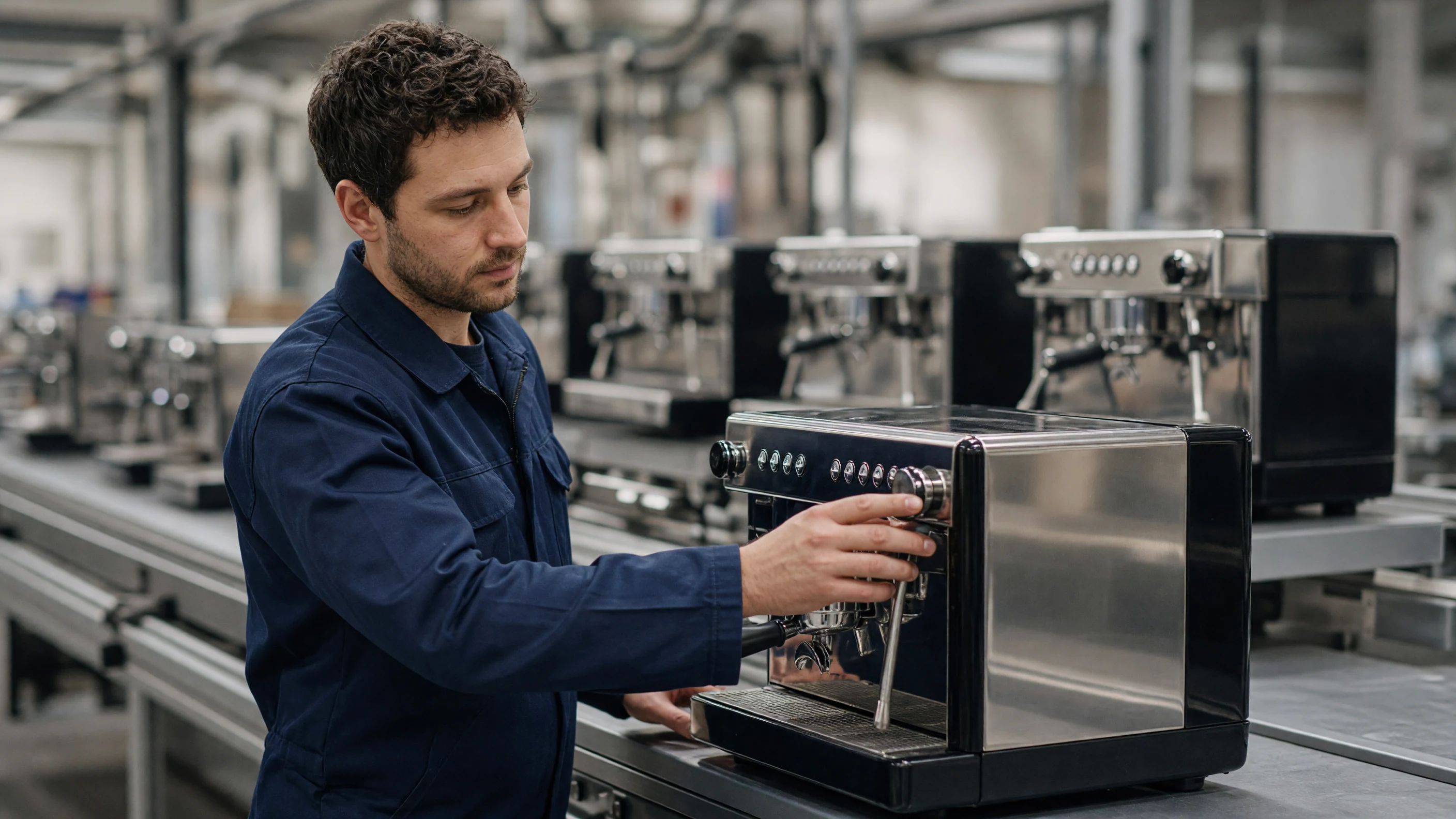
Choosing an espresso machine manufacturer comes down to five checks you can run before you sign a deposit: platform fit, quality evidence, tooling, capacity and MOQ, and sample and payment terms. The FOB price tells you the least about any of them. This guide walks through each check with production facts from our Foshan factory, for brand owners, importers, distributors, and hotel or café buyers.
Key Takeaways
- Define the platform before you request quotes: market, voltage, certifications, portafilter size, and boiler type.
- Ask for batch evidence, such as short-life test records and lot traceability, not only certificates.
- Sort every requested change into a program update or a new tooling job. Their costs and timelines differ a lot.
- Read MOQ as a container plan across models.
- Compare sample cost, deposit, and balance terms together.
What an Espresso Machine Manufacturer Actually Does
A manufacturer designs, tools, assembles, and tests the machine in its own facility. A trading company passes your order to a line it does not run. Both can use the same wording on a website, so ask three questions: who owns the molds, who runs the test lab, and who signs the QC report.
Mold ownership matters most after the first order. In our practice, a mold the customer pays for belongs to that customer, and the cost can be shared by written agreement. Get this in writing before you approve a sample.
OEM and ODM are different starting points. With OEM, you bring a design and the factory builds it. With ODM, you start from the factory's platform and adapt the shell, panel, or features. Our OEM vs ODM vs private label guide explains who owns what in each model.
Step 1: Define the Platform Before You Ask for a Quote
A factory can quote a machine only when the brief names a market, a voltage, and a price band. Our models support 230 V and 50 Hz, but certifications and pump choices change with the destination. Write down the target market, the certification list, and the target FOB before you contact any factory.
Let the market set the spec
Buyers in different markets ask for different things. Russian buyers usually decide on price. US buyers expect a stainless body and steady quality. Middle East buyers often prefer a larger body and a visible 20 bar figure on the panel, although a bar rating says less about the cup than many buyers assume. Use the market to narrow the platform, then check the numbers on the spec sheet.
Pump choice is one of those numbers. Our standard machines use a domestic pump. An imported ULKA pump costs about USD 2.5 more per unit and has a supply cycle of about 30 days.
Boiler type and portafilter size change the cost
Boiler type sets the price band more than any other single spec. Our classic line uses an aluminum die-cast boiler at about 950 W. Our high-end line uses a thermoblock at about 1,350 W, which heats and recovers faster during a busy service. A dual thermoblock adds about USD 6 to 10 per unit, because one block serves brewing and the other serves steam.
A 58 mm portafilter gives a wider brew path and usually a fuller crema. It also needs a finer, more even dose and firmer tamping, so staff trained on a 51 mm machine often need practice. If you supply cafés or hotels, check cycle time too. In our video tests on the commercial CM 1678, an Americano or a cappuccino takes about two to three minutes. Compare the espresso machine series by platform against your venue before you choose a body size.
Step 2: Verify the Quality System, Not the Showroom
A certificate shows that a factory passed one audit. Batch evidence shows that it keeps passing. Our line runs five quality gates: supplier quality engineering (SQE), incoming quality control (IQC), process quality control (PQC), quality assurance (QA), and final quality control (FQC). Each gate can send a failed part back. The gates matter less than the tests behind them, so ask for these:
- A pressure hold at twice the working pressure, for about 30 seconds, with no drop.
- A machine life test of 6,000 continuous cups, and a pump that passes at least 15,000 cups.
- A short-life test on every production order, not only on the approved sample.
- Lot traceability that links a serial number to a production date, a line, and a material lot.
Our five-gate quality system covers the full flow. The red flags checklist covers the warning signs to watch for.
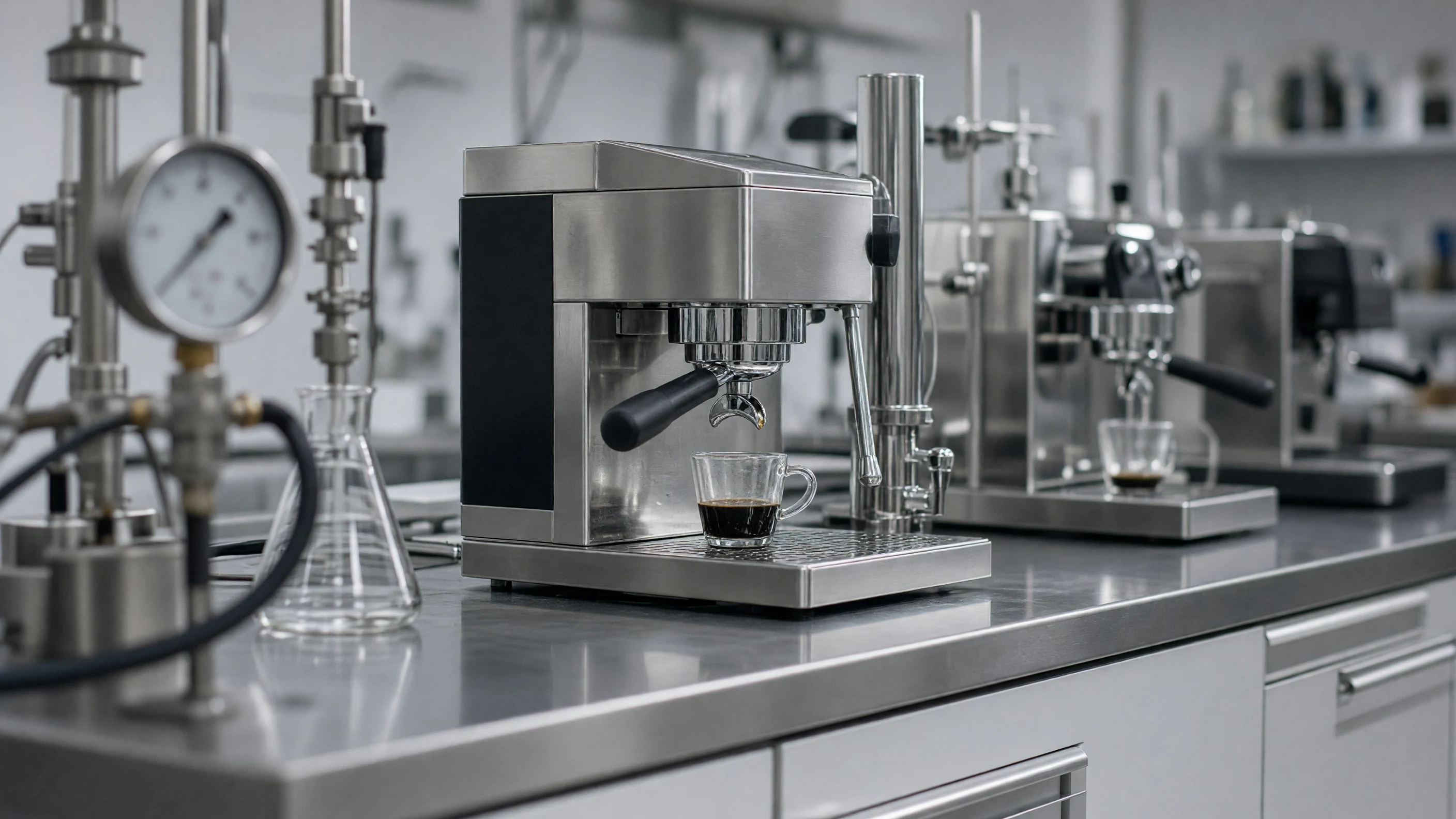
A representative case: when every inspection passes and the valve still fails
The case below is a representative example from our production floor, with example figures. It does not describe a named customer.
On one lot of steam-valve components, incoming inspection was clean, in-line checks were clean, and final QC was clean. Then the short-life test on that order showed a valve that began to weep after a few thousand cycles. Nothing failed on a bench check. It failed under repeated heat and pressure.
The cause was the silicone seal. The supplier had moved to a cheaper compound to hold cost. It passed a hardness check, but it lost elasticity after repeated heat cycles. A weeping valve gives weak steam and unstable milk texture, and the end customer blames the machine, not the seal.
We made three changes. The seal compound became a locked specification with a batch certificate on every delivery. The short-life test moved from sampling to every production order. A valve cycle test was added to incoming inspection, so the seal is checked before it reaches the line. Ask any factory you shortlist for its short-life records from the last three orders.
Step 3: Check Which Changes Need New Tooling
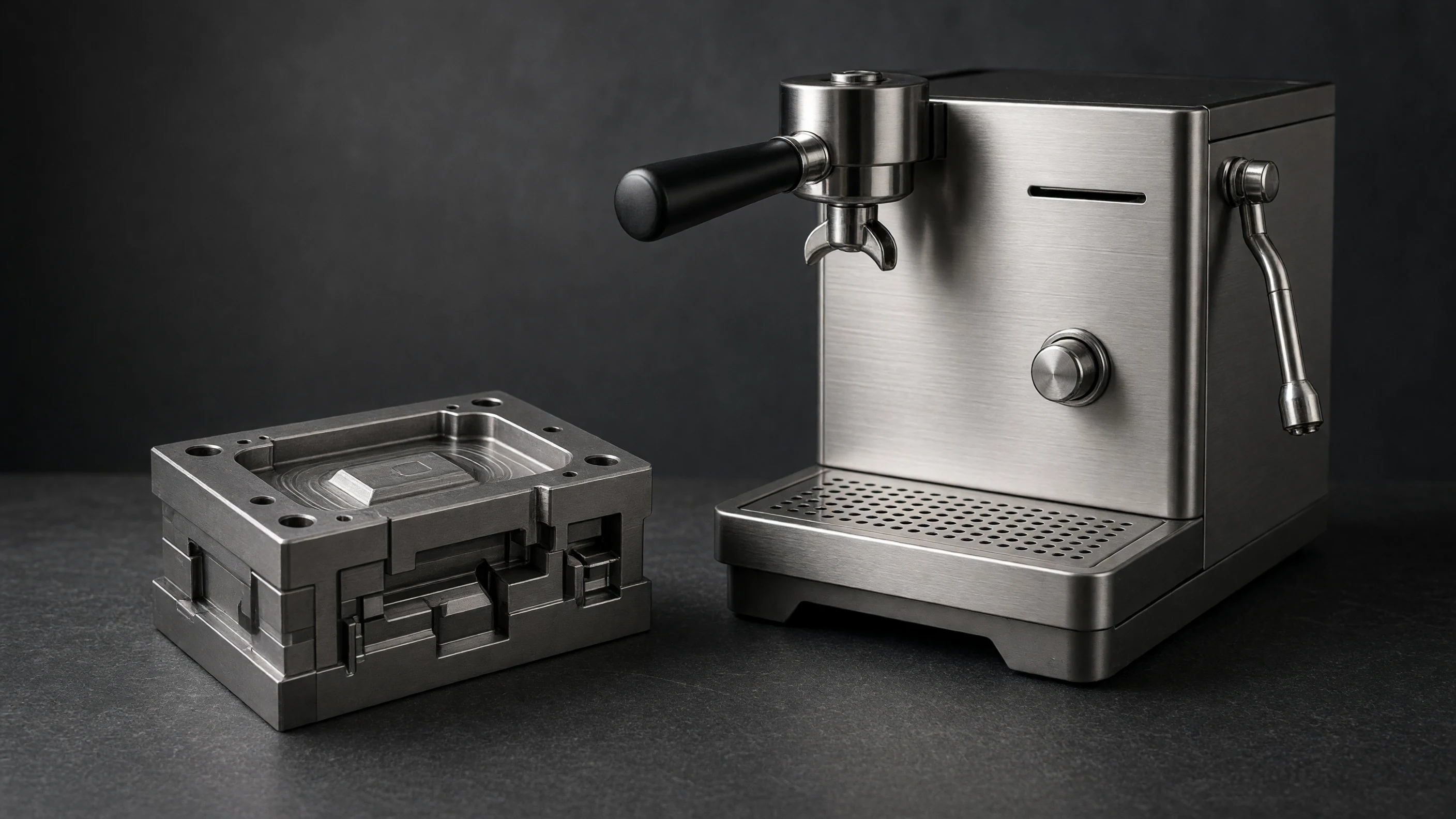
Some changes take a day of firmware work. Others take a new mold and about three months. Classify each request before sampling, because the classification sets the timeline.
| Change | Usual route | Typical cost and time |
|---|---|---|
| Logo and color | Silk-print logo; color change on the existing body | About USD 5 per machine for color, with about two sample rounds |
| Panel label and water timing | Control-program change | Samples in about one month |
| Dual thermoblock or stainless body | Material or component upgrade on the same platform | About USD 6 to 10 more for the dual block; about USD 5 more for stainless |
| New body, portafilter size, or added hardware | New mold | Modification: about 100,000 to 200,000 RMB and about three months; a new set: around 1 million RMB |
A representative case: a program change instead of a new mold
This case is also representative, and the customer is anonymized. A Saudi brand owner already sold a grinder combi of the CM 1629 class, but its buyers kept asking for an Americano button. Their end customers wanted 150 to 350 ml of water over a double shot. Our standard output on that machine was a double shot of roughly 30 to 60 ml, so the first request was for a new machine.
A new body would have meant new tooling. The real question was what could change without touching the mold. We filmed the current shot, the water volume, and the timing, then sent the video with the spec. We proposed a control-program change only. The panel label would read "Americano," the hot-water timing would be extended to deliver 150 to 350 ml, and the grinder dose per shot would be set in the same program.
The sample took about a month, because firmware changes still need proper testing. The buyer stayed on the existing platform. To classify your own request, read how to classify an OEM coffee machine order.
Step 4: Read MOQ, Capacity, and Container Math
MOQ belongs to each model. Our standard MOQ is 500 units per model, and some higher-value machines accept 300. A first order can mix models until it reaches 500 units or one 20-foot container. A mixed order carries a price premium of about 5%, which buyers should weigh against the model mix they need.
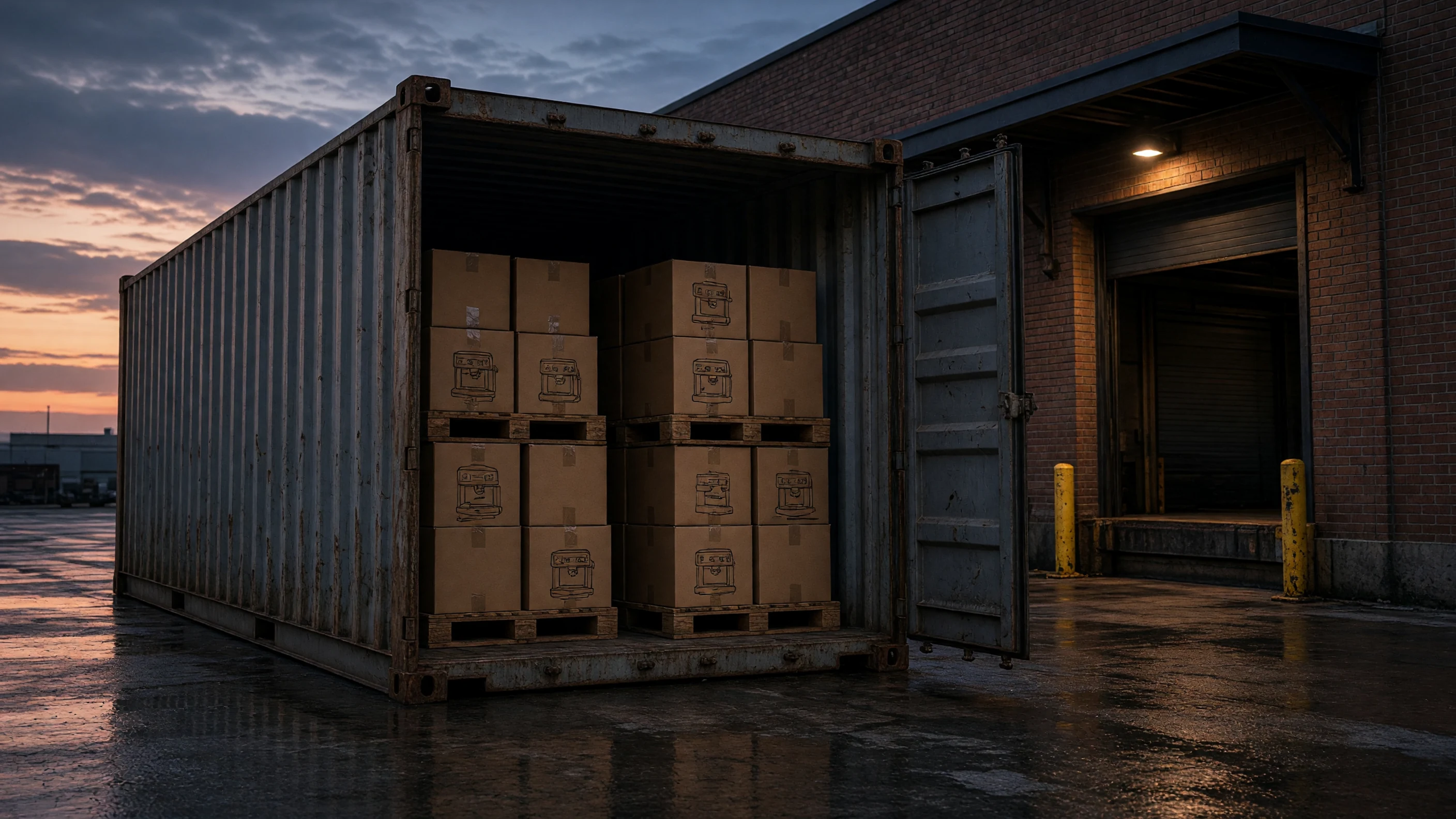
Body size changes the container math. About 320 units of the CM 1610 fit in a 20GP container, and about 780 units of the CM 1833 fit in the same space. We produce about 50,000 units a month on seven lines and run at roughly 90% utilization, which leaves room for peak-season orders. For an order that must land before a selling season, ask for the production schedule in writing. The MOQ and container math guide covers how to split a first order across models.
Step 5: Read Sample, Deposit, and Lead-Time Terms Together
A low FOB with an expensive sample and a 70% balance due before loading is a different deal from a higher FOB with simple terms. Read them as one package.
The first sample costs about 1.5 times the quoted unit price, plus courier. That amount is deducted from the first order balance, for one sample only. Payment is usually a 30% deposit within a week of signing, with the 70% balance paid against the bill of lading when we arrange the forwarder. If the buyer arranges the forwarder, the balance is due before loading.
A standard order takes about 45 days to deliver, and an urgent order can be made in about 30 days. Warranty covers one year on core functions, with free replacement parts for the thermoblock, pump, and boiler, and free express courier for those parts. You can request a sample quote for your model.
Certifications and Market Access: What to Ask For
Our certification list includes ISO, BSCI, CE, CB, ERP, LFGB, RoHS, REACH, ETL, and TÜV. Each answers a different question. ISO and BSCI describe the factory system. CE, ETL, and CB cover model-level safety testing. LFGB, RoHS, and REACH cover materials.
A factory-wide certificate does not certify a single model. Ask for the certificate number and test scope for the exact model you plan to sell. For markets with extra rules, such as EAC in Russia or SABER in Saudi Arabia, ask who prepares the file and who submits it. See our certifications and market-entry support for details by market.
A Buyer's Checklist for the First Call
A good answer gives you a document, a number, or a video. A warning sign is a promise without evidence. Before you compare answers, read case studies from brands that started with a first order.
| Question | Good answer | Warning sign |
|---|---|---|
| Can you show short-life test records for recent orders? | Yes, with dates and lot numbers | "Our engineers test everything" |
| Who owns the mold if I pay for it? | Written terms, exclusive or shared by agreement | A verbal promise only |
| What is the MOQ by model, and how do mixed containers work? | A written MOQ per model and a container plan | One number for all models |
| What is the sample cost, and when is it credited? | A clear amount and a credit rule | "Free" samples with hidden costs |
| What are the deposit and balance terms? | Written percentages and the document that triggers the balance | Full payment before any sample |
| Can I see the line on video or in person? | A live walkthrough scheduled | Renders or stock photos only |
FAQ
How do I confirm an espresso machine manufacturer is a real factory?
Ask for a live walkthrough of the production lines, the incoming inspection area, and the test lab. Check the business registration against the address, and ask for lot traceability on a recent shipment.
What is a typical MOQ for an espresso machine OEM order?
Our standard MOQ is 500 units per model, and some higher-value machines accept 300. A mixed container can meet the MOQ across models at about a 5% price premium. Confirm the number in writing for each model.
Can a factory change the panel or water volume without new tooling?
Often, yes. Panel labels, water timing, and grinder dose usually sit in the control program. A new body, a different portafilter size, or added hardware usually needs a new mold.
Do I need UL or ETL to sell espresso machines in North America?
North American retailers often ask for a recognized safety mark. Our range carries ETL approval, but the mark applies model by model. Confirm the mark and test scope for each model before you place a production order.
Conclusion
Choosing an espresso machine manufacturer is a sequence of checks, not one price comparison. Define the platform, ask for batch evidence, classify every change before sampling, read MOQ as a container plan, and read sample and payment terms together. Next, send your target market, voltage, price band, and quantity to three factories, ask each one the six questions in the checklist, and compare the written replies. If you want answers for your model, talk to our OEM/ODM team.