
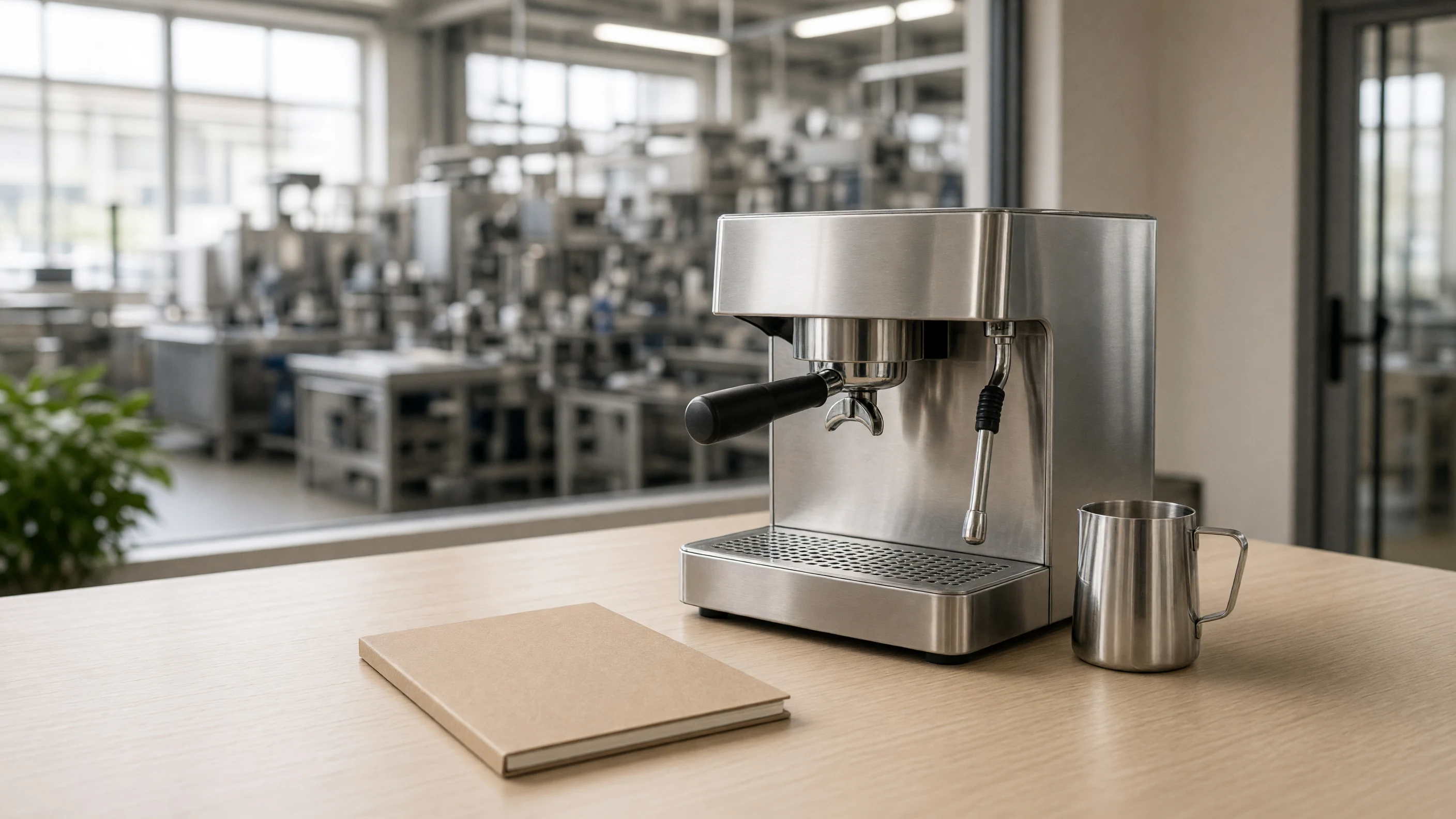
How to tell a second heating circuit from a logo job, before a dual boiler listing is written.
A dual boiler espresso machine OEM order fails when the RFQ says “dual boiler” and the factory builds a different heater. On our line that phrase covers three machines: a Classic aluminum storage boiler, a single instant thermoblock, and a second circuit with one thermoblock for brew and one for steam and milk. Only the third belongs in a dual-boiler listing. Lock that architecture, the platform, and the steam-path QC before anyone cuts a sample.
US shoppers type “dual boiler” because they want café steam at home: a shot and a milk drink in one sequence, steam that holds through a pitcher, and a latte that shows layers. That demand is real. The factory document has to name the paths. This piece is the spec we ask for, the platforms that already have the second circuit, and the checks that keep bulk from drifting off the sample.
I have spent more than 20 years on espresso-machine tooling and production, first inside a large Guangdong ODM group, now at Hardshell Technology in Foshan. The buyers on these projects are Amazon sellers and brand owners who want the machine under their own name.
What “Dual Boiler” Means on the Spec Sheet
“Dual boiler” is a heating architecture. Write which one you mean, or the sample will answer a different question from the listing.
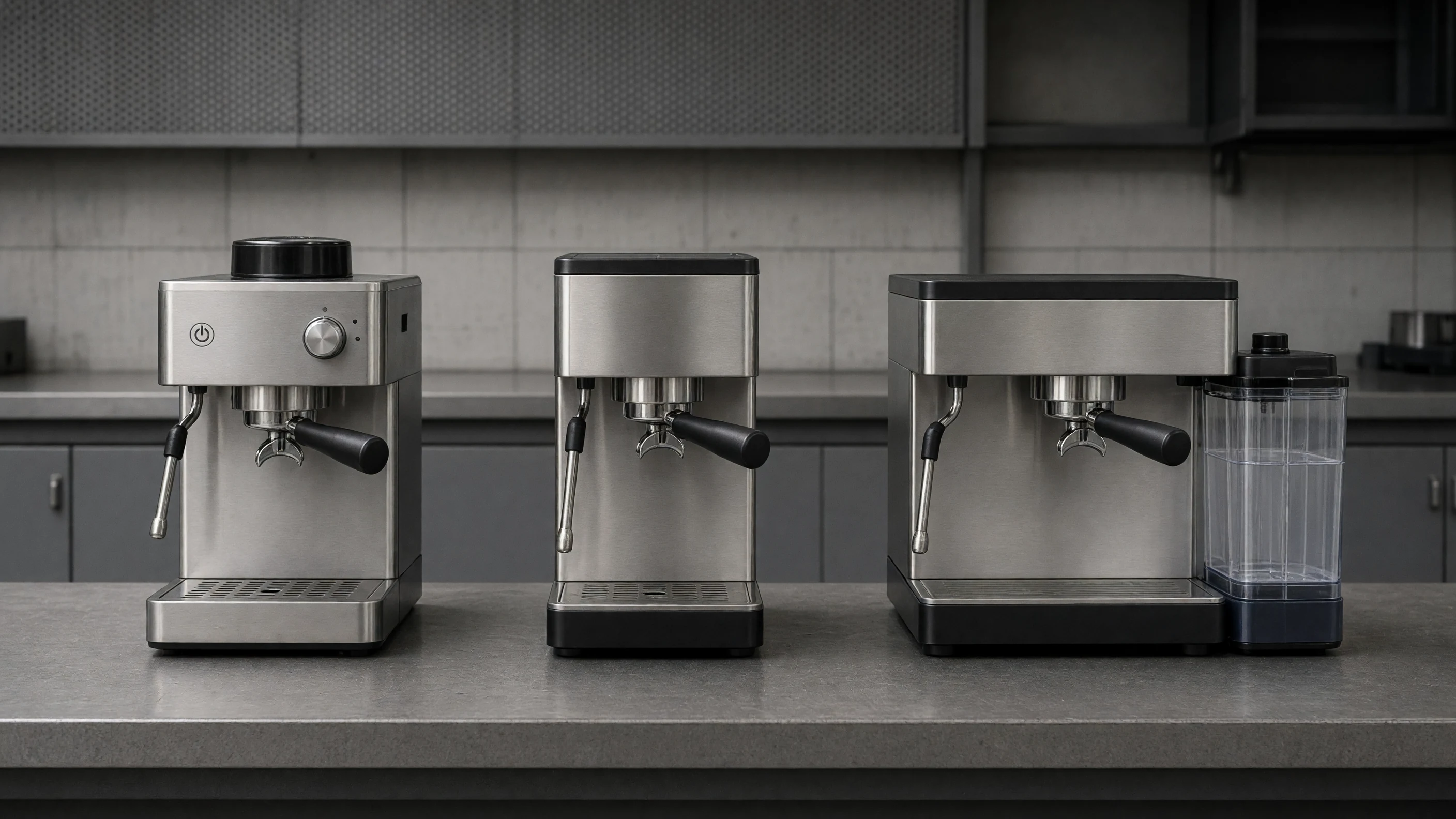
| What the listing says | What we may actually have tooled | What the drink does |
|---|---|---|
| Dual boiler, two tanks | Classic aluminum storage boiler, CM 1650–1699, often about 950 W | Entry price, slower heat, water sits in the boiler |
| Dual boiler, fast heat | Single instant thermoblock, including CM 1663 at 1350 W, about 330 × 165 × 308 mm | One heater changes job between brew and steam |
| Dual boiler, brew and milk in one sequence | Double instant thermoblock: one path for brew, one for steam and milk | Steam does not wait for the brew block to change temperature |
The third row is the dual boiler we OEM for a home listing. Catalogue language is “double instant thermoblock” or “double instant boiler.” Against a single thermoblock, the second block adds about USD 6–10 on the cost sheet. The heating-element system is patented. We use it to put commercial-grade steam in a home machine: short heat-up, a stainless tube, and no pot of water left sitting to scale.
A cappuccino on these machines runs milk first, then espresso, so the cup shows layers. Two circuits let that sequence continue without a heater swap. They do not pour milk and espresso into the cup at the same instant. If the listing must say “brew and steam at the same time,” that sentence goes in the PO, and the platform has to be one that can support it. CM 1678 is the unit whose spec sheet says simultaneous brewing and milk frothing. It is a different machine, covered below.
A stored pair of large café boilers is a different product again. We will not relabel a thermoblock housing as that machine.
Dual Boiler Platforms You Can Brand Without New Steel
Match a platform that already has the second circuit. Adding the words to a single-block tool is a new machine.
CM 1662 and CM 1663 are single instant thermoblocks. CM 1662 is the model behind the CASABREWS Amazon coffee-machine ranking we supply. That rank is a batch-quality story on a single-block slim. It is not a dual-boiler proof point, and we do not clone that tool for a new brand.
The auto-milk slim line already has the second circuit: CM 1630–1639, plus CM 1831 and CM 1831A. CM 1630 is listed at 330 × 215 × 308 mm, 1350 W, 120 V and 220–240 V, with a 1.3 L water tank and a 700 ml milk tank. The extra width versus CM 1663 is the external milk tank. It clips on beside the housing, and the machine can sit as a single unit when the tank is off.
The wide auto-milk line is the same heating idea in a larger body: CM 1820, CM 1821, CM 1823, CM 1832, CM 1833, CM 1835 through CM 1838, CM 1838A, and CM 1838C. Typical power is 1350 W, both voltages. CM 1833, about 281 × 220 × 315 mm, with a 1.8 L water tank and a 430 ml milk tank, is a platform we already ship into the Middle East and Russia. Those markets read a larger body as a more expensive machine.
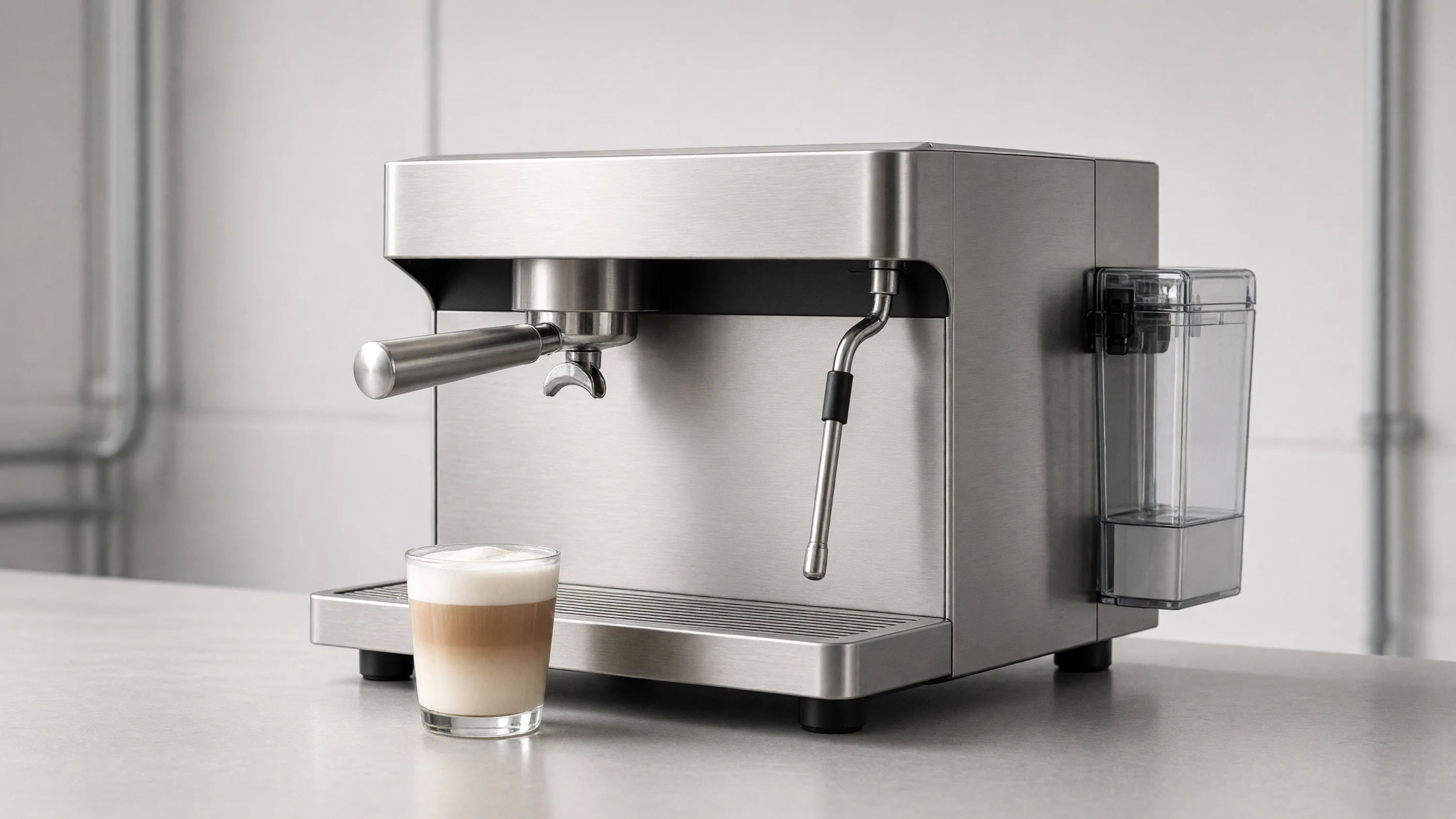
Inside the Professional series without a grinder, only CM 1672 is the double instant boiler: 1900 W, both voltages, 58 mm group, 10 mm steam wand, external OPV, flow meter, about 370 × 224 × 340 mm. CM 1670 and CM 1671, and their B and C variants, are single instant boilers at 1350 W.
CM 1610 is the dual thermal block with a grinder: Italian ULKA pump, 120 V at 1700 W and 220–240 V at 2800 W, 58 mm single-wall basket, flow meter, 10 mm steam wand. CM 1612 is three thermal blocks, listed at 220–240 V and 3100 W. Do not assume a 120 V book spec for CM 1612.
CM 1678 is two pumps and three boilers, 220–240 V, about 2950 W, 58 mm, ULKA large-coil main pump, external OPV. We sell it to offices and serious home users. It is the wrong first SKU when the complaint is weak milk steam on a 1350 W home machine. It also does not become a US 120 V model by changing the plug.
A 58 mm group is a wider, shallower basket. In the cup, pressure is held by the coffee bed, roughly in the 9–18 bar range, usually with a single-wall basket. It needs a tighter grind and tamp. Moving a 51 mm group to 58 mm is new steel. So is burying a milk tank in a housing that does not have one.
The current map of series and models is on our espresso machine platforms.
A Dual Boiler Espresso Machine OEM Lot on an Existing Tool
A brand buyer came in the way many of these jobs do. They already sold a single-thermoblock machine. Espresso reviews were acceptable. Milk reviews were not. People waited between the shot and the steam, or they opened the wand before the ready light and called the steam broken. They wanted the next model to say dual boiler, in stainless, with their logo, a specified side color, one-touch cappuccino and latte, and a first lot around 500 pieces. Their shoppers were in the Middle East and Russia. Voltage was 220–240 V.
Their reference photo was a single-block slim. The drink they needed was already on the wide auto-milk line, so the job stayed on CM 1833. I did not cut a pair of storage boilers to match a café photo, and I did not quote CM 1678.
Logo went through silk print. Color was sampled twice against their chip. Color on our quote is about USD 5 per machine, and a small delta after the first chip is normal. The standard pump is Jiayin. In home use, a 15 bar pump and a 20 bar pump are not a different cup. Middle East and Russia shelves still want the 20 bar mark printed, so that is what the badge carried. An Italian ULKA pump is about USD 2.5 more per unit, with a supply lead time around 30 days, or the buyer moves to a platform that already uses ULKA, such as CM 1610. If ULKA is short, there is a domestic fallback. I do not tell buyers the fallback is identical to ULKA.
The milk system on that lot was the third-generation tank. We have run it for a month of continuous use without cleaning and did not see the clog older tanks pick up, and we have not had a clog complaint on this generation. I still tell the buyer to clean it. A test is not a lifetime promise. Auto-milk foam on this system is specified as a fine texture with milk temperature above 60°C. The auto-cappuccino patent is a separate spec from the dual heating circuit. A dual-boiler machine does not automatically include that tank.
They paid one sample up front at about 1.5 times the quoted unit price. That one unit’s machine cost comes off the first order balance. Courier stays on the buyer. Confirmation took two rounds: color, then the panel words. Production after the 30% deposit was the standard window, about 45 days, then final QC. If sell-through is healthy, a second project often shows up about six months later. That is a pattern. It is not a promise, and it only happens when the first machine was the right platform.
The same buyer asking for North America later can use the 120 V, 60 Hz, 1350 W spec already on CM 1833. A 220–240 V-only model, CM 1678 included, needs a new PCB and a new component spec, then ETL. ETL is often two to four weeks once the certificate fee is agreed, and it can run beside the pilot. CE on a mature platform is the path we already run. Marks by market are on our certifications page.
QC That Keeps the Steam Path Honest After the Sample
The sample can be right and the container can still be wrong. The failures we see are specific.
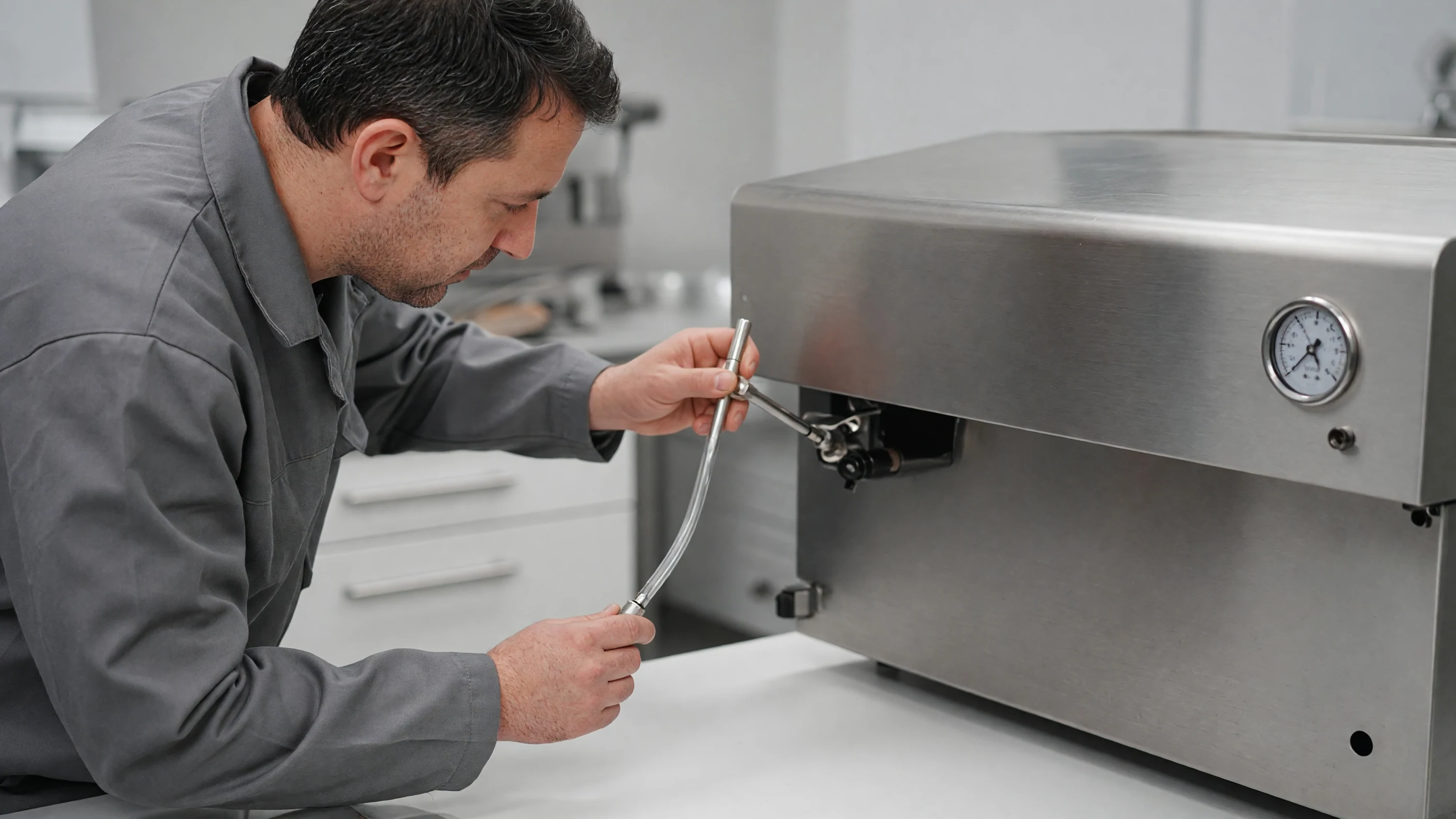
Someone cheapens the steam path. The sample used two heating circuits. Bulk quietly shares one heater. The listing still says dual boiler. Reviews do not.
A valve cavity or an O-ring drifts at the supplier. Incoming dimension changes like that will not always show on a finished-machine function test. They show after tens or hundreds of uses in homes. We try to catch supply issues at SQE and IQC, before the line is full of them. Core parts — pump, boiler or heater, valve, control board — are the ones we inspect hardest. Pump, boiler, and board are also the three largest core-part costs, in that order.
A steam valve passes on day one and tires later because the seal material was wrong. Incoming, line, and final checks can all pass. A short life run on the order is what catches it. Our machine life test is 6,000 cups. The pump test is 15,000 cups and above. The leak check is a closed hold at about twice working pressure — a 20 bar machine toward 30–40 bar — for about 30 seconds. The rule is zero leak. A pressure drop means the seal failed.
Food-contact parts are the other silent swap. Water tank, tubes, filter screen, and the boiler path are food-grade. High-heat parts are not plastic. Hot plastic smells, and people who drink every day notice. Seals on these machines use a commercial-style fluoroelastomer, and the tubing is a thicker PTFE of the kind used on commercial machines. Instant boilers use a stainless tube, so water is not stored in a pot between shots. Device reports we cite to buyers are CE, CB, ERP, LFGB, RoHS, and REACH. Food-contact parts are specified so they can pass LFGB. FDA-type checks are something those materials can be put through. FDA is not a mark we print as already held on every model.
Five gates sit on every order: SQE, IQC, PQC, QA, and FQC. We publish a 99% shipment pass rate. An internal estimate puts a typical industry band around 85–90%. Treat that industry figure as our estimate, not as an audited survey. Warranty is one year on manufacturing defects. Thermoblock, pump, and boiler-type assemblies are covered: replacement parts and courier when the fault is ours. We hold a defect band around 2–3%.
Weak steam is often use, not a missing boiler. The ready light was still off. Milk sat in the steam path. Coffee grounds on the brew-head seal caused a leak. The second circuit removes the wait while one heater changes job. It does not remove a dirty milk tube.
How a confirmed sample moves through those gates is covered in how a custom espresso machine moves from sample to shipment.
MOQ, Lead Time, and Jobs We Will Not Open a Tool For
On current buyer-facing terms, MOQ is normally 500 pieces per model. Some higher-value machines start around 300. If the first order cannot hit 500 on one model, two models can be combined, or the order can fill a 20-foot container, at roughly a 5% premium.
A mature design with no tooling change samples in about a week. A customized sample is about a month. After the 30% deposit, production is about 45 days, about 30 days if the slot is urgent. A real reshape — spec, design, mould, PCB, tool trial, pilot, mass production — is 3–6 months. A mould modification we have quoted sits around RMB 100,000–200,000 and about three months. A new tool set is on the order of RMB 1 million. If you pay the mould fee, that tool stays exclusive. A split tool cost can be shared, and that has to be agreed before anyone cuts steel. We already hold several hundred tool sets, which is why the first move is to match one.
Custom cartons generally start at 1,000 cartons per design. Below that, the carton start-up is about RMB 1,000. Payment is 30% by T/T within a week of signing, and 70% against the bill-of-lading draft if we book the forwarder, or before loading if you book it.
Before the sample we lock five items in one pass: target market, brand position, target buy price, the machine the listing should sit beside, and a performance list that names the heating architecture. Two or three small revisions after that are normal. At sample, buyers change color, panel, and function. Size almost never should change.
A concept photo with no brand or channel scale, no annual volume, no target price, and no drawing is a conversation. We also refuse a copy of a machine we already build for another brand. When a new buyer asks for the same machine as CASABREWS, the working answer is a different price band on a different platform, around USD 99–129 or around USD 139–159.
App or Bluetooth remote control on a semi-automatic is a request this industry has already tested, including at the ODM group I worked in before Hardshell. Consumers did not adopt it. We do not list it as a dual-boiler feature.
PID versus an ordinary thermostat is a spec line you should ask us to answer, including the brew-temperature band a 10-cup test holds. We look at that choice when we define a machine. We do not publish a ±0.5°C hold on CM 1672 or CM 1833.
FAQ
What does dual boiler mean on a Hardshell OEM spec?
A second instant heating circuit: one thermoblock for brew, one for steam and milk. It is not the Classic aluminum storage boiler, and it is not the single thermoblock used on CM 1663. The cost adder versus a single thermoblock is about USD 6–10.
Which models already have that second circuit?
Auto-milk slim: CM 1630–1639, CM 1831, CM 1831A, at 1350 W. Auto-milk wide: CM 1820 through the CM 1838 family, including CM 1833, also typically 1350 W. Professional double instant boiler: CM 1672 at 1900 W. Dual thermal block with grinder: CM 1610. Three blocks: CM 1612. Two pumps and three boilers: CM 1678, 220–240 V, about 2950 W.
Can you add dual boiler to CM 1663?
Not as a program change. CM 1663 is a single thermoblock in a housing about 330 × 165 × 308 mm. The auto-milk dual-circuit slim, CM 1630, is about 330 × 215 × 308 mm because the milk tank is external. That is a different platform. A new mould for a real housing change is on the order of RMB 1 million, and a modification we have quoted is about RMB 100,000–200,000 and three months.
Does a dual boiler machine brew and steam at the same time?
On the home dual-circuit machines, milk runs first and espresso follows, so the drink can show layers, without waiting for one heater to change job. CM 1678 is the model specified for simultaneous brewing and milk frothing. Put the exact listing sentence in the PO.
What MOQ and lead time should I plan?
Normally 500 pieces per model, about 300 on some higher-value machines. Sample about one week if the tool does not change, about a month if it does. Production about 45 days after the 30% deposit, about 30 days if the slot is urgent. One sample is charged at about 1.5 times the quoted unit price, and that one unit’s machine cost is deductible from the first order balance.
What QC numbers apply to the steam path?
Leak test at about twice working pressure for about 30 seconds, zero leak. Machine life test 6,000 cups. Pump life test 15,000 cups and above. Five gates from incoming parts to final QC. Shipment pass rate we publish: 99%. Warranty: one year on manufacturing defects, including thermoblock, pump, and boiler-type assemblies, with a defect band we hold around 2–3%.
Conclusion
A dual boiler espresso machine OEM project holds its listing when the heating path is named before the sample: Classic storage boiler, single thermoblock, or a second circuit for brew and steam. Match a platform that already has that circuit, write the milk sequence the listing is allowed to claim, and keep the steam-path tests on the purchase order.
If you have a target market, a buy price, and whether the SKU must run brew and steam in one sequence, start a dual boiler OEM brief or send those three items to the factory. WhatsApp: +86 15914570351.