
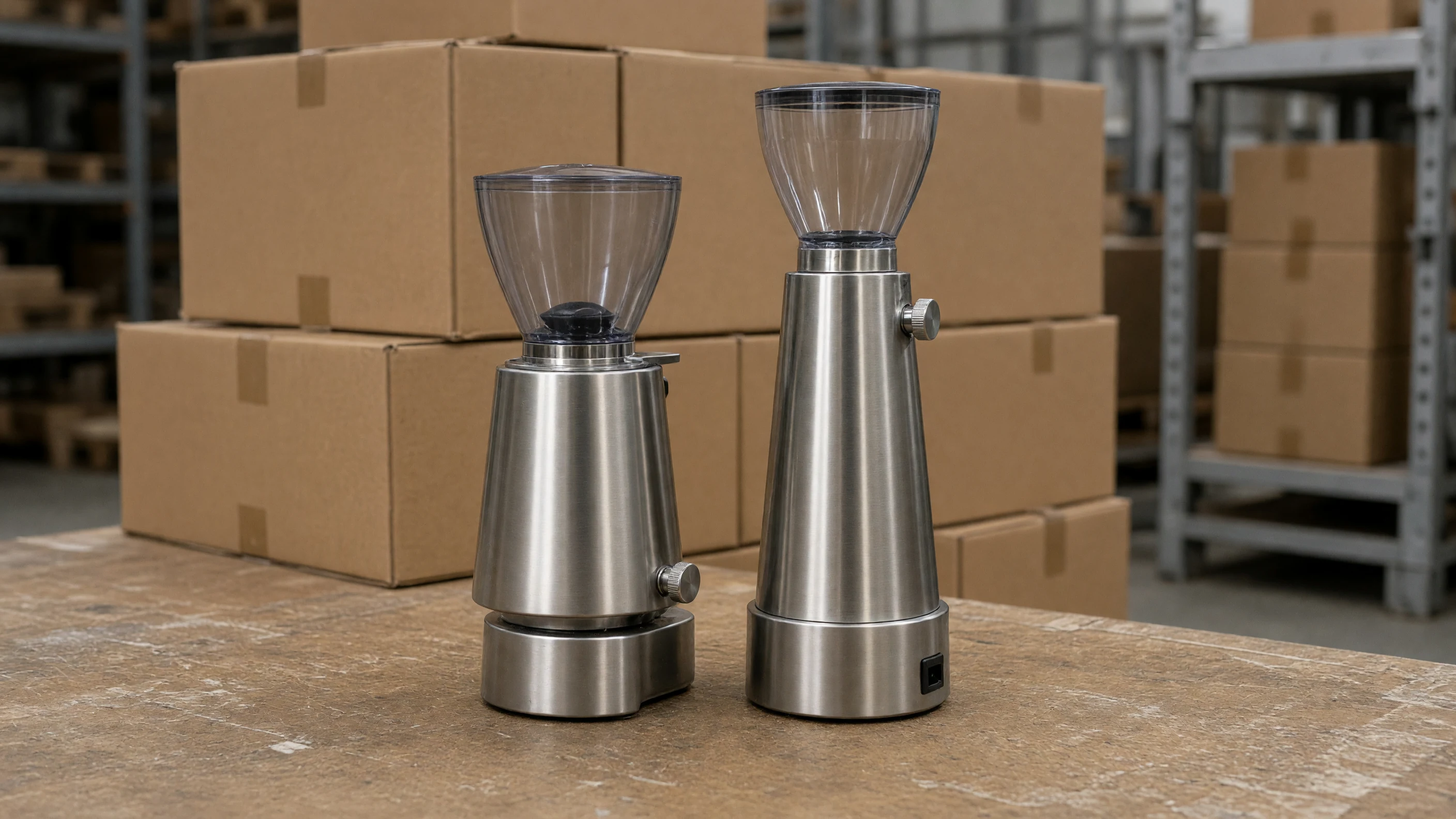
An OEM grinder wholesale order is only as useful as the match between the burr and the door. A home-espresso listing, a 58 mm group, and a camping counter are three different grinders. One SKU across the first two is how the second container comes back with powder on the counter or a sour shot, even when every unit passed the bench. Name the door first. Then decide whether the job is a mark on a tool we already cut, or a new housing.
I have spent more than 20 years on espresso machines and grinders, first inside a large Guangdong ODM group, now at Hardshell Technology in Foshan. We build the grinders. We do not appoint dealers. If you are placing an OEM grinder wholesale order, or you run a kitchen-equipment house adding a grinder line next to machines you already sell, the checks below are the ones that keep the second container from turning into returns.
Why One Wholesale Grinder Comes Back
The call I still get is not “it will not start.” It is powder across the counter, or a shot that goes sour after a season and the brand on the box takes the blame. Both have landed on the same conical platform after the lot had cleared our bench.
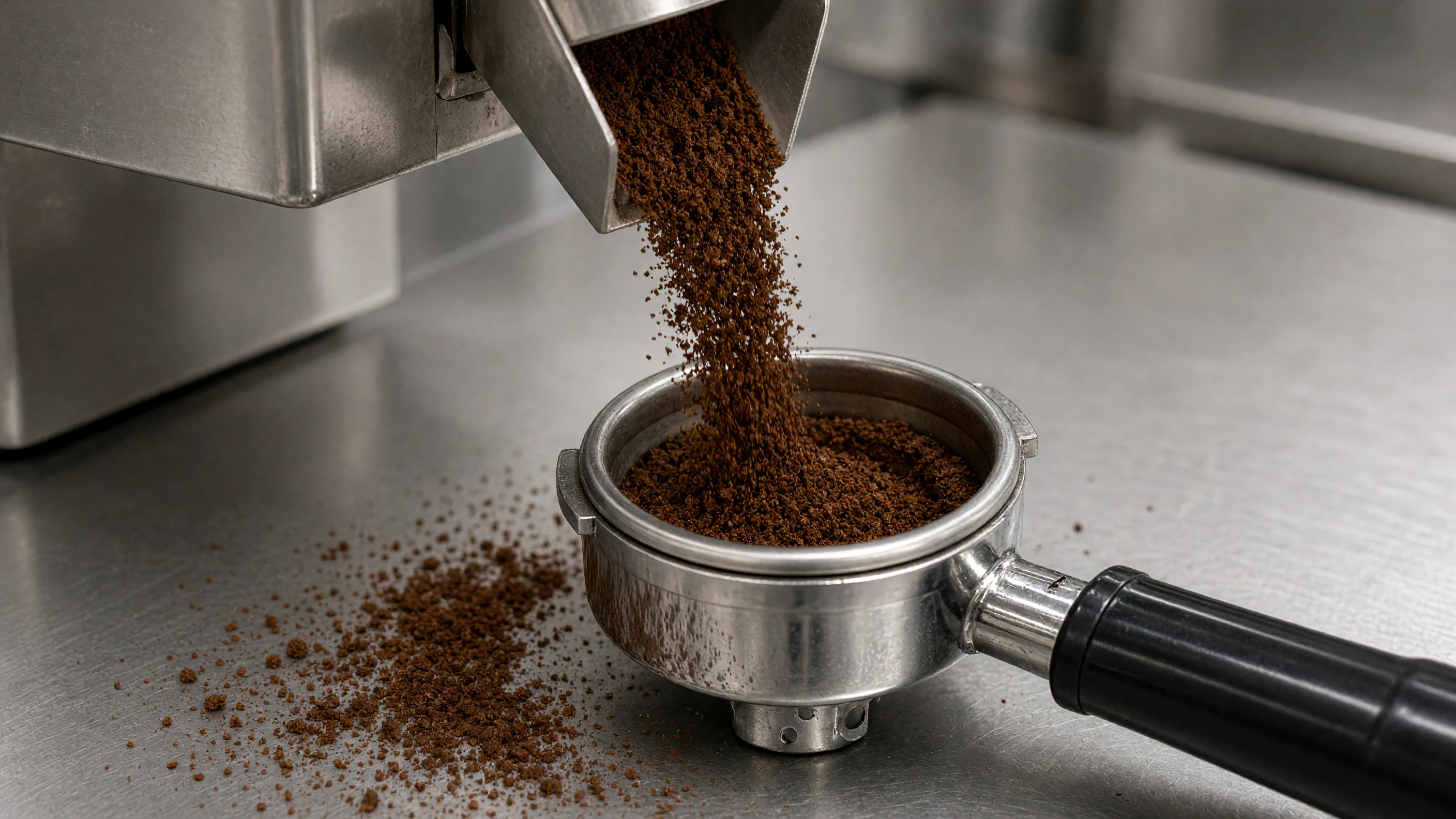
Fine espresso grounds leave the burr with a charge. They cling to the fork, the cup rim, and the photo on the listing. That is static. On the conical line, CG 2101 through CG 2109, we fit a dual negative-ion module so the charge is cancelled before the grounds drop. On the 64 mm flat burr, CG 2107, the same job is a plasma unit. The dose should land in the basket or the cup.
The second complaint is the gap we shipped. A US counter often wants the espresso band a step coarser. A domestic China counter wants it finer. One setting on two purchase orders makes one market call the grinder inconsistent. We set the gap to the market named on the order, and we watch whether that gap is still in the same band a year later. A cheap burr set drifts coarser inside about six months. On our line that drift stays small past a year. That is what we see in use. It is not a promise that a burr never wears.
Humidity is the third. Oily or damp beans cake in the chute in a wet spring. Those complaints are why the powder path was changed, and why a lot is not released until it has been through a clog trial. A grinder that looks clean on a dry demo and blocks in April is a returns problem.
Wholesale buyers then ask for one model to cover home espresso and a 58 mm light-commercial door. A conical burr is the home match. The 64 mm flat burr is what we put with a 58 mm group, because that basket is wider and shallower and the grind has to be even. We say so before the deposit.
A single photo and the line “build this under our brand” is the other delay. Often that photo is a logo on a platform we already tool. If it copies a face we already ship to another account, we refuse it. Your mark can go on a current platform. A picture with no market, no target price, and no door is not an order.
Choosing the factory is a different job: how to evaluate a coffee grinder supplier.
Match the OEM Grinder to the Door You Actually Sell
Name the door, then open the coffee grinder range. The table is a fit guide, not a ranking.
| Door | What belongs there | Leave off this door |
|---|---|---|
| Home espresso, own-brand listing | Conical, CG 2101 class. 150 W DC, about 450 rpm, 250 g hopper, 75 g grounds box, stainless, 120 V and 220–240 V. Color touch (CG 2102 or CG 2103) next to an IMD machine. Push-button with a screen (CG 2101 or CG 2101A) for a simpler face. | A 64 mm flat burr as the only home SKU. The portable. |
| 58 mm group, light-commercial or a serious pro-home user | CG 2107. 64 mm stainless flat burr, 100 steps from Turkish to French press, grind time in 0.5 second steps, plasma anti-static, IMD panel, 250 g hopper, a holder for 51 mm and 58 mm. | A conical asked to be professional enough for a shallow 58 mm basket. |
| Outdoor, travel, RV, patio | CG 2100. Aluminum body, 30 g hopper, 16 steps, Type-C, 800 mAh. A different buyer from the countertop account. | Folding it into the first container unless that channel exists. |
| Grinder inside the espresso machine | Not this order. A built-in conical sits on the CM 1600–1629 and 3-in-1 lines. | A CG model quoted as if it were the module inside the machine. |
The portafilter fork on the conical line is an option. I do not assume it is in every carton. CG 2107’s holder for 51 mm and 58 mm is on that model’s sheet.
CG 2101, CG 2101A, CG 2102, and CG 2103 load about 1,128 pieces in a 20-foot container, about 2,004 in a 40-foot, and about 3,060 in a 40-foot high cube. CG 2107, CG 2108, and CG 2109 have no published container count. I will not invent one.
The standalone line is eight models. Match the face to the machine: an IMD color screen with a color-screen grinder. Color, panel, and function are what change at sample. A new outer size is a new product.
How a burr behaves in the cup is covered in how to choose a burr grinder for espresso. A grinder that is already inside the machine is a different product: espresso machines with a built-in grinder.
What an OEM Grinder Wholesale Job Actually Includes
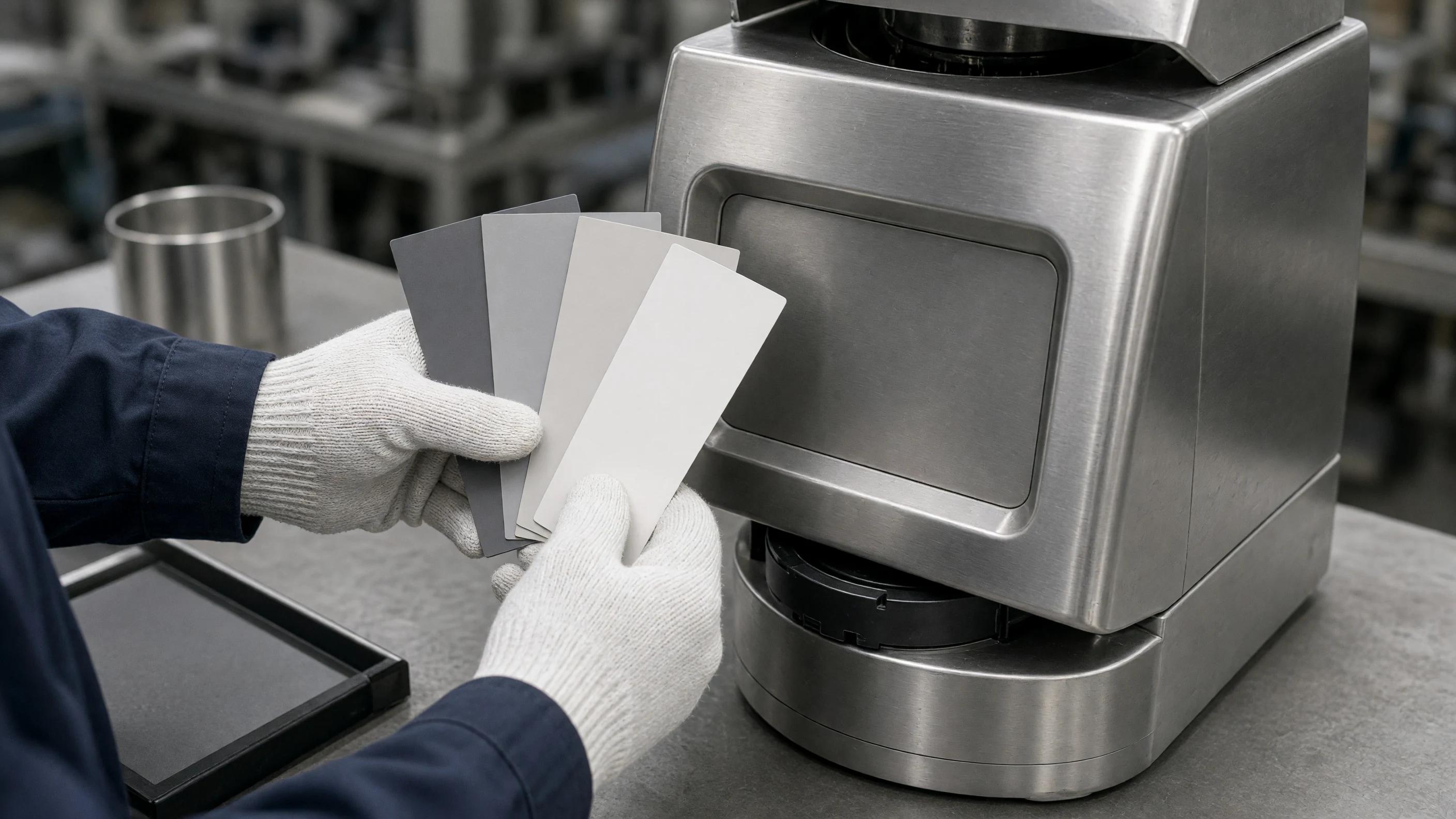
Wholesale buyers often price two different jobs as one. A mark, a color, and a carton sit on a tool we already have. A new housing is steel, and a different calendar. I separate them in the first reply.
Run these five checks before anyone pays a deposit.
1. Door and voltage before the model number. Write 120 V / 60 Hz or 220–240 V on the brief. Europe is CE, low voltage and EMC, plus the reports we already cite to buyers: CB, ERP, LFGB, RoHS, and REACH, under ISO and BSCI. North America is ETL or UL, booked in parallel once we agree who pays the certificate. CE does not open the United States. A stainless shell sees a higher hipot test, because the shell conducts. The marks we walk through are on the certifications page.
2. Split the logo from new steel. On a tool we already have, the mark is silk print, laser, a nameplate, or IMD. Color is about USD 5 a unit, and it takes about two rounds against a chip, because the first chip is off. Carton print starts at about 1,000 cartons. Under that, the printer’s start-up is about RMB 1,000. A new housing is a new mould, about RMB 100,000 to 200,000 and about three months. If you pay for the tool, it stays yours. If we split the cost, the tool can be shared, and we say that before cutting steel. A sample with no tooling change is about a week. A customized sample is about a month. A full new product is about three to six months, not the 45-day path.
3. Quantity is 500 per model. Some high-value units are 300. A first order that cannot hit 500 of one model can mix two models until it reaches 500, or fill one 20-foot container, at about 5% more. The worked example we give buyers is two espresso machines. The same rule is what I apply to two CG models. There is no softer minimum that exists only for grinders.
4. Sample, deposit, calendar. One sample is about 1.5 times the quoted unit price, paid up front. That one unit comes off the first-order balance. The courier stays with you. Extra sample units are not all credited. After the 30% deposit, a catalogue-platform order is about 45 days, about 30 if the slot is clear. The remaining 70% is against the bill-of-lading draft if we book the forwarder, or before loading if you book it.
5. Say the warranty in the words the policy actually uses. One year from purchase or delivery, on manufacturing defects. The written examples are the thermoblock, the pump, the boiler, and other critical assemblies, part and courier included. A grinder has no boiler. A defect in the motor or the grinding assembly can sit under “other critical assemblies.” Normal burr wear is not that claim. The defect band we hold is about 2–3%. A grinder lot still gets hipot, earth continuity, a grind check, a drop test, and a short life run, through the five gates on the quality page. Do not copy an espresso machine’s 6,000-cup life test onto a CG sheet.
A Representative First Order
A brand that already sold our espresso machines asked for a grinder under the same mark, both voltages, and a first quantity under 500. They also wanted the grinder to sit next to the machine in the listing photo. What follows is a representative pattern from that kind of brief, not a named account.
The photo decided the conical. An IMD color machine went to CG 2102 or CG 2103, not a plain push-button. The 58 mm door moved to CG 2107. CG 2100 stayed off. They had no outdoor channel.
The logo stayed on the silk-print line. No new housing tool, so the clock stayed on the catalogue path in the checks above. They got a conical for the home listing and a flat burr for the 58 mm listing, in one mixed first shipment. When a machine account adds a grinder line, the limit we actually see is the money to open the second line.
Conclusion
Place an OEM grinder wholesale order by naming the door, then the burr, then whether the job is a mark or a mould, then the container. A home listing and a 58 mm group will not live on one FOB number. A buyer who wants the cheapest single SKU for every door is a poor fit. So is a hotel-room project that never needed a burr grinder.
When the doors are clear, talk to our OEM/ODM team or book a live factory walk-through.
FAQ
What is the difference between OEM grinder wholesale and buying a stock grinder?
A stock unit is the catalogue grinder. OEM on that same unit is the mark, the color, and the carton. A new housing is a different job, with a mould and a longer calendar.
Should a wholesale line be conical or 64 mm flat?
Home espresso takes the conical. A 58 mm light-commercial door, or a serious pro-home user on a shallow basket, takes CG 2107. The first container often holds both. It is not a contest with one winner.
What is the MOQ for an OEM grinder?
500 pieces per model. Some high-value units are 300. Two models can be combined to 500 pieces, or to one 20-foot container, at about 5% more on the quote we give new buyers.
Does a CE grinder ship to the United States?
No. North America needs ETL or UL on the specification you are actually building. CE covers the European safety and EMC path.